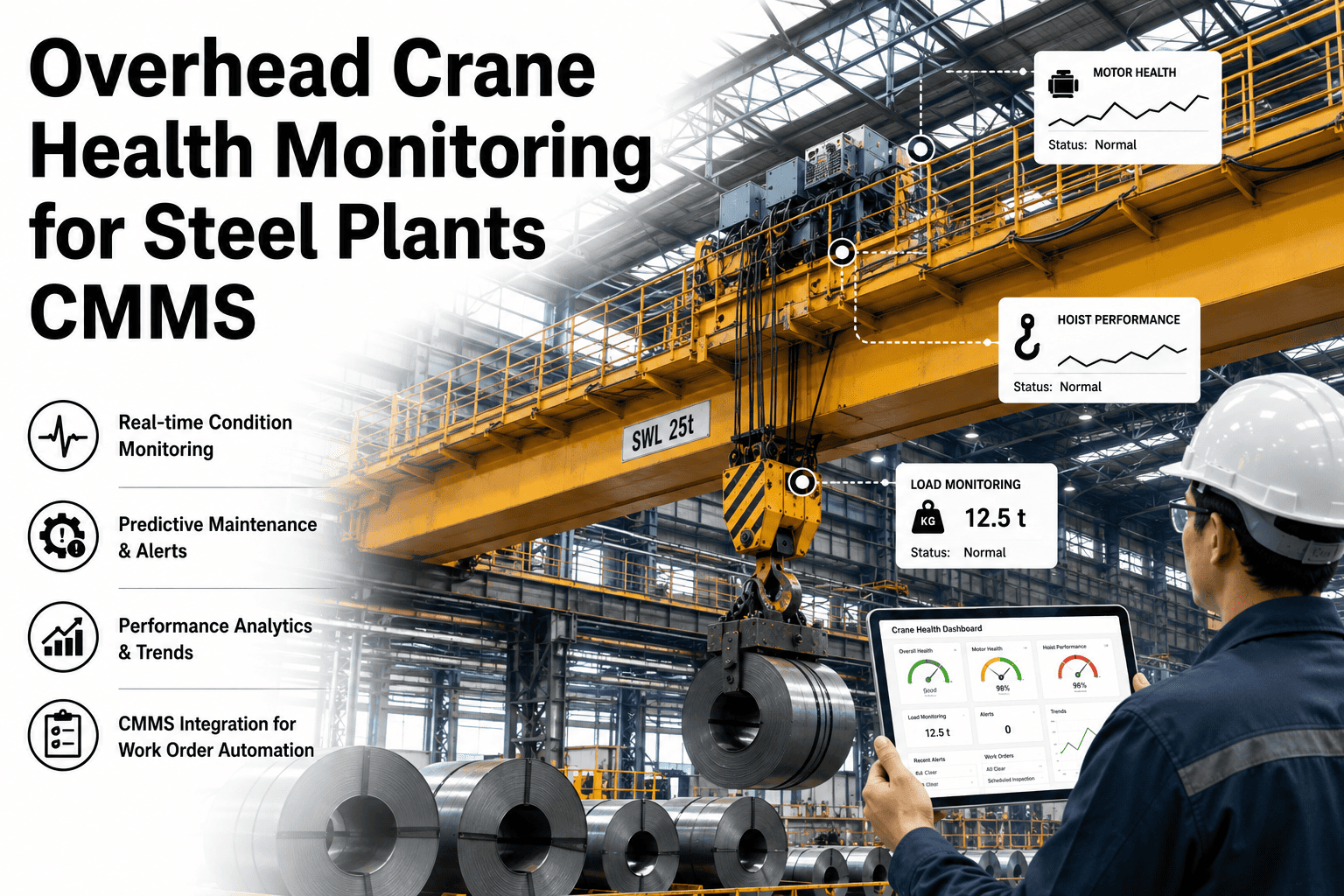
Overhead crane predictive maintenance in steel plants uses vibration analysis, wire rope condition monitoring, brake performance trending, and gearbox oil analysis to detect failures before they cause unplanned downtime or catastrophic safety events. Ladle cranes carrying molten metal operate under extreme thermal and mechanical stress, making a reactive maintenance strategy a serious risk to production continuity and worker safety. An AI-powered CMMS like OxMaint ingests sensor data and inspection history to forecast component degradation, automatically triggering work orders before a failure can escalate. Steel plants that shift from time-based PMs to condition-based crane predictive maintenance typically cut unplanned crane downtime by 30–50%. See how OxMaint automates condition monitoring and work order generation when you Start Free Trial today.
Steel Plant Crane Reliability
One ladle crane failure can halt an entire melt shop for 14 hours. Are you predicting it — or waiting for it?
Overhead crane predictive maintenance powered by OxMaint turns hoist motor vibration, rope wear, and gearbox oil data into automatic work orders — preventing safety incidents before they happen.
Critical Failure Modes
Why steel plant crane maintenance demands condition-based monitoring
Overhead cranes in steel mills carry molten metal, heavy slabs, and coiled steel across critical production areas. A single hoist motor seizure or wire rope failure doesn’t just stop the crane — it halts the caster, the rolling mill, and the entire production chain. These are the four failure modes that overhead crane predictive maintenance targets first.
Hoist Motor Vibration Analysis
FFT vibration spectra on hoist drive motors detect bearing defect frequencies (BPFO, BPFI) up to 8 weeks before seizure. ISO 10816 velocity thresholds trigger automatic CMMS work orders at 4.5 mm/s RMS.
Wire Rope Condition Monitoring
Electromagnetic rope testing (EMRT) identifies broken wires, cross-sectional loss, and corrosion. Trending rope diameter loss against ISO 4309 discard criteria prevents catastrophic drop events on ladle cranes.
Brake Performance Trending
Monitoring brake torque decay, lining wear rates, and engagement times catches dangerous drift before stopping distance exceeds safe limits on fully loaded ladle transfers.
Gearbox Oil & Wear Debris Analysis
Elemental spectroscopy and ferrography on crane gearbox oil reveal gear-tooth pitting and bearing spall progression. A 3x rise in iron particles over baseline means a gearbox inspection is overdue.
Implementation Framework
How to build a crane predictive maintenance program with a CMMS
Moving from reactive or calendar-based crane maintenance to predictive condition monitoring requires structured phases. Here is the 4-month implementation roadmap steel plants use to deploy overhead crane CMMS workflows with OxMaint.
Asset & Sensor Baseline
Register all overhead and ladle cranes in OxMaint. Map criticality tiers (A/B/C), attach OEM manuals, and install vibration sensors plus rope EMRT sensors on Tier-A cranes carrying molten metal.
Condition Thresholds & Routes
Define ISO 10816 vibration alarms, brake torque decay limits, and oil particle count thresholds inside OxMaint. Build automated inspection routes for operators using the mobile CMMS app.
Predictive Work Order Automation
Connect sensor breach events directly to OxMaint work order generation. A vibration alert at 7.1 mm/s RMS automatically creates a corrective WO, assigns a technician, and reserves spare bearings in inventory.
Reliability Analytics & Tuning
Review Mean Time Between Failures (MTBF) and crane availability dashboards. OxMaint AI refines alarm thresholds to reduce false positives and predicts remaining useful life (RUL) for ropes and motor bearings.
ROI & Cost Impact
Crane predictive maintenance ROI: downtime cost vs. program cost
A single hour of ladle crane downtime in a steel plant can cost $12,000–$25,000 in lost production. The financial case for overhead crane CMMS is built on avoided catastrophic failures and reduced unnecessary preventive maintenance.
Annual ROI Formula
ROI (%) = [(Avoided Downtime Cost + Reduced PM Labor + Saved Spare Parts) − Annual Program Cost] / Annual Program Cost × 100
| Metric | Reactive Maintenance | Time-Based PM | Predictive (OxMaint) |
|---|---|---|---|
| Unplanned crane downtime / yr | 140 hours | 85 hours | 35 hours |
| Molten metal safety incidents | High risk | Moderate risk | Low risk |
| Spare parts inventory holding | High (hoarding) | Moderate | Optimized by RUL forecasting |
| OEM manual lookup time | 45+ min/shift | 20 min/shift | 0 min (instant in OxMaint) |
| MTBF on hoist motors | 11 months | 18 months | 32 months |
| Annual maintenance cost / crane | $94,000 | $71,000 | $46,000 |
How OxMaint Helps
How OxMaint’s CMMS powers crane condition monitoring for steel plants
OxMaint is an AI-powered CMMS and EAM platform built to transform sensor data and inspection history into automatic, prioritized work orders. Here is how steel reliability teams use OxMaint to eliminate reactive crane maintenance.
AI-Driven Failure Prediction
OxMaint AI ingests vibration, oil analysis, and brake performance data to forecast component failure dates. Outcome: Cut unplanned overhead crane downtime by 30–50% by catching bearing and rope degradation weeks before failure.
Automated Predictive Work Orders
When a condition threshold is breached, OxMaint auto-generates a work order, assigns the technician, and links the required spare parts. Outcome: Eliminate 15+ hours of manual scheduling and dispatch per week.
Asset & Inspection History
Every crane’s OEM specs, inspection photos, torque readings, and past repairs live in one digital record. Outcome: Achieve 100% audit-readiness for ISO 55000 and OSHA compliance with zero paper binders.
Spare Parts RUL Forecasting
OxMaint predicts remaining useful life for wire ropes, bearings, and brake linings, triggering inventory reorders at the optimal time. Outcome: Reduce spare parts holding costs by 25% while preventing stockouts.
Real-World Impact
A worked example: 12-crane steel mill cuts downtime with predictive maintenance
A Midwest steel plant operating 12 overhead cranes (including 4 ladle cranes) was losing 140 hours annually to unplanned hoist motor and gearbox failures. After implementing OxMaint’s crane predictive CMMS with vibration and oil analysis integration, they reduced unplanned downtime to 35 hours/year and saved $1.8M in avoided production losses within the first 12 months.
See OxMaint predict crane failures on your assets
Book a 30-minute demo and see how OxMaint turns crane vibration, oil, and brake data into automatic work orders that prevent downtime.
FAQ
Overhead crane predictive maintenance: frequently asked questions
What is overhead crane predictive maintenance in a steel plant?
Overhead crane predictive maintenance uses condition-monitoring data — such as hoist motor vibration, wire rope electromagnetic testing, brake torque decay, and gearbox oil analysis — to predict when a crane component will fail. In a steel plant CMMS, this data automatically triggers work orders before the failure occurs, preventing both unplanned downtime and safety hazards associated with molten metal handling.
How does a CMMS support crane condition monitoring?
A CMMS like OxMaint acts as the central hub for crane predictive maintenance by ingesting sensor data, tracking inspection history, and automating work order creation. When vibration or oil analysis thresholds are breached, the CMMS instantly generates a prioritized work order, assigns a technician, and reserves the necessary spare parts from inventory — no manual data entry required. You can Book a Demo to see this workflow live.
What are the most critical inspection points for a ladle crane?
The most critical inspection points for a ladle crane are the hoist wire rope (for broken wires and diameter loss per ISO 4309), the main hoist brake torque and lining wear, the trolley and gantry wheel flange condition, the gearbox oil particle count, and the structural girder welds. These components face the highest thermal and mechanical stress during molten metal transfers.
How much can steel plants save by switching to predictive crane maintenance?
Steel plants typically reduce unplanned crane downtime by 30–50% by switching to predictive maintenance, which translates to $1M–$2M in avoided production losses annually for a mid-sized mill. Additional savings come from a 25–30% reduction in unnecessary calendar-based PM labor and optimized spare parts inventory holding costs.
How long does it take to implement a crane predictive maintenance program?
Implementing a crane predictive maintenance program with OxMaint typically takes 3–4 months. Month one focuses on asset registration and sensor installation, month two on defining condition thresholds, month three on automating work order generation, and month four on analytics and AI threshold tuning. You can Start Free Trial to begin mapping your cranes immediately.
Stop reacting to crane failures. Start predicting them.
Join the steel plants using OxMaint to cut unplanned crane downtime by up to 50% with AI-powered condition monitoring and automated work orders.
Free 14-day trial · No credit card