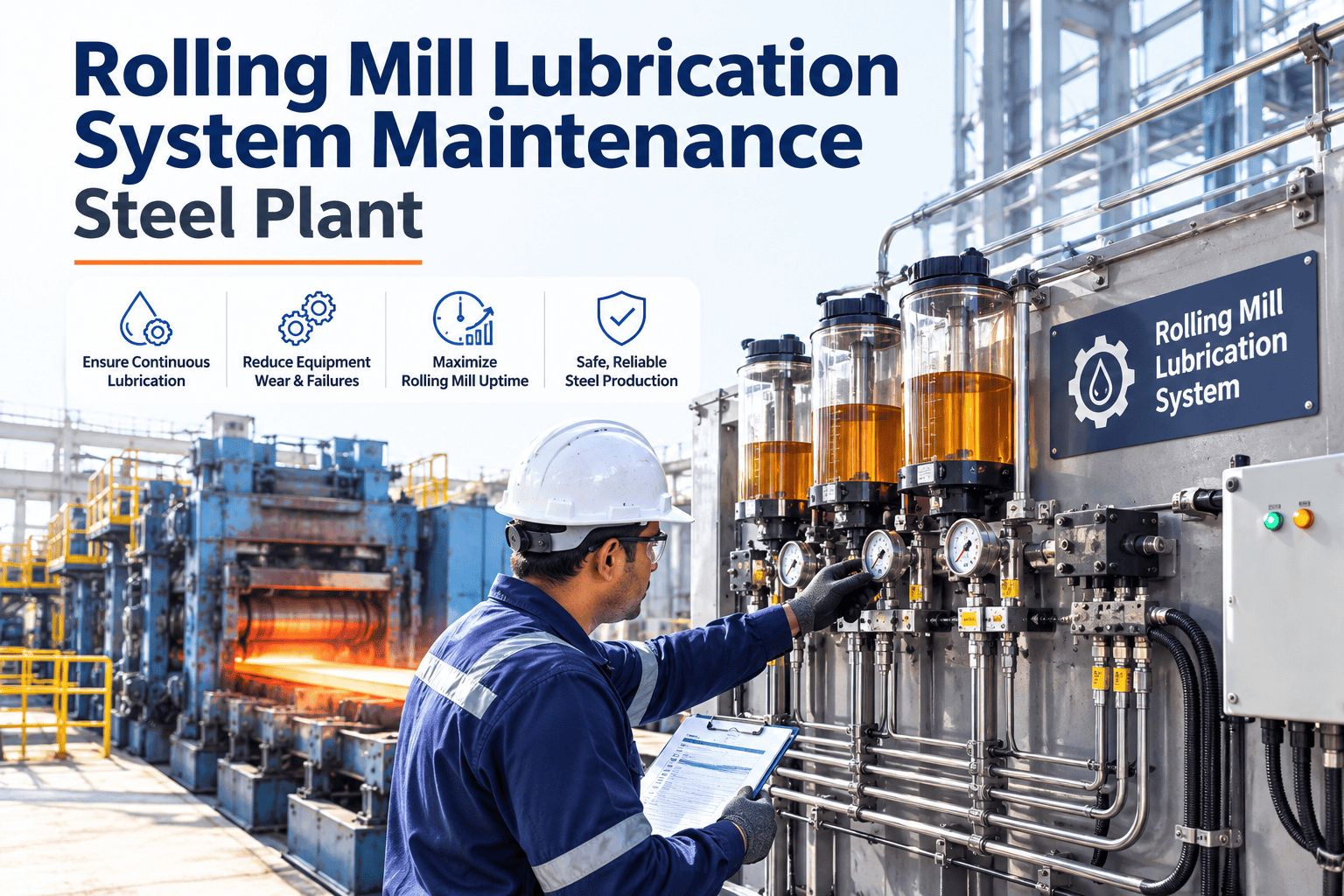
Hydraulic systems are the circulatory network of a steel plant — driving rolling mill roll gap adjustments, press operations, shear actuation, and descaler pumps simultaneously across every shift. A single undetected hydraulic failure can halt an entire production line for 6 to 12 hours. Steel plants that have deployed AI-driven predictive maintenance for hydraulic systems are catching pressure anomalies, pump wear patterns, and seal degradation 3 to 6 weeks before failure — eliminating the unplanned stops that reactive maintenance cannot prevent. This is how Oxmaint's predictive maintenance analytics addresses hydraulic failure in steel operations.
Case Study · Hydraulic Systems · P1 Critical
Hydraulic System Failure Prediction in Steel Plants
How AI maintenance analytics detects hydraulic leaks, pressure drops, pump wear, and actuator failures weeks before they halt production — validated across real steel plant operations.
$2.1M
Average annual cost of hydraulic-related unplanned downtime at a mid-size steel plant
Plant Engineering Journal, 2024
78%
Of hydraulic failures show detectable pressure or thermal anomalies 2 to 6 weeks prior
Oxmaint Predictive Analytics Data
6.4x
Cost difference between planned hydraulic repair vs emergency replacement under production pressure
McKinsey Industrial Maintenance
Case Study Context
The Hydraulic Failure Problem in Steel Production
A large integrated steel plant operating four rolling mill lines and a heavy plate press was experiencing 11 to 14 unplanned hydraulic stoppages per quarter. Each event averaged 7.2 hours of lost production. Engineering had condition-based inspection rounds on paper — but with over 340 hydraulic cylinders, 28 HPUs (Hydraulic Power Units), and 180+ actuators across the plant, inspection coverage was inconsistent and data was never aggregated into trend analysis. The plant engaged Oxmaint to deploy predictive analytics on their highest-criticality hydraulic circuits.
HPU
Hydraulic Power Units
Critical
Pump pressure oscillation, motor current rise, oil temperature trending, filter differential pressure
RGC
Roll Gap Cylinders
Critical
Position drift under load, seal leakage rate, pressure hold decay testing per campaign
SHR
Shear Actuators
High
Cycle time deviation, pressure spike amplitude, return speed degradation indicating seal wear
PRS
Press Cylinders
Critical
Force deviation at rated pressure, cylinder drift rate, accumulator pre-charge loss detection
Detection Methodology
How AI Predicts Hydraulic Failures Before They Occur
Oxmaint's predictive analytics engine monitors hydraulic system data across four signal types simultaneously — pressure waveform, temperature trend, flow rate, and motor current draw. The AI model builds a baseline behavioural profile for each hydraulic circuit during normal operation, then scores deviations from that baseline in real time. Anomaly scores above configurable thresholds trigger maintenance alerts with the predicted failure mode, estimated time window, and recommended intervention action attached to an auto-generated work order.
| Failure Mode |
Detection Signal |
Advance Warning |
Without Prediction |
With Oxmaint AI |
| Pump Valve Seat Erosion |
Pressure pulsation amplitude +12–18% |
4–6 weeks |
Emergency Replacement |
Planned Overhaul |
| Cylinder Seal Degradation |
Pressure hold decay rate increasing |
2–4 weeks |
Unplanned Stop |
Scheduled Reseal |
| Oil Contamination Buildup |
Filter differential pressure trending |
3–5 weeks |
Valve Seizure Risk |
Planned Oil Change |
| Accumulator Pre-charge Loss |
Response time elongation on cycle |
1–3 weeks |
Press Force Failure |
Nitrogen Recharge |
| Motor Bearing Wear |
Current draw +6–9% at equivalent load |
5–8 weeks |
Motor Failure |
Planned Bearing Change |
See Hydraulic Prediction in Oxmaint
AI anomaly detection, automated work orders, and hydraulic failure dashboards — configured for your steel plant hydraulic systems.
Case Study Results
Outcomes at the Steel Plant After 12 Months
89%
Reduction in unplanned hydraulic stoppages
From 13 per quarter to 1.4 per quarter across four rolling lines
$1.7M
Avoided emergency repair and lost production cost in year one
34 days
Advance warning achieved on most critical HPU pump failure — allowing full planned overhaul
4.2 mo
Full platform payback period including AI analytics module and sensor integration
Expert Review
What Hydraulic Reliability Specialists Say
"Hydraulic systems are particularly well-suited to AI-driven failure prediction because their failure modes produce consistent, detectable precursor signals — pressure oscillation, temperature rise, current deviation — that follow predictable patterns across equipment types. The challenge in steel plants has never been detection capability; it has been aggregating the signals from hundreds of circuits into a coherent monitoring system. CMMS-integrated AI solves exactly that aggregation problem."
— Hydraulic and Pneumatic Technology Review, Steel Plant Applications Issue, Q2 2024
"The plants achieving the most dramatic hydraulic downtime reductions are not necessarily those with the newest equipment — they are those with the most complete sensor coverage and the most disciplined data capture process. AI models are only as good as the signal quality fed into them. Steel plants that invest in baseline data quality see prediction accuracy rates of 85 to 93 percent."
— Industrial Maintenance and Plant Operation, Predictive Analytics Feature, 2024
Common Questions
Frequently Asked Questions
What sensors are required to deploy hydraulic failure prediction in Oxmaint?
The minimum effective sensor set for hydraulic prediction is pressure transducers on HPU output and return lines, oil temperature sensors, and motor current measurement on pump drive motors. Filter differential pressure sensors add significant value for contamination detection. Most steel plants already have a proportion of this instrumentation installed — Oxmaint's onboarding team conducts a sensor coverage assessment and identifies the incremental sensors needed to reach effective prediction coverage. Full deployment typically requires 60 to 90 days from initial assessment to live anomaly alerting.
Book a demo to start with a sensor coverage review for your hydraulic systems.
How does Oxmaint's AI distinguish between a normal pressure transient and a genuine anomaly?
Oxmaint's anomaly detection model builds a behavioural baseline for each hydraulic circuit by learning its normal pressure waveform, temperature range, and cycle signature across 2 to 4 weeks of operation. Alerts are triggered when deviations exceed statistically defined thresholds — not fixed limits — so the model adapts to the operating characteristics of each specific circuit rather than applying generic alarm setpoints. This approach reduces false positive alert rates to below 8 percent in established installations, meaning maintenance teams receive alerts they can trust and act on rather than noise they learn to ignore.
Can hydraulic circuit monitoring integrate with our existing DCS or SCADA infrastructure?
Yes. Oxmaint connects to existing DCS and SCADA systems via OPC-UA, Modbus TCP, and REST API protocols — the three most common industrial data exchange standards in steel plant automation environments. This means hydraulic sensor data already being collected by the plant control system can be streamed directly into Oxmaint's predictive analytics engine without duplicating sensor infrastructure. Where gaps exist, edge data collectors can be deployed on specific circuits.
Sign up free and our integration team will assess your current DCS connectivity during onboarding.
How are hydraulic failure predictions translated into maintenance work orders?
When Oxmaint's AI detects an anomaly pattern above the alert threshold for a specific hydraulic circuit, it automatically generates a predictive maintenance work order containing the circuit ID, the detected anomaly type, the predicted failure mode, the estimated time window before failure, and the recommended intervention action with parts list. The work order is assigned to the responsible maintenance planner or technician and appears in the maintenance dashboard alongside all open work orders. The planner then schedules the intervention for the next available planned outage window within the predicted safe operating period.
Stop Losing Production to Hydraulic Failures You Could See Coming
AI pressure anomaly detection, automated predictive work orders, and hydraulic failure dashboards — deployed for your steel plant in 60 to 90 days with Oxmaint.