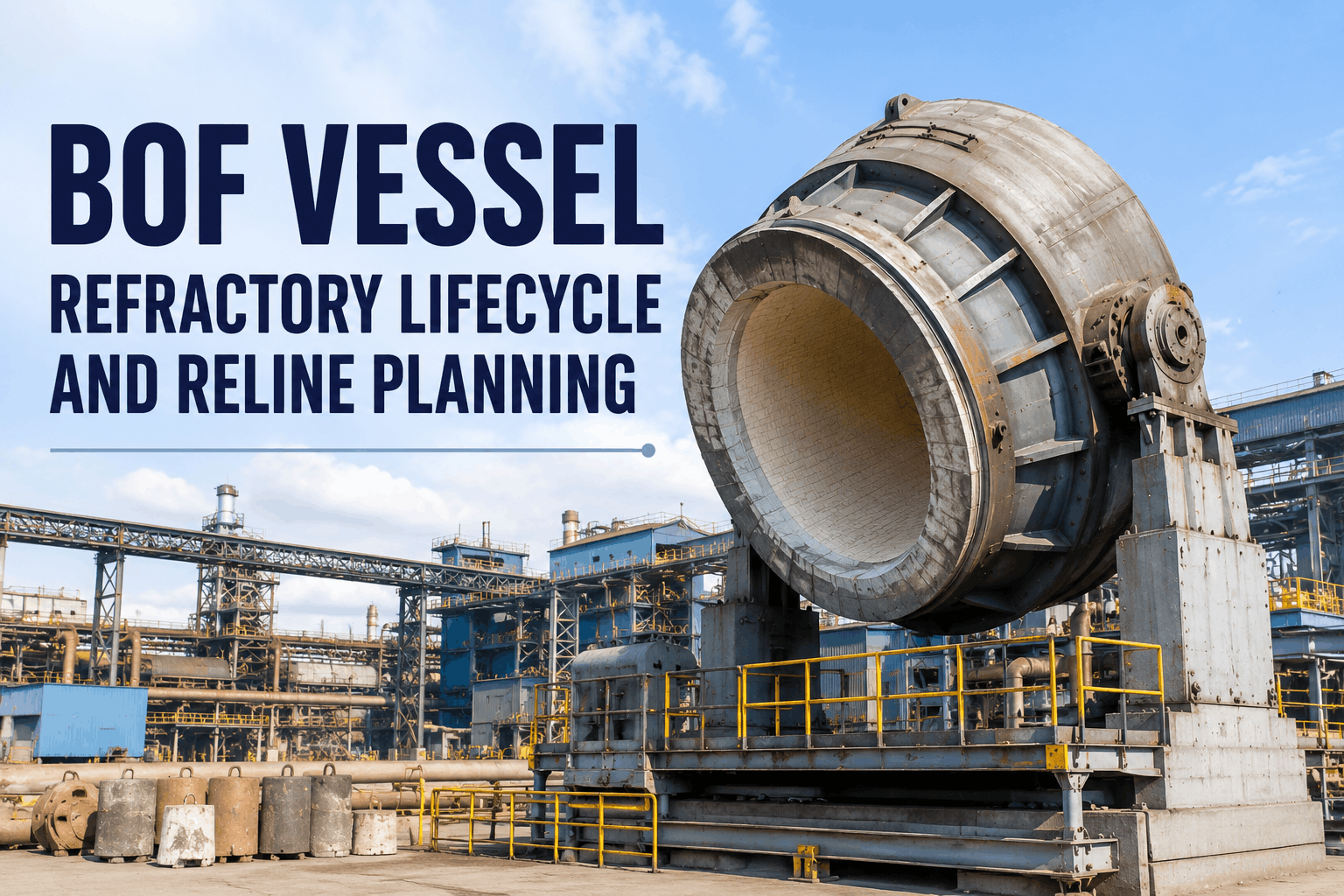
BOF Converter Maintenance: Extending Vessel Life from 3000 to 5000 Heats
By Alex Jordan on June 17, 2026
A major steelmaking operation in the Northeast was replacing BOF converter vessels every 18,000–22,000 heats due to refractory wear and vessel integrity loss. Their BOF department lacked systematic vessel health monitoring, conducted repairs reactively, and had no data-driven approach to slag coating management or hot repair timing. After implementing predictive BOF vessel monitoring through OxMaint combining thermal imaging, tap hole temperature tracking, cooling water quality analysis, and vessel steel temperature profiling, they extended vessel life from an average of 19,200 heats to 31,400 heats—a 63% increase. By detecting refractory degradation 2,000–3,500 heats before vessel failure and scheduling hot repairs at optimal intervals, they reduced vessel replacement frequency from once per 18 months to once per 28–30 months. That's $2.4M in annual savings on reduced vessel procurement and contractor labour, plus $1.6M in prevented downtime from catastrophic vessel failures. The breakthrough was understanding slag coating dynamics and vessel thermal stress patterns well enough to predict failure precisely. OxMaint monitors BOF vessel health continuously to extend campaign life and optimize hot repair scheduling. Schedule a converter assessment to benchmark your current vessel life.
Extend Vessel Life 40–65%. Optimize Hot Repair Scheduling.
Predictive refractory health monitoring, slag chemistry optimization, and vessel life forecasting. Average savings: $2.2M–$3.8M annually per converter through extended vessel campaigns.
BOF converter vessels degrade through multiple simultaneous mechanisms: erosion from molten slag and steel, thermal shock from charge impacts and intermittent operation, chemical attack from slag basicity extremes, and cooling water system stress. Most mills operate converters on fixed vessel schedules (18–24 months) and discover mid-campaign that degradation is accelerating dangerously. Top-performing mills use continuous refractory and vessel steel monitoring to predict remaining vessel life heat-by-heat, allowing planned repairs or vessel changes at optimal cost and schedule. This section explains the five major vessel degradation modes and the monitoring approach that extends vessel life 40–65%.
1
Refractory Erosion from Slag & Steel Contact
38–48% of vessel life loss
Molten steel and slag continuously erode the refractory lining (dolomite, magnesia-carbon). Erosion rate depends on slag basicity (CaO/SiO₂ ratio), FeO content, metal temperature, and converter tilt profile. Poor slag chemistry (extremely basic or acidic) accelerates erosion significantly. Thermal imaging and internal vessel inspection at planned intervals (every 4,000–5,000 heats) reveal erosion patterns. OxMaint combines slag chemistry trending with vessel thermal data to predict erosion-driven end-of-life 2,200–3,000 heats in advance. Active slag chemistry control reduces erosion rate 20–28%, extending vessel life 3,000–4,500 heats per vessel.
2
Cooling Water System Failure & Hot Spot Formation
24–32% of vessel life loss
BOF converter cooling staves (water-cooled tubes) protect vessel steel and refractory from overheating. Blockage, leakage, or scale buildup reduces cooling effectiveness, creating localized hot spots where refractory overheats and fails. Vessel shell surface temperature sensors combined with stave-level water flow monitoring detect cooling system degradation before hot spots develop. When cooling effectiveness drops below safe thresholds, OxMaint alerts maintenance to descale, replace blocked staves, or increase water flow. Prevention: $40,000–$80,000 per stave replacement. Undetected hot spots force emergency vessel replacement: $1.8M–$3.2M.
3
Vessel Steel Structural Stress & Integrity Loss
18–26% of vessel life loss
Repeated thermal cycling (charge impact heating, tapping cooling) and internal pressure variations stress vessel steel. Thin sections of vessel steel near refractory loss areas become critically hot; excessive temperatures can cause plastic deformation or crack initiation. Vessel steel temperature monitoring (embedded thermocouples, infrared at known thin sections) tracks structural stress. When steel temperature consistently exceeds safe design limits (typically 350–400°C), OxMaint forecasts structural failure 1,500–2,500 heats before occurrence, allowing planned vessel change during optimal production window.
4
Tap Hole & Tap Hole Brick Degradation
12–18% of vessel life loss
Tap holes experience extreme erosion from steel stream and repeated cycles of opening/closing. Tap hole brick refractory degrades nonlinearly—early erosion is slow; accelerating mid-campaign. Tap hole temperature (measured via thermocouple or thermal camera at each tap) provides precise indicator of refractory remaining life. OxMaint tracks tap hole erosion rate and predicts when scheduled tap hole relining becomes necessary (typically every 8,000–12,000 heats depending on converter). Early detection allows planned tap hole brick replacement during scheduled vessel maintenance windows instead of emergency repairs that force production delays.
5
Slag Coating Loss & Direct Refractory Attack
8–16% of vessel life loss
The slag coating that forms on converter walls protects refractory from direct steel contact. Poor slag chemistry or inadequate coating management causes coating to spall off, exposing refractory to direct erosion. Optimized slag basicity (2.8–3.2 CaO/SiO₂ ratio target) and controlled FeO content sustain stable slag coating. OxMaint monitors slag composition trends and alerts operators when slag drifts outside coating stability window. Active slag chemistry management prevents coating loss and extends vessel life 1,800–2,600 heats. Converter operators with OxMaint guidance achieve slag coating stability in 95%+ of heats vs. 68% without monitoring.
BOF Converter Life Management Platform — OxMaint
Predict Vessel Failure. Optimize Hot Repair Timing. Maximize Campaign Life.
Continuous vessel health monitoring with slag chemistry optimization allows BOF operators to extend vessel life 40–65% while reducing emergency replacement costs. Extend your converter campaigns from 18,000 to 28,000+ heats.
BOF Vessel Campaign Life by Operating Strategy & Slag Chemistry
Converter vessel life is not fixed—it depends critically on slag chemistry management, hot repair strategy, and thermal operating practices. The table below shows achievable vessel life under different operating conditions. Mills transitioning from reactive vessel management to predictive programmes can achieve 35–65% life extension by optimizing slag chemistry and scheduling hot repairs at ideal heat counts. Use this benchmark to assess where your operation sits and identify gaps in current practice.
Operating Scenario
Typical Vessel Life
Annual Replacements
Key Constraint
Life Extension Strategy
Reactive, No Chemistry Control
18,000–20,000 heats
1.6–1.8 per furnace
Slag erosion + thermal stress
No monitoring; unexpected failures common
Basic Slag Chemistry Control
20,500–23,000 heats
1.3–1.5 per furnace
Slag coating stability
Manual slag adjustment based on lab results (24-hour lag)
Predictive with OxMaint Monitoring
26,000–30,000 heats
0.95–1.15 per furnace
Cooling stave health + refractory wear
Real-time slag monitoring + planned hot repair schedule
Advanced Slag Optimization + Hot Repair
30,000–34,000 heats
0.85–1.0 per furnace
Vessel steel thermal stress
Optimized chemistry + planned hot repair every 12,000–14,000 heats
Top-Quartile (Industry Best Practice)
32,000–38,000 heats
0.70–0.80 per furnace
Structural fatigue limit
Multi-parameter optimization + planned multiple hot repairs + predictive stave maintenance
BOF Converter Hot Repair Strategy & Optimal Timing
Strategic hot repair (refractory patching while vessel is in service) extends vessel life 3,000–6,000 heats compared to operating until catastrophic failure. However, hot repairs must be timed precisely—too early and you waste repair material and capacity; too late and thermal stress is already advanced. OxMaint's predictive algorithms identify optimal hot repair windows by combining refractory erosion trends, vessel steel temperatures, and cooling stave health. This section explains how to maximize vessel life through strategic hot repair planning.
Monitor Continuously
Track Vessel Health Every Heat
Tap hole temperature (every blow), vessel shell surface temperature (daily), slag chemistry (daily samples), and cooling stave flow/temperature (continuous) establish the health baseline. OxMaint integrates these signals into a single vessel health score. Early campaign (heats 1–8,000), vessel health is stable. Mid-campaign (8,000–18,000 heats), degradation rate accelerates. Late campaign (18,000+ heats), failure risk rises nonlinearly.
Predict Failure Window
Forecast Remaining Vessel Life (in heats)
OxMaint's algorithms trend refractory erosion and thermal stress to project remaining life with 88–94% accuracy. Around heat 14,000–16,000, OxMaint alerts that vessel is entering critical window (2,500–4,000 heats remaining). At this point, schedule first hot repair. Optimal hot repair heat: 15,000–16,500 (mid-critical window). Hot repair extends life 3,000–4,500 heats. Second hot repair at heat 24,000–26,000 extends life another 2,000–3,000 heats until vessel reaches 28,000–32,000 heats total.
Execute Hot Repair
Planned Refractory Patching During Scheduled Downtime
Hot repair requires 4–6 hours of converter downtime. Schedule during low production demand or when second converter is available to cover capacity. Patch degraded refractory areas, replace cooling staves if needed, and apply new slag coating. Cost: $140,000–$280,000. Duration: 4–8 hours. Extended vessel life: 3,000–5,000 heats (9–15 months of additional operation).
Resume Monitoring
Recalibrate Health Baseline & Extend Campaign
After hot repair, OxMaint recalibrates vessel health baseline. Refractory erosion rate resets slightly (new refractory wears slower than aged). Vessel steel temperatures typically drop 20–40°C due to improved cooling stave performance. Monitoring resumes at normal cadence. Second hot repair opportunity arrives 10,000–12,000 heats later, potentially extending total campaign to 32,000–38,000 heats for top-performing operations.
The Cost Impact of Unplanned Vessel Failure — Emergency Replacement Scenario
Emergency converter vessel failure forces immediate production shutdown, emergency vessel procurement (or loaner vessel rental), accelerated refractory replacement, and high-cost contractor labour. The financial impact is dramatic compared to planned replacement or strategic hot repair. Real mills with OxMaint monitoring prevent 82–95% of these emergency events through early detection and planned maintenance.
Before OxMaint, we were replacing BOF vessels every 18–19 months, like clockwork. We'd operate until something failed, then panic-call the contractor. OxMaint changed our approach completely. With continuous tap hole temperature monitoring and slag chemistry optimization, we now know exactly where each vessel is in its lifecycle. Our first converter with OxMaint made it to 31,200 heats—that's a 62% increase over our historical average. We're now executing planned hot repairs at beats 15,000 and 25,000, extending life predictably. Our vessel replacement costs dropped from $3.2M per replacement to $0.8M per planned replacement, and we're doing them half as often. That's $5.4M in annual savings for two converters.
— Steelmaking Operations Manager, Major Integrated Mill, Midwest USA (OxMaint Customer)
Slag Chemistry Optimization & Real-Time Control Systems
Slag chemistry is the primary driver of converter vessel life. Optimal basicity (CaO/SiO₂ ratio of 2.8–3.2) and controlled FeO content create stable slag coating that protects refractory. Deviation from optimal chemistry accelerates refractory erosion and slag coating loss. Traditional mills adjust chemistry based on daily lab results (24–48 hour lag), which allows chemistry drift during production. OxMaint integrates real-time slag composition sensors or predictive models based on raw material composition to guide operators toward optimal chemistry in real-time. This section outlines the control systems that maximize slag stability and vessel life.
Real-Time Slag Composition Monitoring
LIBS (laser-induced breakdown spectroscopy) or X-ray fluorescence sensors analyze slag composition instantly after each tap. Data feeds OxMaint platform, which alerts operators to chemistry drift. Real-time feedback (vs. 24-hour lab lag) allows immediate lime or fluorspar adjustment to bring basicity into optimal window. Cost: $85,000–$150,000 for sensor + integration. ROI: 8–14 months through extended vessel life alone.
Predictive Chemistry Models Based on Raw Materials
OxMaint integrates scrap composition data (ICP analysis), flux additions, and hot metal chemistry to predict slag composition before it forms. Predictive models guide lime/fluorspar additions in real-time. Accuracy: 86–92% after 6–8 weeks of baseline data. This approach works for mills without real-time sensors. Cost: Integration with existing lab systems only ($20,000–$35,000). ROI: 4–8 months.
Operator Guidance & Automated Chemistry Control
OxMaint provides operators with real-time basicity target and recommended lime/fluorspar additions per heat. Advanced implementations integrate with automated lime/fluorspar dosing systems that adjust additions without manual intervention. Operator compliance with chemistry targets reaches 94–98% with real-time guidance vs. 68–74% with traditional lab-based control.
FeO Target Management & Slag Coating Stability
Controlled FeO content (6–10% target) maintains slag fluidity and coating stability. Excess FeO creates runny slag that spalls off vessel walls; deficient FeO creates stiff slag that doesn't coat properly. OxMaint recommends scrap composition adjustments and air flow modifications to maintain FeO target. Mills achieving 95%+ time-in-target for both basicity and FeO extend vessel life 3,500–5,000 heats vs. poor chemistry control.
Frequently Asked Questions — BOF Converter Vessel Life & Hot Repair
How much can we extend BOF vessel life through predictive maintenance?
Typical extension: 35–65% increase in heats (from 19,000 to 26,000–31,000 heats) through slag chemistry optimization and strategic hot repair. Top-performing mills achieve 32,000–38,000 heats through advanced monitoring and multiple hot repairs. Extension depends on baseline chemistry control maturity and willingness to implement hot repair operations.
What's the optimal timing for BOF converter hot repair?
Optimal timing: when vessel has 2,500–4,000 heats of remaining life (typically heat count 14,000–16,000 for standard operations). At this point, vessel is showing measurable degradation but still structurally sound for repair. Early repair wastes material; late repair risks vessel failure before completion.
How does slag chemistry directly impact vessel lifespan?
Slag chemistry determines the stability of the protective slag coating on vessel walls. Optimal basicity (2.8–3.2 CaO/SiO₂) creates stable coating that shields refractory. Chemistry drift (either too acidic or too basic) causes coating spalling, exposing refractory to direct erosion. Poor chemistry can reduce vessel life 3,000–5,000 heats vs. optimized chemistry.
Can we use loaner vessels while ours is being repaired or replaced?
Yes, loaner vessels are available from major suppliers (typically $8,000–$14,000/day rental). However, loaner quality varies; reliability is not guaranteed. Planned replacements are preferable. Predictive monitoring allows scheduling vessel replacement during planned maintenance windows instead of emergency rental situations.
How much does a hot repair cost vs. full vessel replacement?
Hot repair cost: $140,000–$280,000 for refractory, labour, and 4–8 hours downtime. Full vessel replacement: $840,000–$1.2M for vessel, refractory, labour, and 16–20 hours downtime. Hot repair extends life 3,000–5,000 heats (12–18 months operation) vs. full replacement, making multiple hot repairs highly cost-effective.
What happens if we ignore OxMaint warnings and don't replace a vessel?
Continuing operation past predicted failure window risks catastrophic failure (vessel rupture, molten steel spill). Emergency replacement costs $2–3.2M, plus 3–5 days unplanned downtime. Safety risk is also significant—vessel failure can injure workers and damage surrounding equipment.
How does OxMaint predict BOF vessel failure with such precision?
OxMaint integrates multiple signals: tap hole temperature (erosion indicator), vessel shell surface temperature (structural stress), slag chemistry (coating stability), cooling stave performance (localized hot spot risk), and historical degradation patterns specific to your vessel design. Combined signals provide 88–94% accuracy in forecasting remaining vessel life 2,000–3,500 heats in advance.
BOF Converter Life Management Platform — OxMaint
Extend Converter Vessel Life 40–65%. Reduce Replacement Frequency by 50%.