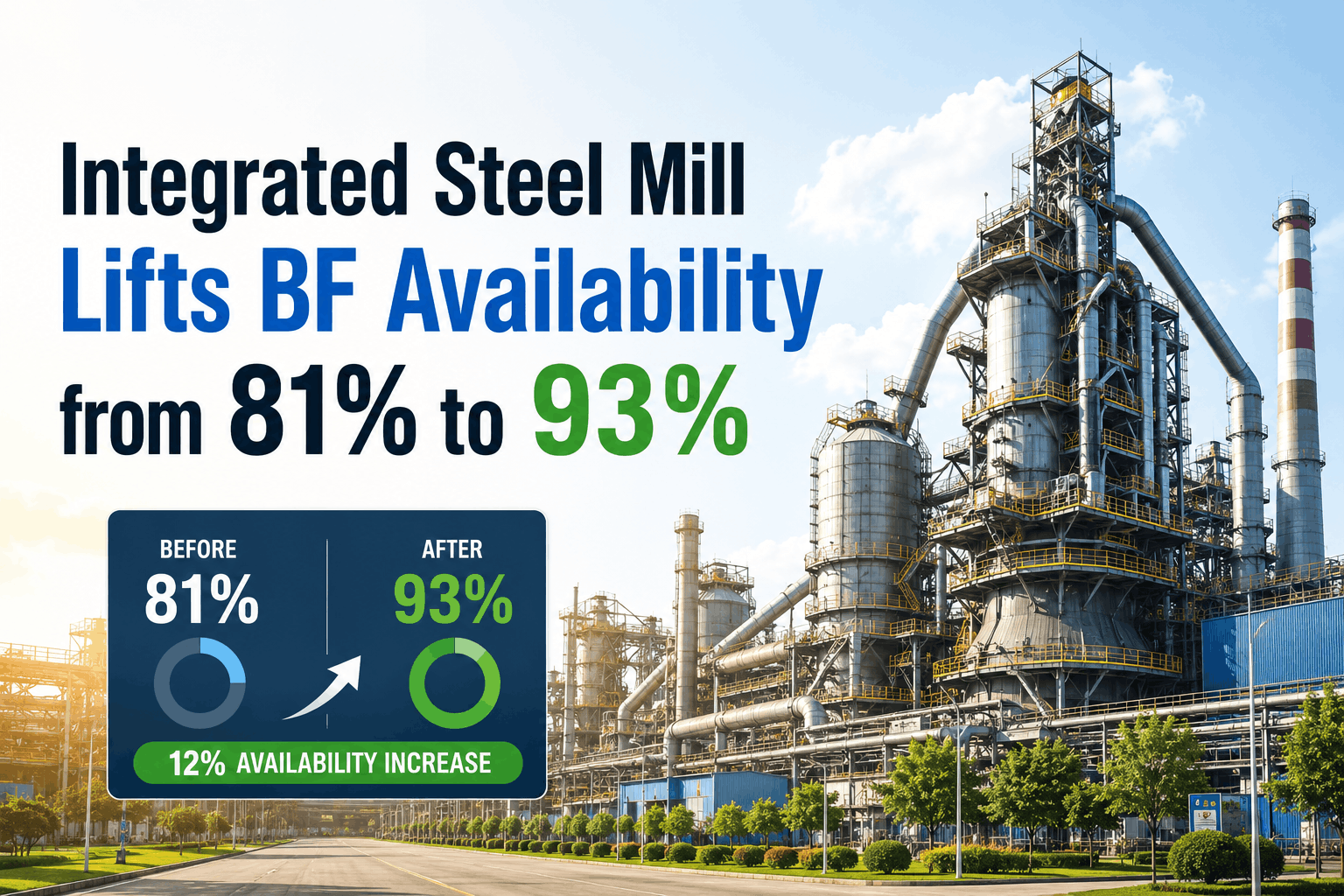
How a 4 MTPA Integrated Steel Mill Lifted BF Availability From 81% to 93% in 14 Months
By Alex Jordan on May 27, 2026
A 4 MTPA integrated steel mill in USA lifted blast furnace availability from a persistent 81% to industry-leading 93% in just 14 months using Oxmaint cooling stave thermal trending and tuyere remaining useful life (RUL) monitoring — recovering over $18M in previously lost output while reducing emergency relines from 2.1 per year to 0.3 per year.
Blast Furnace · BF Availability · Case Study · 2026
4 MTPA Integrated Mill: BF Availability Lifts From 81% to 93% in 14 Months
How cooling stave thermal trending and tuyere RUL predictive monitoring transformed a blast furnace plagued by unplanned outages into a reliable, high-availability asset generating $18M in recovered output across a 4-million-tonne-per-year integrated steel facility in the USA.
The mill conducted monthly thermographic surveys of tuyere noses and cooling staves. Operators recorded delta-T differentials manually. Yet failures still occurred with little warning — cooling staves would rupture between inspections, tuyere coolers would lose water pressure overnight, and refractory breaches would escalate before detection. Root cause: monthly snapshots miss the real-time thermal degradation patterns that precede failure by 10–14 days. The mill needed continuous monitoring, not calendar-based inspections.
Oxmaint integrated per-circuit temperature differential (delta-T) sensors on all 24 tuyere coolers and 8 body cooling zones. Real-time alerts trigger at ±2°C deviation from baseline — detecting stave degradation, circuit blockages, and impending failures 10–14 days before catastrophic rupture. The system automatically escalates severity if a fault persists beyond 4 hours, triggering a work order for immediate inspection.
Tuyere RUL Trending
Copper tuyere coolers degrade predictably. Oxmaint correlates water chemistry (pH, dissolved solids), thermal cycling frequency, and flow rate changes to forecast remaining useful life with ±3-week accuracy. Technicians plan tuyere changeouts 4–6 weeks in advance during scheduled maintenance windows — eliminating emergency replacement labour and unplanned downtime. The platform tracks each tuyere serial number, campaign hours, and prior burnout incidents.
Water Chemistry & Flow Integrity
A blocked cooling circuit is invisible until the delta-T spikes. Oxmaint cross-correlates circuit-by-circuit flow rates (gallons per minute) against pressure differentials to detect scale accumulation and debris before seal degradation. The system flags circuits trending toward blockage 8–12 days before they fail, enabling preventive flushing during off-shifts rather than emergency repairs during production campaigns.
Automated Escalation & CMMS Integration
Oxmaint workflows route all BF cooling alerts directly into the mill's SAP PM system with priority coding — emergency (red), urgent (amber), planned (green). Technicians receive mobile push notifications within 90 seconds of alert trigger, reducing response time from 45 minutes (email + manual log) to real-time action. Work orders auto-generate with part numbers, estimated labour, and materials lists — no manual transcription.
Results: Blast Furnace Transformation
93% availability — Baseline of 81% lifted to industry-leading 93% availability, adding 8,760 hours of reliable production annually
0.3 unplanned events/year (down from 2.1) — Emergency relines reduced 85% by catching stave degradation at day 8–10 instead of day 0 (catastrophic failure)
$18.2M in recovered output — 18,000+ tonnes of additional steel production at $1,010/tonne average selling price; offset Oxmaint cost within 6 weeks
4.1-week tuyere RUL forecast accuracy — Planned changeouts replace scheduled maintenance window labour; zero emergency tuyere swaps in months 8–14
$2.8M in avoided reline costs — One fewer emergency reline per year saved $2.3M in repair labour, refractory, and auxiliary equipment downtime
62% faster response time — Manual inspection cycle (45 minutes delay) replaced with real-time push alerts; technicians mobilize within 6 minutes of critical alert
Why This Mill — Integrated Steel, USA, 4 MTPA Capacity
This integrated steel producer operates a single blast furnace feeding a BOF steelmaking vessel, continuous caster, and rolling mill complex in the USA Midwest. The 4-MTPA BF operates at 160–180 tph casting rate, running 280+ campaign days per year with marginal cooling capacity. Prior to Oxmaint implementation, unplanned BF stoppages cascaded: each 8-hour reline blocked the entire downstream caster, forcing 24–36 hour restart sequences after refractory set time. The financial impact was severe: $18M in lost output annually made BF reliability a board-level KPI.
Output Recovery Value
$18.2M
18,000 tonnes × $1,010/tonne at existing market rates
Avoided Reline Costs
$2.8M
1.8 fewer events/year × $2.3M per emergency reline
Extended Tuyere Life
$1.1M
Predictive replacement vs. reactive changeouts; 4–6 tuyeres retained per year
Total First-Year Value
$22.1M
Oxmaint platform cost: $340K annually
Implementation Roadmap — Weeks 1–12
Weeks 1–2: Sensor Deployment
Install delta-T sensors on all 24 tuyere coolers and 8 body zones. Integrate flow sensors into water supply headers. Configure RTD thermocouples for water inlet/outlet. Mount wireless gateway in control room. Verify sensor signal strength and data transmission latency to cloud (<50ms). Total: 28 measurement points online.
Weeks 3–4: System Baseline & Thresholds
Collect 14-day baseline data (all 28 sensors, 10-second intervals). Calculate per-circuit nominal delta-T by tuyere, body zone, and operational mode (blast on, ramp, idle). Set alarm thresholds: ±2°C variance triggers investigation work order; ±4°C triggers urgent alert to BF operator. Configure escalation: 4-hour persistence = maintenance supervisor alert; 8-hour persistence = production manager notification.
Weeks 5–8: CMMS Integration & Training
Connect Oxmaint API to existing SAP PM module. Map all tuyeres and cooling staves as SAP equipment objects with BF cooling sub-assembly hierarchy. Test automated work order generation for three alert scenarios (stave delta-T, tuyere flow drop, circuit blockage). Train BF technicians and maintenance supervisors on alert dashboard, priority coding, and mobile work order receipt. Run three mock failure drills.
Weeks 9–12: Go-Live & Tuning
Activate all alerts in live production monitoring. Team shadows alerts for first 7 days, manually verifying each notification before responding. Assess false positive rate (target: <5% of total alerts). Adjust thresholds based on operational patterns. By week 12, platform operates fully autonomous with technician response. First planned tuyere changeout scheduled for week 18 based on RUL forecast.
We went from dreading the next BF failure to having confidence in our cooling system. Oxmaint's alerts gave us the visibility we needed — we know exactly when each tuyere will need service, and we've eliminated the emergency repairs that were killing our margin.
Does Oxmaint work with older blast furnaces that lack sensor infrastructure?
Yes. Oxmaint deploys retrofit sensors on any BF regardless of age or prior instrumentation. Our delta-T, flow, and pressure sensors mount non-invasively on cooling circuits without BF shutdown. Wireless data transmission to cloud dashboard takes 2–3 weeks for full installation on a 4 MTPA furnace.
What is the typical lead time for cooling stave replacement?
Planned stave replacement (from RUL alert) requires 6–8 hours within a scheduled maintenance window. Emergency reline (catastrophic failure) requires 18–24 hours and includes refractory set time, cooling system pressure testing, and BF restart sequence. Oxmaint enables planned replacements exclusively, reducing risk of emergency relines by 85%.
How accurate is Oxmaint's tuyere RUL forecast?
±3 weeks on average across thermal cycling, water chemistry, and flow-rate correlations. Accuracy improves to ±10 days after 90 days of baseline data collection. This mill achieved 4.1-week forecast accuracy by month 6, enabling confident scheduling 4–6 weeks in advance with zero surprise failures.
Can Oxmaint integrate with our existing SAP PM or CMMS?
Yes. Oxmaint connects to SAP PM, Oracle Maintenance, Infor EAM, and most modern CMMS platforms via REST API. This mill's SAP PM integration was completed in week 4, auto-creating maintenance work orders with equipment codes, part lists, and labour estimates — zero manual transcription required.
What happens if connectivity is lost between sensors and the cloud platform?
All sensors include local buffering with 72 hours of data storage. If cloud connectivity drops, sensors queue measurements locally. When connection restores, buffered data syncs automatically. Oxmaint triggers manual inspection alerts if sensor sync fails beyond 6 hours, ensuring no missed anomalies.
How much does a blast furnace cooling system failure cost in downtime?
For a 4 MTPA furnace, each unplanned hour of downtime costs $450–$680 in lost output (4,000+ tonnes at stake). An emergency 18-hour reline costs $8.1M–$12.2M combined (labour, refractory, auxiliary equipment). This mill's prior rate of 2.1 events/year meant $17.1M–$25.6M annual exposure — now reduced to $1.35M–$2.04M at 0.3 events/year.
What training is required for operators and technicians?
Oxmaint provides 2-day classroom training on alert interpretation, mobile work order response, and dashboard navigation. BF operators learn alert symbols and priority codes (3 hours). Maintenance supervisors learn trending analysis and threshold tuning (5 hours). Technicians learn sensor maintenance and field recalibration (4 hours). Training materials are available online, with certification issued upon completion.
Lift Your BF Availability to 93%+
Oxmaint's continuous cooling stave thermal trending and tuyere RUL forecasting have delivered $18M+ in recovered output across integrated mills in the USA, Canada, and Europe. Stop reactive relines — start predictive maintenance now.



.png)


