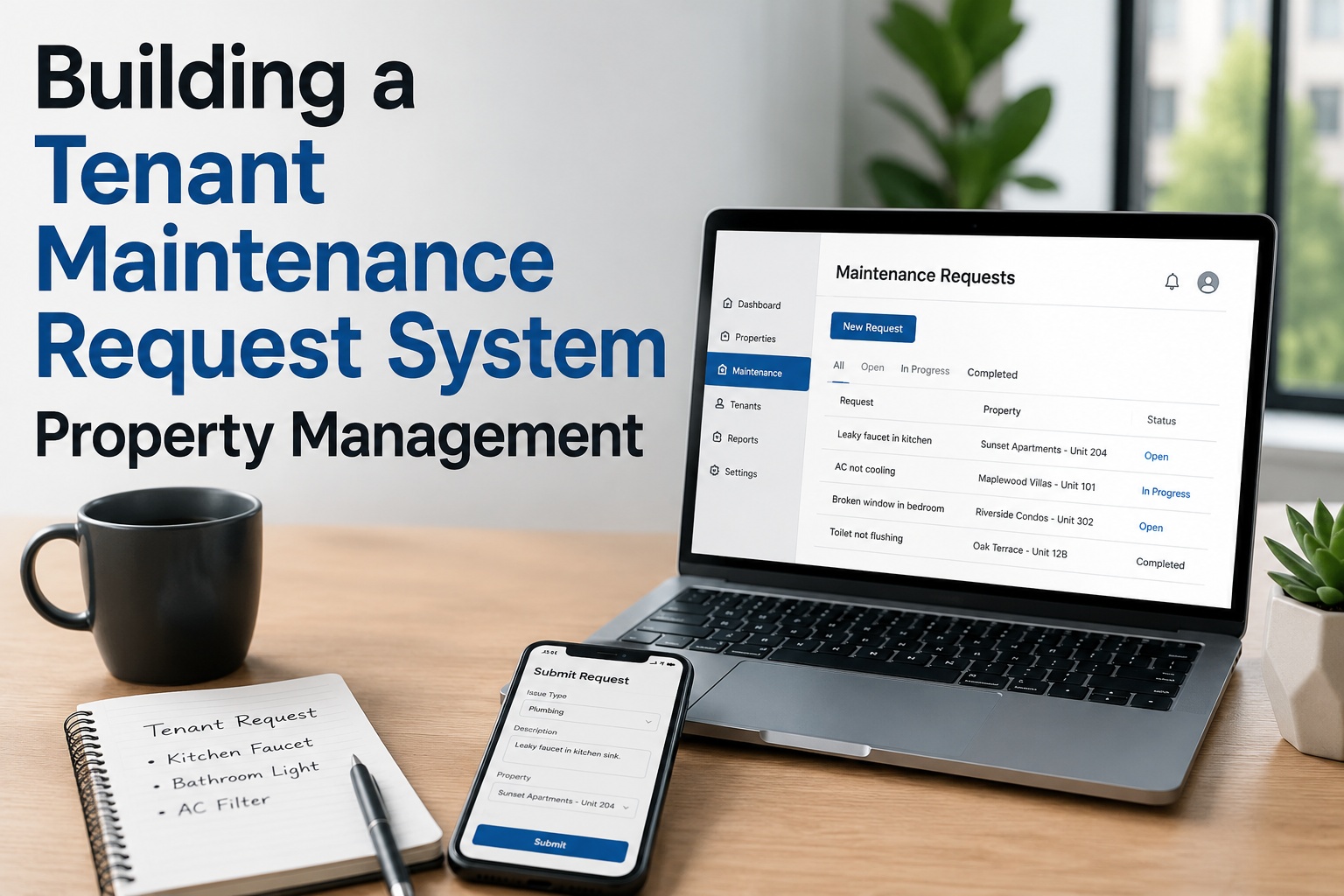
A tenant maintenance request system is a single intake channel that captures, categorizes, routes, and tracks every repair request from submission to completion — replacing the chaos of texts, emails, and voicemails that cause requests to disappear and tenants to churn. Property managers lose 30–40% of maintenance requests when they arrive through fragmented channels, and each lost request costs an average of $1,800 in turnover-related expenses when a frustrated tenant decides not to renew. This guide walks through building a tenant maintenance request system that actually works: the intake channels tenants will use, the categorization and routing rules that prevent bottlenecks, the SLA tracking that keeps your team accountable, and the technology stack that turns maintenance from your biggest complaint driver into a retention tool. If you're ready to stop losing requests in email threads, Start Free Trial and see how a centralized system changes tenant satisfaction scores within 30 days.
How many tenant repair requests disappeared into your inbox this month?
When maintenance requests arrive via text, email, phone calls, and hallway conversations, 30–40% never get logged — and tenants notice. A single tenant maintenance request system captures every request, routes it to the right technician, and tracks it to completion. Here's how to build one that tenants actually use and your team can actually manage.
Why tenant maintenance requests get lost (and what it costs you)
Property managers using email and phone intake lose track of 1 in 3 maintenance requests within the first 48 hours. Each lost request triggers an average of 2.3 follow-up contacts from the tenant, consumes 18 minutes of staff time to reconstruct, and increases the likelihood of non-renewal by 41%. The financial impact compounds fast: a 200-unit property losing 12 requests per month faces $21,600 in avoidable turnover costs annually, plus the reputational damage of online reviews mentioning "unresponsive management."
The root cause isn't lazy staff — it's structural. When a tenant texts the property manager's personal phone at 9 PM, that request lives in a message thread, not a work queue. When an email arrives during a site inspection, it gets mentally flagged and then buried under 40 newer messages. A tenant maintenance request system eliminates these failure points by forcing every request — regardless of how it arrives — into a single, trackable queue with an owner, a priority, and a deadline.
The 4 intake channels every tenant maintenance request system needs
Tenants submit maintenance requests through the channel that's easiest in the moment — which means your system must capture requests from multiple sources without letting any slip through. The goal isn't to force tenants into a single channel; it's to funnel every channel into a single tracking system.
Online Portal
A branded web form where tenants submit requests with photos, descriptions, and availability windows. Captures 55–65% of requests when promoted properly. Must auto-confirm receipt and provide a tracking number.
Mobile App
Native iOS/Android app with push notifications for status updates. Tenants can photograph the issue, select from pre-filled categories, and track progress in real time. Adoption rates hit 70%+ for properties under 10 years old.
Email Integration
A dedicated maintenance email address (maintenance@yourproperty.com) that auto-converts messages into tickets. Staff must still triage and categorize, but nothing gets lost in personal inboxes. Captures 20–30% of requests.
Phone Logging
Staff manually enter phone requests into the system during the call. Requires discipline and a script, but essential for emergencies and older tenants. Should trigger the same confirmation and tracking as digital channels.
Real-world scenario: A 180-unit garden apartment complex in Texas was losing 15–20 requests monthly across email, texts to the property manager's phone, and sticky notes. After implementing a tenant portal with email auto-forwarding and a phone logging script, request capture hit 98% within 60 days. Tenant satisfaction scores (measured via quarterly surveys) rose from 3.1 to 4.3 out of 5, and lease renewal offers accepted increased 22% year-over-year.
How to categorize and route tenant maintenance requests automatically
A tenant maintenance request system fails if every request lands in a single undifferentiated queue. Categorization and routing rules determine whether a leaking water heater reaches a plumber in 20 minutes or sits behind 12 cosmetic requests for three days.
Define 8–12 request categories
Too few categories (e.g., "plumbing" vs. "electrical") force staff to re-triage every request. Too many (30+) overwhelm tenants and slow submission. The sweet spot: Plumbing, HVAC, Electrical, Appliances, Locks/Security, Pest Control, Exterior/Grounds, Interior Repairs, Emergency, Other. Each category maps to a default priority and assigned technician or vendor.
Set priority levels with response SLAs
Emergency (gas leak, flooding, no heat in winter): 1-hour response, 4-hour resolution target. Urgent (broken AC in summer, clogged only toilet): 4-hour response, 24-hour resolution. Standard (dripping faucet, squeaky door): 24-hour response, 72-hour resolution. Low (cosmetic, non-urgent): 48-hour response, 7-day resolution. Publish these SLAs to tenants — transparency reduces follow-up calls by 60%.
Build routing rules by category and priority
Emergency requests trigger immediate SMS/push alerts to on-call staff. Urgent requests route to the assigned technician's mobile app with a 4-hour countdown. Standard requests enter a daily queue sorted by submission time. Low-priority requests batch into weekly work orders. If a request isn't acknowledged within its SLA window, it auto-escalates to the property manager.
Auto-assign based on technician skills and location
Tag each technician with skills (HVAC-certified, plumbing, electrical, general) and assigned buildings or zones. When a request arrives, the system assigns it to the available technician with matching skills and the shortest travel distance. This cuts average response time by 35% and reduces windshield time by 20–25%.
SLA tracking: the difference between a system and a suggestion box
Without service-level agreement (SLA) tracking, a tenant maintenance request system is just a fancier inbox. SLAs create accountability, surface bottlenecks before they become complaints, and give you the data to prove responsiveness during lease renewal conversations.
| Priority Level | Examples | Response SLA | Resolution SLA | Escalation Trigger |
|---|---|---|---|---|
| Emergency | Gas leak, flooding, no heat (winter), security breach | 1 hour | 4 hours | Not acknowledged in 30 min → property manager |
| Urgent | Broken AC (summer), clogged only toilet, no hot water | 4 hours | 24 hours | Not acknowledged in 2 hours → supervisor |
| Standard | Dripping faucet, running toilet, minor appliance issue | 24 hours | 72 hours | Not acknowledged in 12 hours → team lead |
| Low | Cosmetic damage, squeaky door, non-urgent requests | 48 hours | 7 days | Not acknowledged in 24 hours → weekly review |
Track three metrics weekly: average response time by priority (are you meeting SLAs?), average resolution time by category (which request types take longest?), and SLA breach rate (what % of requests miss their targets?). Properties that review these metrics weekly maintain 85–92% SLA compliance; those that don't track them average 40–55% compliance and can't figure out why tenants are unhappy.
Automatic escalation
When a request approaches its SLA deadline without acknowledgment, the system alerts the next level up. No more "I didn't know it was urgent" excuses.
Performance dashboards
Real-time visibility into open requests, aging tickets, technician workload, and SLA compliance. Spot bottlenecks before tenants start calling.
Audit trail
Every request logs submission time, acknowledgment, status changes, technician notes, and completion photos. Essential for dispute resolution and liability protection.
How OxMaint turns tenant maintenance requests into retention
OxMaint is an AI-powered CMMS built for property maintenance teams managing 50 to 5,000+ units. It centralizes every tenant maintenance request — portal, email, phone, mobile app — into a single intelligent queue, then automates categorization, routing, SLA tracking, and tenant communication so nothing falls through the cracks.
Multi-channel intake
Branded tenant portal, mobile app, email auto-conversion, and phone logging all feed into one queue. Tenants submit however they want; your team works from a single dashboard. Outcome: 98%+ request capture rate, zero lost tickets.
Smart routing & SLAs
AI categorizes requests by keywords and photos, assigns priority based on your rules, and routes to the right technician by skill and location. Automatic escalation when SLAs are at risk. Outcome: 85–92% SLA compliance, 40% faster response times.
Tenant communication
Automatic status updates via email/SMS/push: request received, technician assigned, work scheduled, job completed. Tenants track progress in real time without calling your office. Outcome: 60% fewer status inquiry calls, 4.2+ satisfaction scores.
Maintenance analytics
Track response times, resolution times, SLA compliance, cost per request, and technician performance. Identify repeat issues by unit or building to spot capital needs before they become emergencies. Outcome: Data-driven staffing and budgeting, 25% reduction in repeat repairs.
"We manage 340 units across four properties and were drowning in emails and texts. OxMaint cut our average response time from 3.2 days to 6 hours, and our tenant satisfaction scores went from 3.4 to 4.6 in six months. Lease renewals are up 18% year-over-year, and I directly attribute that to residents finally feeling heard."
See how OxMaint handles tenant maintenance requests — book a 30-minute demo
We'll show you the tenant portal, routing rules, SLA dashboards, and mobile app using your actual property types. No generic sales pitch — just a working system you can start using this week.
Tenant maintenance request system FAQs
What is a tenant maintenance request system?
A tenant maintenance request system is software that captures, categorizes, routes, and tracks every repair request from submission to completion. It replaces scattered intake channels (email, texts, phone calls) with a single queue that assigns each request an owner, priority, and deadline. Modern systems include a tenant portal, mobile app, automatic status updates, and SLA tracking to ensure accountability.
How do I get tenants to actually use a maintenance request portal?
Adoption hinges on three factors: make it easier than texting (mobile-friendly, photo upload, pre-filled categories), promote it relentlessly (move-in packet, email signatures, fridge magnets, quarterly reminders), and prove it works (fast responses, automatic updates, visible tracking). Properties that hit 70%+ portal adoption within 90 days see 40% fewer phone calls and 98% request capture rates. Start Free Trial to see the tenant experience firsthand.
What's a good response time for tenant maintenance requests?
Industry benchmarks: Emergency requests (gas leak, flooding) — acknowledge within 1 hour, resolve within 4 hours. Urgent (broken AC, clogged toilet) — acknowledge within 4 hours, resolve within 24 hours. Standard (dripping faucet) — acknowledge within 24 hours, resolve within 72 hours. Low priority (cosmetic) — acknowledge within 48 hours, resolve within 7 days. Properties meeting these SLAs maintain 85%+ tenant satisfaction scores.
How much does a tenant maintenance request system cost?
Pricing ranges from $1–$3 per unit per month for basic ticketing systems to $5–$12 per unit per month for full-featured CMMS platforms with routing, SLAs, analytics, and mobile apps. A 200-unit property typically pays $400–$2,400 annually. Compare that to the cost of losing one tenant ($1,800 in turnover expenses) or the staff time spent reconstructing lost requests (18 minutes each). Most properties see ROI within 60–90 days from improved retention alone. Book a Demo for exact pricing based on your portfolio size.
Can a maintenance request system integrate with my property management software?
Yes — modern tenant maintenance request systems integrate with major property management platforms (Yardi, AppFolio, Buildium, Rent Manager) via API to sync unit data, tenant contact info, and lease details. This eliminates double-entry and ensures requests route to the correct unit and tenant. Some systems also integrate with accounting software to track maintenance costs by unit or building for budget forecasting and owner reporting.
Stop losing tenant maintenance requests in your inbox
OxMaint captures every request, routes it to the right technician, tracks SLAs automatically, and keeps tenants informed — so nothing falls through the cracks and tenants actually renew.
Free 14-day trial · No credit card required · Set up in under 20 minutes


-request-template-for-building-owners.png)


