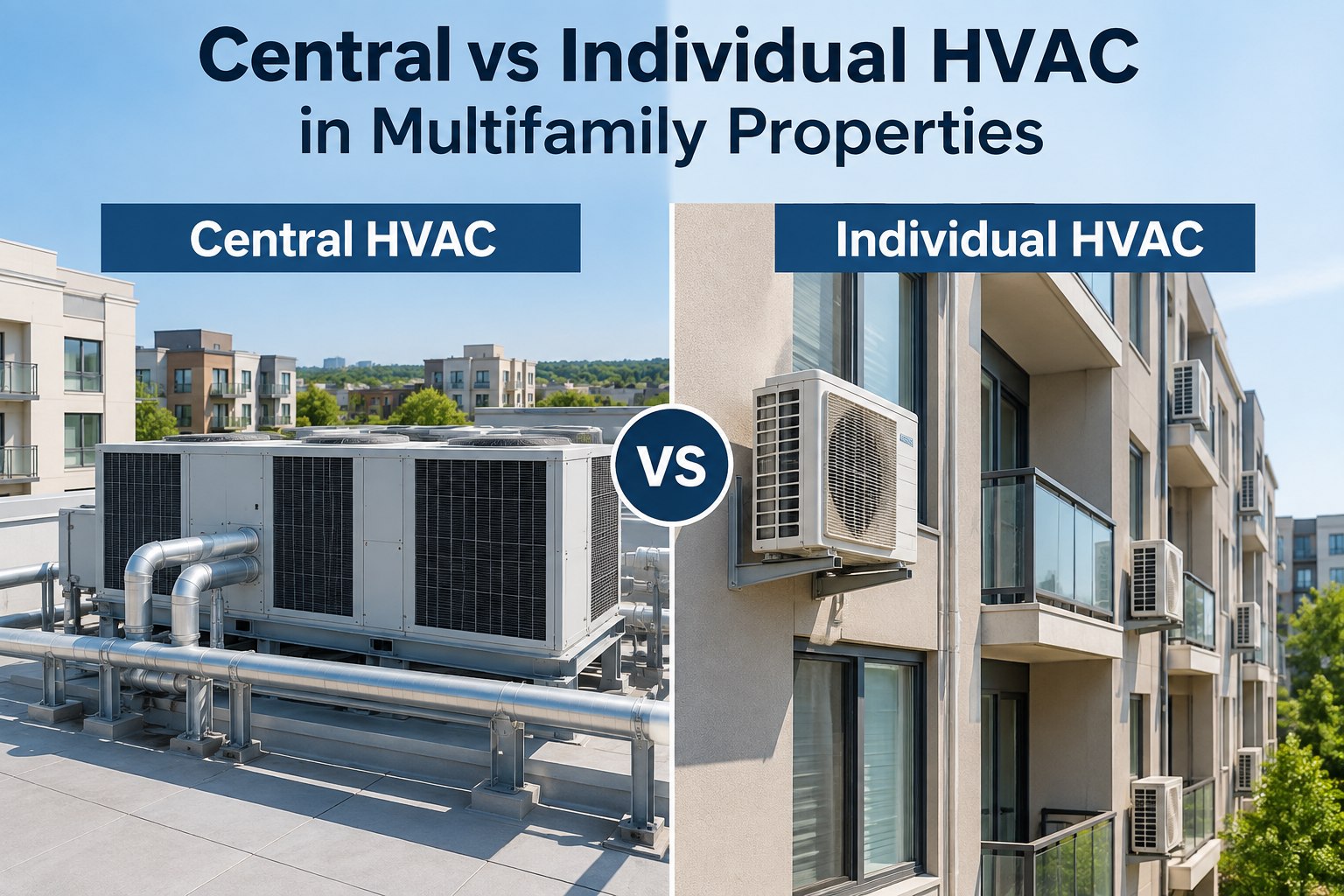
The HVAC configuration decision on a multifamily property gets made once — usually at design or major renovation — and then everyone lives with it for the next 20-plus years. Choose a central plant and you're locked into shared metering complexity and one chiller failure that can take down comfort for the whole building; choose individual per-unit systems and you've traded that risk for higher total mechanical square footage, more equipment to maintain, and a maintenance team that now needs eyes on hundreds of small units instead of one plant room. Neither option is universally "better" — the right call depends on building age, unit count, climate, and how you want to bill for utilities. This guide breaks down capital cost, operating cost, submetering and billing fit, tenant control, and maintenance load for both configurations, plus a simple framework for choosing between them on new construction or a major retrofit. Book a Demo to see how OxMaint tracks HVAC assets and maintenance load differently for central-plant vs. distributed-unit properties.
Central vs. Individual HVAC in Multifamily Properties: The Decision Guide
One chiller room or hundreds of small units — the choice shapes your capital cost, your utility billing model, and your maintenance workload for decades. Here's how to choose correctly the first time.
Central Plant or Per-Unit — The Core Trade-Off in One View
Before the detail, here's the shape of the decision: central systems concentrate cost, risk, and control in one place; individual systems distribute all three across every unit. Start a free workspace to model maintenance load under either configuration against your actual unit count.
- Lower total mechanical equipment count
- Single point of failure risk
- Efficient at scale, harder to submeter
- Specialist technicians for plant equipment
- Long equipment life (15–25+ yrs typical)
- Higher total equipment count, distributed risk
- One failure affects one unit only
- Straightforward direct or sub- metering
- Simpler per-unit repairs, more of them
- Shorter equipment life (10–15 yrs typical)
Capital & Operating Cost — Where the Money Actually Goes
Central systems generally cost less per square foot to install at scale and run more efficiently in aggregate, but individual systems shift the ongoing utility spend — and the failure risk — directly onto whoever pays the bill.
Whichever You Run, You Can't Manage What Isn't Tracked
One chiller or three hundred PTAC units — OxMaint logs every HVAC asset, its service history, and its failure pattern, so you know exactly where the next dollar of maintenance spend is actually going.
Billing & Submetering — Which Configuration Fits Your Utility Model
How you plan to bill for utilities should influence which configuration you choose, not the other way around. Here's how each maps to the common billing approaches.
Individual systems pair naturally with per-unit billing because usage is already physically separated at the equipment level. Central plants require retrofitting metering onto a shared loop — technically possible, but a materially bigger project.
Maintenance Load — One Plant Room vs. Hundreds of Units
This is where the day-to-day operational difference is starkest, and where most owners underestimate the individual-system side of the ledger.
Which Configuration Fits Your Property? — A Quick Decision Framework
Use these as directional signals, not absolutes — most large-scale decisions combine two or three of these factors.
- Large unit count with uniform usage patterns
- Utilities included in rent or billed via RUBS
- Climate favors efficient shared chilled/hot water loops
- Ground-up construction with plant space designed in
- Direct or submetered billing is a priority
- Renovation without practical space for a plant/distribution retrofit
- Residents want per-unit thermostat control
- Smaller or garden-style property layout
We inherited a 180-unit property with individual PTAC units and assumed the maintenance load would be light because each failure was small. It wasn't — we were running dozens of service calls a month across the portfolio, and without a system tracking which units were repeat offenders, we kept replacing the same handful of units' compressors every year instead of just swapping the unit. Once we started logging every call by unit and pattern, the repeat-failure units became obvious within a quarter, and our per-unit repair spend dropped noticeably the next year.
Frequently Asked Questions
Whatever Configuration You Run, Know Exactly What It's Costing You.
OxMaint tracks every HVAC asset — central or individual — with service history, failure patterns, and maintenance cost, so your next configuration decision is backed by real data, not guesswork.