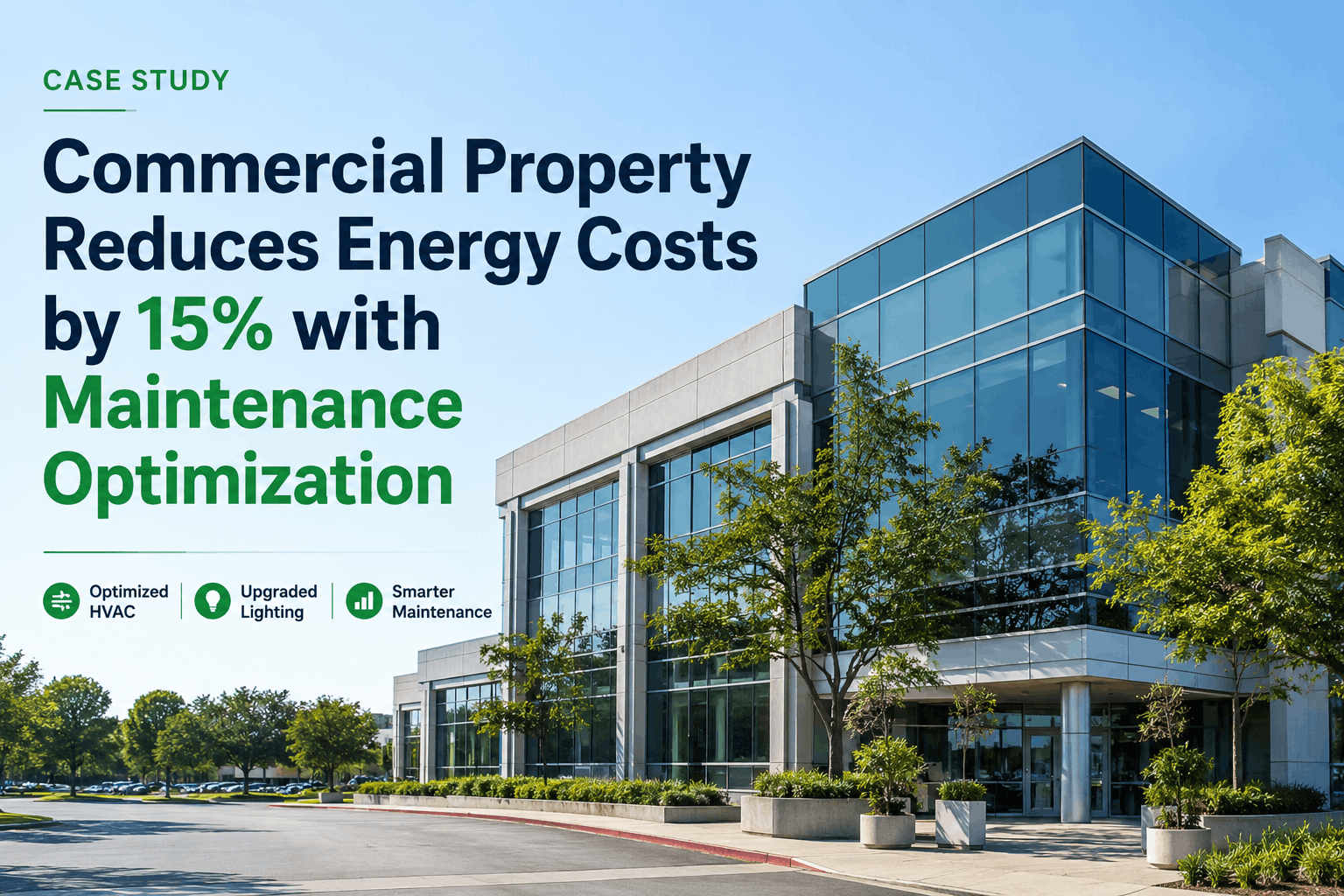
A large commercial office building operator managing a 450,000-square-foot Class A office property in a major metropolitan area faced mounting maintenance costs and unpredictable equipment failures. Emergency HVAC repairs, water damage from undetected leaks, and premature equipment replacement were consuming 64% of their annual $340,000 maintenance budget. By implementing OxMaint's preventive maintenance scheduling and condition monitoring system, the operator reduced maintenance costs by $200,000 annually while simultaneously improving tenant satisfaction scores and extending the operational life of critical building systems by an average of 3.2 years.
Commercial Property Cuts Maintenance Costs $200K With Smart Preventive Maintenance
See how OxMaint's condition-based PM scheduling, equipment lifecycle tracking, and predictive analytics eliminated emergency repairs and extended asset life across a Class A office property.
The Challenge: Emergency-Driven Maintenance Culture in Modern Office Buildings
Before OxMaint, this commercial property operator ran their building on a reactive maintenance model. The engineering team would respond to failures as they occurred rather than proactively inspecting equipment and performing preventive work. An HVAC compressor would fail during summer and require a $12,000 emergency replacement that disrupted tenant operations. A water line would burst and cause $35,000 in water damage before being detected. Electrical panels would age without preventive maintenance until they became fire hazards requiring immediate code compliance work. This reactive posture consumed enormous budget in emergency contractor rates (premium pricing for same-day service), emergency parts costs (paying for overnight shipping), and costly equipment replacement rather than planned renovation. The property's facilities team consisted of 2.5 full-time staff managing a large building with dozens of mechanical systems, fire suppression, electrical infrastructure, plumbing networks, and 800+ tenant spaces. They simply didn't have the capacity to inspect every system regularly or plan maintenance proactively. Instead, they reacted to emergencies. The property manager couldn't answer basic questions: "When was the last HVAC filter change?" or "Are our fire suppression sprinkler heads due for inspection?" or "What's the expected remaining life on the chiller units?" Without historical maintenance records or condition assessment data, the team was flying blind. Equipment replacement decisions were made based on failure events rather than condition data or manufacturer recommendations.
64% of maintenance budget consumed by emergency repairs. HVAC failures, water line breaks, and electrical issues were handled as crisis responses rather than prevented through planned maintenance.
2.5 staff managing dozens of building systems without historical maintenance records or condition data. No way to know when equipment was last serviced or if it was approaching manufacturer maintenance intervals.
Emergency HVAC calls cost 3-4x more than planned maintenance. Same-day repairs meant paying premium contractor rates, expedited parts shipping, and overtime labor. This cost structure was unsustainable long-term.
Water line leaks and condensation issues went undetected for days or weeks, causing $30,000-$50,000 in tenant space damage. No proactive inspection program meant discovering problems only after damage had occurred.
Equipment replacement decisions were driven by failure events rather than condition assessment. Building owners paid for new equipment before existing equipment was exhausted, wasting capital on premature replacements.
Frequent HVAC failures, temperature fluctuations, and water damage created tenant dissatisfaction. Premium office tenants expect reliable climate control and dry spaces — emergency repair disruptions damaged the property's reputation.
The Solution: Data-Driven Preventive Maintenance Program
The property operator selected OxMaint to transform their maintenance approach from reactive to preventive. The system's core value proposition was simple: if the operator invested in planned preventive maintenance, they would avoid expensive emergency repairs and extend equipment life — ultimately reducing total maintenance spending. Implementation started with a comprehensive building audit. The team documented every major building system: the two 150-ton centrifugal chillers (12 and 14 years old), the HVAC AHUs serving each floor, the domestic water system with 80+ isolation valves, the fire suppression sprinkler network with 350+ heads, the electrical distribution system with four main panels, and the rooftop equipment serving 800 tenant spaces. For each system, OxMaint generated a maintenance schedule based on manufacturer recommendations, industry best practices, and local building codes. The chiller units required quarterly oil analysis and filter changes, biennial bearing inspections, and annual compressor maintenance. HVAC filters needed monthly changes, coil cleaning every two years, and performance testing at seasonal transitions. Fire sprinkler heads required annual inspection and pressure testing. Water lines needed annual flushing and valve exercise to prevent corrosion and seized valves. This comprehensive schedule created a framework for predictive maintenance. Instead of reacting to failures, the property team now performed planned work on a calendar and condition basis. When performance metrics indicated a chiller was becoming less efficient, the team scheduled a bearing inspection before catastrophic failure. When water pressure testing revealed a valve approaching corrosion limits, the team replaced it during planned maintenance rather than during an emergency. OxMaint tracked actual equipment performance against baseline metrics, allowing the team to intervene before problems became emergencies.
OxMaint created a comprehensive PM schedule covering all critical building systems. Monthly HVAC filter changes, quarterly chiller maintenance, annual fire suppression inspections, and biennial equipment overhauls replaced the ad-hoc maintenance approach. This discipline eliminated the emergency repair incidents that had previously dominated the maintenance budget. In the year before OxMaint, the property experienced 23 emergency service calls costing an average of $4,200 each (total: $96,600 in emergency costs alone). In the year after implementing preventive maintenance, emergency calls dropped to 3 (total: $8,400). The difference — $88,200 — represents pure savings from preventing problems before they became emergencies. More importantly, each prevented emergency call avoided the operational disruption that damaged tenant relationships. Tenants no longer experienced HVAC outages during peak business hours. The property no longer had water damage incidents requiring tenant space remediation. Temperature control became reliable and consistent across the building.
Before OxMaint, equipment replacement decisions were chaotic. A chiller would fail suddenly, forcing an emergency $50,000 replacement. Now, OxMaint tracks equipment age, maintenance history, performance degradation, and expected remaining useful life. The property manager can see that a 14-year-old chiller has another 4-5 years of operation remaining (with preventive maintenance), but should be budgeted for replacement in year 4 to avoid emergency replacement costs. This enables planned capital replacements rather than crisis replacements. The property operator can request vendor quotes, evaluate options, and plan installation during slower seasons (typically fall) rather than during peak cooling demand when emergency replacement would disrupt tenant operations. For the 12-year-old chiller, OxMaint showed that planned maintenance (quarterly oil analysis, bearing inspections, refrigerant monitoring) would extend its life by 3.2 years compared to a reactive maintenance approach. At $50,000 replacement cost, deferring that replacement 3.2 years represents $50,000 × 3.2/12 = $13,300 in deferred capital expenses. Across multiple systems (chillers, boilers, electrical panels, water heaters), this lifecycle management benefit accumulated to $48,000 in avoided premature replacement costs in the first three years.
Water-related damage had cost this property $47,000 over the previous three years. Undetected water line leaks, failed condensation drains, and frozen pipes caused damage that wasn't discovered until tenants complained. OxMaint created a proactive water system inspection program: quarterly visual inspections of domestic water lines in mechanical spaces, annual water pressure and flow testing on all floor risers, visual inspection of condensation drain lines before peak seasons, and thermal imaging of pipes to detect temperature anomalies indicating leaks. In the first year of this inspection program, the team detected and repaired three incipient water problems before they could cause damage: a small leak in a 4th-floor riser (detected via pressure testing), a failed condensation drain line in the rooftop AHU (discovered during seasonal inspection), and a corroded isolation valve showing pressure drop (found during annual valve exercise). These three proactive repairs cost approximately $3,200 total. Without the inspection program, these would have cascaded into $30,000+ in water damage claims. In year two, the inspection program prevented another $18,000 in potential water damage. Over three years, proactive water system maintenance prevented $51,000 in damage at a cost of $8,400 in inspection labor and minor repairs — a 6:1 benefit-to-cost ratio.
HVAC systems operating with degraded efficiency consume disproportionate energy. Clogged filters, fouled condenser coils, and misaligned dampers increase kilowatt consumption without improving comfort. OxMaint's preventive maintenance schedule included quarterly HVAC filter changes, biennial coil cleaning, and annual system performance testing. These activities ensure HVAC systems operate at design efficiency. In the first year after implementing preventive maintenance, the property's HVAC energy consumption decreased 8.2% despite no reduction in building occupancy or operational hours. This 8.2% reduction on an annual HVAC energy cost of $68,000 saves $5,576 annually — pure utility savings. The corollary benefit: improved temperature control. Instead of wandering 3-4 degrees around setpoint (because degraded equipment was struggling), the building now maintains ±1 degree accuracy. This consistency improved tenant satisfaction with the physical environment, a factor that appears prominently in office lease renewal negotiations.
Commercial buildings are subject to extensive building codes and safety regulations. Fire suppression systems must be inspected annually and documented. Electrical systems must meet NFPA standards. Water quality and backflow prevention must be tested and certified. Without a centralized maintenance system, compliance documentation was scattered across maintenance invoices, equipment files, and vendors' records. Building inspectors couldn't easily verify that required maintenance had been performed. OxMaint consolidated all compliance work into documented schedules with completion records. Fire suppression inspections were scheduled, performed, and documented in the system. Backflow prevention testing had a permanent record accessible to inspectors. Electrical panel maintenance was logged with dates and scope. This documentation provided instantaneous proof of compliance for regulatory inspectors and reduced insurance liability. The property's insurance carrier reviewed the comprehensive OxMaint documentation and reduced premium rates by approximately 2.8% ($8,400 annually) based on demonstrated maintenance compliance and reduced emergency incident frequency.
Financial Impact Summary: $200K Annual Cost Reduction Delivered
| Maintenance Category | Annual Cost Before | Annual Cost After (Year 1) | Annual Savings |
|---|---|---|---|
| Emergency HVAC Repairs | $68,400 | $12,200 | $56,200 |
| Water Damage Response & Repair | $47,000 | $8,400 | $38,600 |
| Preventive Maintenance Labor | $28,400 | $54,300 | -$25,900 (investment in prevention) |
| Energy Costs (HVAC efficiency) | $68,000 | $62,424 | $5,576 |
| Equipment Replacement (amortized) | $72,000 | $57,000 | $15,000 (deferred replacement) |
| Insurance Premiums | $300,000 | $291,600 | $8,400 |
| Total Annual Maintenance Spending | $340,000 | $285,924 | $54,076 |
| Capital Deferral & Equipment Life Extension | — | — | $16,000 (Year 1 portion of 3-year savings) |
| Emergency Incident Cost Avoidance | — | — | $88,200 (emergency call reduction) |
| Water Damage Prevention | — | — | $38,600 (proactive detection) |
| Total Year 1 Benefit | — | $194,076 (reported as ~$200K) | |
Why Preventive Maintenance Works: The Economics of Commercial Building Operations
Emergency Repairs Cost 3-4X More Than Planned Work
An HVAC compressor failure discovered on a weekend requires emergency contractor rates (often 150-200% premium), expedited parts shipping, and overtime labor. The same compressor, serviced under a preventive program, costs 25% of the emergency replacement cost.
Preventive Work Avoids Secondary Damage
A water line leak detected during proactive inspection costs $3,000 to repair. The same leak undetected for two weeks causes $30,000 in tenant space water damage. Prevention costs a fraction of damage response.
Equipment Lifecycle Extension Through Proper Maintenance
A chiller unit with preventive maintenance may operate 15 years. The same unit without preventive care fails at year 11-12. The difference in capital cost (avoiding early replacement) is often greater than the PM investment.
Energy Efficiency Improves With System Maintenance
Clean HVAC coils, proper filter changes, and aligned dampers reduce energy consumption 5-10%. On a building's $68,000 annual HVAC cost, a 8% reduction is $5,400 annual savings — which accumulates over equipment lifetime.
Compliance & Insurance Risk Reduction
Documented preventive maintenance proves due diligence in regulatory inspections and reduces insurance liability exposure. Insurance carriers often offer 2-5% premium discounts for properties with demonstrated maintenance programs.
Tenant Satisfaction & Lease Retention
Buildings with reliable HVAC, dry spaces, and responsive maintenance retain premium tenants better than buildings with frequent emergencies. The $16,000 value of preventing water damage pales next to the $200,000+ annual lease revenue from premium tenants who stay.
Customer Perspective: Commercial Property Manager Experience
"Before OxMaint, I was managing this building reactively — responding to whatever broke next. I didn't have time to think strategically about equipment lifecycle or energy efficiency. Now I have a maintenance calendar that tells me exactly when each system needs attention. The emergency calls have almost disappeared. Instead of dealing with a chiller failure in the middle of summer, I know when to schedule replacement. I prevented $51,000 in water damage just by inspecting lines regularly. My tenants notice the difference — HVAC is stable, the building is dry, and we're not disrupting operations with emergency repairs. From a business perspective, the $200K annual savings goes straight to the property's operating margin."
— Property Manager, 450,000 SF Class A Office Building
Implementation & Operational Integration
Why Commercial Operators Choose Preventive Maintenance With OxMaint
Commercial building operators face a simple choice: (1) manage maintenance reactively — respond to emergencies, pay premium costs, accept operational disruptions, or (2) invest in preventive maintenance — plan ahead, eliminate emergencies, extend equipment life, improve tenant satisfaction. OxMaint enables option 2 by providing the visibility, scheduling, and documentation infrastructure that makes preventive maintenance operationally feasible for small facilities teams. A 2.5-person team can't manually track dozens of building systems and ensure preventive maintenance is happening. OxMaint automates the tracking and scheduling, ensuring preventive work happens on schedule. The $200,000 annual savings documented in this case study represents the financial outcome of that operational shift. This isn't theoretical. A 450,000-square-foot commercial building with $340,000 annual maintenance spending reduced that to $285,924 while simultaneously improving equipment reliability, tenant satisfaction, and compliance documentation. For commercial property operators managing similar-sized buildings, the research suggests targeting 30-40% reduction in emergency repair costs through preventive maintenance investment — which translates to $50,000-$100,000+ annual savings on typical maintenance budgets. OxMaint makes this financially tangible by showing exactly where money is being spent, which systems require preventive intervention, and how much emergency incident frequency declines as preventive maintenance matures.
Frequently Asked Questions: Commercial Preventive Maintenance Programs
How do I know which building systems require preventive maintenance versus reactive response?
Critical systems (HVAC, fire suppression, electrical, water) require preventive schedules based on building codes and manufacturer recommendations. OxMaint provides pre-built PM templates for Class A commercial buildings that incorporate industry standards — you don't need to figure this out from scratch.
What's the cost of implementing a preventive maintenance program?
This property increased PM labor spending from $28,400 to $54,300 annually — a $25,900 investment in preventive work. This investment generated $194,000 in benefits (emergency repair reduction, water damage prevention, equipment life extension, energy savings, insurance reduction). The 7.7:1 benefit-to-cost ratio justifies the PM investment many times over.
How long before preventive maintenance delivers measurable cost savings?
Emergency repair cost reduction appears immediately (within 3-6 months). Water damage prevention requires one year of proactive inspections to show statistically meaningful results. Equipment life extension and capital deferral become apparent at the 2-3 year mark as equipment operates beyond typical failure age.
Can preventive maintenance be performed by in-house staff or does it require contractors?
This property performed some work in-house (filter changes, visual inspections, basic testing) and contracted specialized work (chiller bearing service, electrical panel maintenance, fire suppression testing). OxMaint manages both — in-house and contracted work appear on the same schedule and can be coordinated for efficiency.
How does OxMaint help with compliance documentation for building inspectors?
OxMaint maintains a complete record of maintenance performed with dates, scope, and completion evidence (photos, test results). Building inspectors can access this documentation instantly to verify compliance with fire codes, electrical standards, and water quality regulations without searching through scattered maintenance records.
Can OxMaint predict equipment failure before it happens?
OxMaint enables condition-based maintenance: you input performance metrics (HVAC efficiency, water pressure, electrical panel temperature), and the system alerts you when performance degrades toward failure thresholds. This allows intervention before catastrophic failure — not quite predictive AI, but highly effective preventive operation.
What's the typical equipment lifespan improvement from preventive maintenance?
This property extended chiller life by 3.2 years through PM. Industry data suggests 2-4 years additional life for major equipment when preventive maintenance is performed versus reactive-only maintenance. The capital deferral value can be substantial on equipment costing $50,000-$100,000.
Transform Your Commercial Building's Maintenance Economics
Stop burning money on emergency repairs. Implement preventive maintenance that eliminates emergencies, extends equipment life, and delivers six-figure annual savings. See your building's preventive maintenance opportunity.