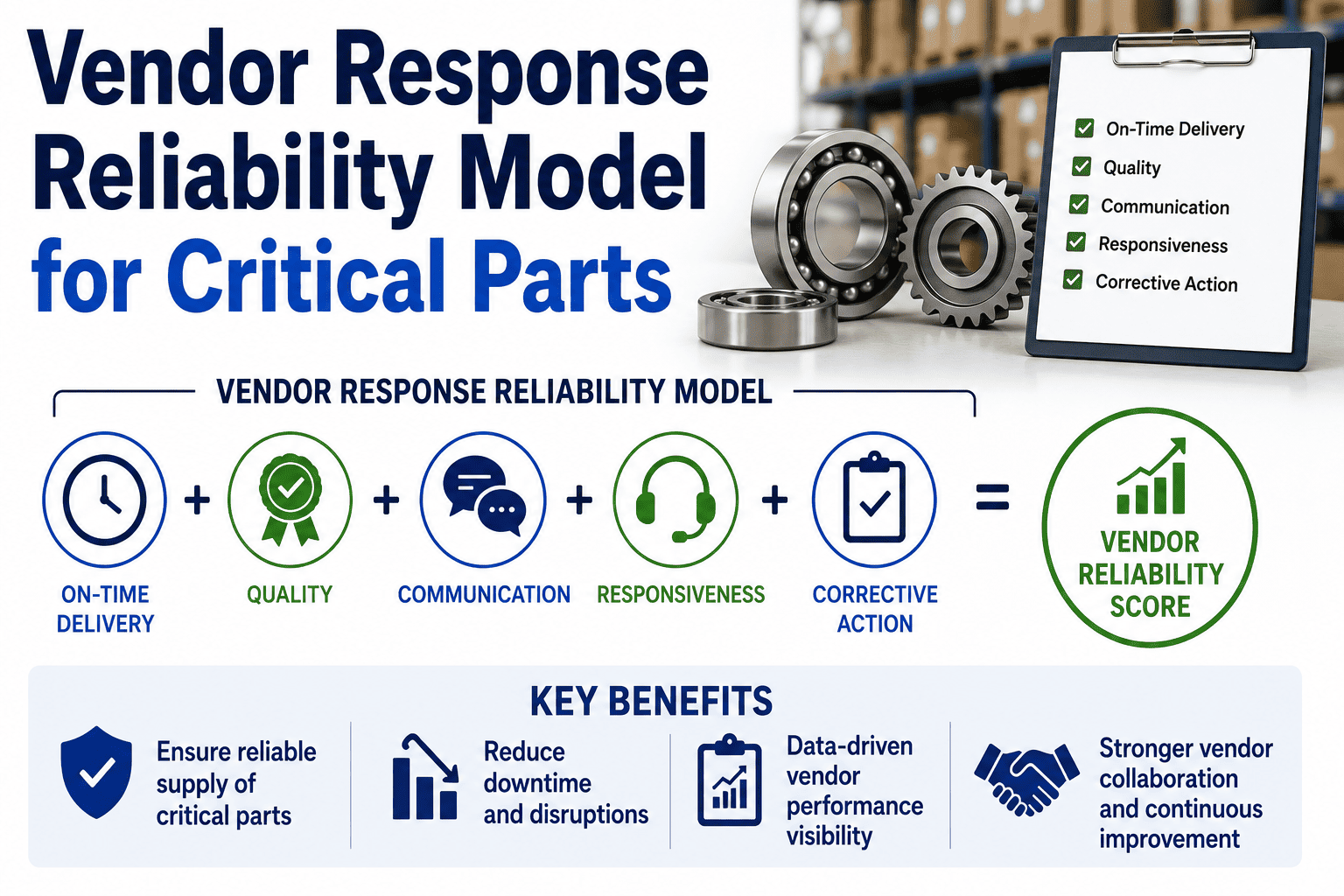
Vendor response reliability is one of the most underleveraged metrics in industrial procurement — yet it determines whether your maintenance team receives critical parts on time, whether escalation channels work under pressure, and whether your supply continuity holds when production cannot afford to wait. Facilities using Sign Up Free on OxMaint can build structured vendor scorecards, track delivery timing against work order urgency, and maintain document consistency records that reveal true partner reliability long before an urgent request exposes a weak link. When critical parts procurement is connected to a Book a Demo with OxMaint's CMMS, procurement gaps become visible before they become production stoppages.
Why a Vendor Response Reliability Model Protects Critical Parts Supply
When a motor fails mid-shift or a critical valve requires emergency replacement, procurement teams depend on vendor response reliability — not just catalog availability. A structured reliability model evaluates three measurable dimensions: delivery timing against committed lead times, escalation quality when orders fall behind, and document consistency across purchase orders, compliance certificates, and shipment confirmations. Without this model, Sign Up Free and discover how OxMaint connects vendor performance data to work order histories, so procurement decisions are driven by operational evidence rather than relationship preference.
Three Dimensions of a Vendor Response Reliability Model
A credible vendor response reliability model measures behavior across the full procurement cycle — from initial order acknowledgment through delivery, documentation, and exception handling. Each dimension generates a trackable score that compounds into a composite vendor reliability rating your procurement team can act on.
Delivery Timing and Lead-Time Spread
Delivery timing reliability measures how consistently a vendor fulfills orders within quoted lead times — and how wide the variance is across order types. Narrow lead-time spread signals a reliable fulfillment process. Wide spread signals capacity, logistics, or prioritization problems that your team discovers only when urgency is highest. OxMaint links purchase order records to work order due dates, surfacing lead-time spread data vendor by vendor.
Escalation Quality Under Urgent Requests
When a delivery falls behind on a critical part, escalation quality determines whether the delay is recovered or compounds into downtime. Escalation quality measures response speed to delay notifications, accuracy of updated delivery commitments, and follow-through against revised timelines. OxMaint's work order escalation tracking records these interactions against vendor records, building an evidence-based escalation quality score over time.
Document Consistency Across Order Cycles
Document consistency measures whether vendors deliver accurate purchase order confirmations, compliance certificates, inspection reports, and shipping documentation on every order — not just the first one. Inconsistent documentation creates receiving delays, compliance gaps, and receiving inspection failures that add hidden cost to every order. OxMaint's vendor asset records track document compliance rates alongside delivery performance to surface the true cost of document-inconsistent vendors.
Vendor Reliability Scoring by Critical Parts Category
Not all critical parts carry equal procurement risk. Reliability scoring requirements vary by lead time sensitivity, substitutability, and regulatory compliance burden. Use this category framework to prioritize which vendor relationships require a formal reliability model first.
| Parts Category | Lead-Time Sensitivity | Escalation Risk | Document Compliance Burden | OxMaint Procurement Action |
|---|---|---|---|---|
| Motor and Drive Components | Very High | High — OEM-specific parts | Medium — warranty certs required | Delivery timing work orders + vendor lead-time tracking |
| Hydraulic and Pneumatic Parts | High | High — few alternate sources | High — test certs and traceability | Document consistency records + escalation log PMs |
| Instrumentation and Control Parts | Very High | Very High — long alternate lead times | Very High — calibration certs and compliance | Compliance cert tracking + urgency-linked POs |
| Consumable Maintenance Parts | Medium | Low — multiple source options | Low — standard shipping docs | Lead-time spread monitoring + reorder point PMs |
| Safety and Regulatory Parts | High | Medium — compliance deadlines | Very High — certification and audit trail | Document audit work orders + regulatory compliance PMs |
Procurement Patterns That Expose Hidden Vendor Reliability Failures
Vendor reliability failures rarely announce themselves in isolation. They emerge as patterns across multiple orders — patterns that only become visible when procurement data is connected to maintenance execution records. Book a Demo to see how OxMaint surfaces these patterns before they become procurement crises. Four failure patterns consistently precede supply continuity breakdowns at facilities without a structured reliability model.
Building Your Vendor Response Reliability Model in OxMaint
Register Vendors as Supplier Assets with Parts Category Tags
Enter each vendor into OxMaint with parts category classifications, contract lead-time commitments, and primary escalation contacts. This creates the vendor record foundation that delivery timing, escalation, and document tracking depend on.
Link Purchase Orders to Work Order Urgency Levels
Configure OxMaint to attach purchase orders to the work orders that generate them, capturing the urgency level at the time of procurement. This creates the delivery timing baseline that vendor lead-time spread analysis requires.
Log Escalation Events Against Vendor Records
Record every escalation event — delay notification, vendor response, revised delivery commitment, and actual delivery — against the vendor's record in OxMaint. Escalation quality scoring emerges from this log over multiple order cycles.
Track Document Compliance at Goods Receipt
Configure OxMaint receiving inspection work orders to record document compliance status at goods receipt — flagging missing certificates, incorrect documentation, and recurring error types by vendor. Document error frequency becomes a scored reliability dimension.
Generate Vendor Reliability Reports for Contract Review
OxMaint's reporting dashboards compile delivery timing, escalation quality, and document consistency data into vendor reliability scorecards — providing the procurement evidence your team needs to renegotiate SLAs, diversify sources, or qualify alternative vendors before supply continuity is at risk.
Frequently Asked Questions: Vendor Response Reliability for Critical Parts
What is a vendor response reliability model?
A vendor response reliability model scores supplier performance across delivery timing, escalation quality, and document consistency — generating a composite reliability rating that procurement teams use to manage critical parts sourcing decisions and contract terms.
How does delivery timing reliability differ from on-time delivery rate?
On-time delivery rate measures whether orders arrive by the committed date. Delivery timing reliability also measures lead-time spread — how variable actual delivery times are across orders — which reveals fulfillment consistency that a simple on-time rate obscures.
Why does escalation quality matter for critical parts procurement?
For critical parts, a late delivery is only recoverable if the vendor escalation channel responds quickly with accurate revised commitments. Poor escalation quality converts a delay into unplanned downtime by removing the window to source an alternative before the maintenance deadline passes.
How does OxMaint support vendor response reliability tracking?
OxMaint connects purchase order records to work order urgency, logs escalation events against vendor records, and tracks document compliance at receiving inspection — generating vendor reliability scorecards from operational data rather than self-reported supplier metrics.
Which parts categories require the strictest vendor reliability scoring?
Instrumentation, control, and safety parts carry the highest reliability scoring requirements due to long alternate lead times, strict document compliance obligations, and the regulatory and operational consequences of delayed delivery in critical maintenance scenarios.
How often should vendor reliability scores be reviewed?
Quarterly reviews aligned with contract renewal cycles are the minimum. For high-urgency parts categories, monthly scoring reviews with automatic alerts for vendors whose delivery timing or escalation scores fall below threshold provide earlier intervention windows. Book a Demo to see how OxMaint automates vendor reliability alerts.


