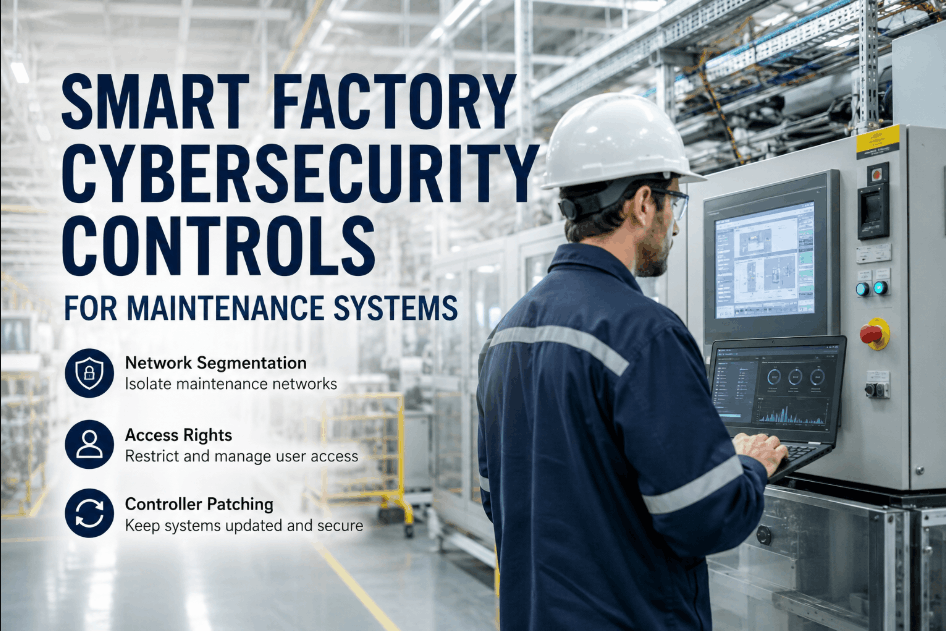
Smart factory cybersecurity failures rarely originate in corporate IT — they enter through the operational technology layer, where maintenance systems, controller interfaces, and remote access tools sit on networks that were designed for availability rather than security. When maintenance networks lack segmentation, access rights are shared across technicians and contractors without role-based controls, and controller patching cycles lag years behind the threat landscape, the attack surface of the smart factory becomes the maintenance system itself. Organizations securing industrial operations using Sign Up Free on OxMaint can enforce role-based access controls on maintenance work orders, log technician activity against specific assets, and maintain structured records of system configuration changes — building the access governance and audit trail that OT security frameworks require without disrupting the maintenance workflows that keep production running.
Why Maintenance Systems Are a Smart Factory Cybersecurity Vulnerability
Maintenance access to smart factory systems is operationally necessary and cybersecurity-relevant in equal measure. Technicians require connectivity to PLCs, controllers, and SCADA interfaces to diagnose faults and execute repairs — and that same connectivity, if uncontrolled, provides an attack path from maintenance networks into production control systems. Without network segmentation between maintenance and control layers, role-differentiated access rights, and structured logging of who accessed what system and when, the maintenance function becomes the factory's largest unmanaged attack surface. Book a Demo to see how OxMaint's work order management and access control tools give maintenance teams structured, auditable access governance without compromising operational speed.
Six Cybersecurity Controls for Smart Factory Maintenance Systems
Securing smart factory maintenance systems requires layered controls across network architecture, access governance, device hardening, and audit trail management. Each control layer must be implementable without disabling the maintenance workflows that depend on system access to execute production-critical work. Sign Up Free to build the access governance and activity logging foundation in OxMaint that OT security controls require to be enforceable across maintenance teams, shifts, and contractor access events.
Maintenance Network Segmentation from Production Control Systems
Maintenance networks must be architecturally separated from production control networks through firewall rules, VLANs, and unidirectional data diodes where applicable. OxMaint operates as a maintenance management system within the maintenance network tier — providing work order data, asset records, and procedure documentation without requiring direct connectivity between maintenance interfaces and production PLC or SCADA layers.
Role-Based Access Rights Tied to Work Order Assignments
Maintenance system access rights should be scoped to the specific asset, system, and task covered by an active work order — not granted as standing permissions for all systems at all times. OxMaint's role-based access controls allow maintenance managers to assign technician permissions at the work order level — ensuring access is purposeful, time-bounded, and revoked automatically when the work order closes.
Contractor Access Governance and Third-Party Session Controls
Contractor maintenance access represents the highest-risk access category in most smart factory environments — temporary credentials, unfamiliar systems, and limited accountability without formal session controls. OxMaint's contractor work order records and access logging ensure third-party maintenance activity is authorized against a specific work order, documented, and reviewable after each access event without relying on contractor self-reporting.
Controller and Device Patching Schedule Management
Industrial controller firmware and embedded device software require structured patching cycles that balance security vulnerability remediation against production uptime constraints. OxMaint's PM scheduling tools can manage controller patching as a recurring maintenance task — tracking patch status by device, linking patch windows to planned shutdown schedules, and creating audit records of patch completion that OT security governance programs require.
Configuration Change Management and Audit Trail
Unauthorized or undocumented configuration changes to controllers and maintenance interfaces are both a reliability risk and a security indicator. OxMaint's change management records capture who authorized, who executed, and what was changed for every configuration modification — creating the audit trail that security incident investigations and compliance audits require to reconstruct the timeline of system changes before and after an anomalous event.
Mobile Device and Field Access Security for Maintenance Technicians
Technicians accessing OxMaint work orders on mobile devices in the plant introduce device-level security risks that must be governed through MDM enrollment, screen lock enforcement, and network access policies. OxMaint's mobile platform supports controlled deployment configurations that keep field maintenance access productive while ensuring device access policies required by OT security frameworks are applied consistently across all field endpoints.
Cybersecurity Controls by Maintenance System Risk Layer
Different maintenance system interfaces carry different threat exposure profiles and require differentiated controls. A patch management approach appropriate for a CMMS mobile app is insufficient for a PLC configuration interface — and a segmentation strategy that works for remote monitoring will not address the risks of on-machine controller access during shutdown windows. Book a Demo to explore how OxMaint supports smart factory cybersecurity governance across the maintenance system access layers most frequently targeted in OT security incidents.
| Maintenance System Layer | Primary Threat Vector | Key Control Requirement | Incident Impact if Breached | OxMaint Security Lever |
|---|---|---|---|---|
| CMMS and Work Order Platform | Credential theft, unauthorized access | Role-based access + MFA | Maintenance data exposure, false work orders | Role-scoped permissions + access audit log |
| Remote Diagnostic Interfaces | Unsecured VPN, credential sharing | Session logging + time-limited access | Lateral movement to control systems | Work order-bounded access + contractor log |
| PLC and Controller Configuration | Unauthorized parameter changes | Change management + dual authorization | Process disruption, safety event | Configuration change records in OxMaint |
| Mobile Field Maintenance Devices | Lost device, unsecured network access | MDM enrollment + network policy | Credential exposure, CMMS data breach | Controlled OxMaint mobile deployment |
| Condition Monitoring Sensors | Firmware vulnerabilities, spoofed data | Firmware patching schedule | False condition data, missed failure alerts | Sensor patch tracking as PM task in OxMaint |
How Weak Maintenance Access Controls Compound OT Security Risk
Maintenance access controls that are too permissive accumulate security debt quietly — through shared credentials, standing remote access sessions, undocumented contractor connections, and configuration changes that are never formally recorded. Each gap is individually exploitable and collectively represents a systemic vulnerability that OT security assessments consistently identify as the primary attack pathway into production control environments. OxMaint provides the access governance and documentation discipline that closes these gaps without requiring maintenance teams to work around security controls that create operational friction. Sign Up Free to establish the role-based access, audit trail, and configuration change management practices that smart factory cybersecurity requires within your maintenance operations.
Implementing Smart Factory Cybersecurity Controls with OxMaint
Segment Maintenance Network and Define OxMaint Access Boundaries
Establish network segmentation between maintenance and production control layers. Define OxMaint as the authorized maintenance management interface operating within the maintenance network — ensuring technician access to work orders, asset records, and procedures does not require direct connectivity to production control systems.
Configure Role-Based Access Controls in OxMaint by Technician and Asset
Define technician roles in OxMaint that scope system access to the asset classes, work order types, and data fields each role requires. Restrict contractor access to specific work order assignments — preventing field access to asset records, historical data, or configurations beyond the scope of the active maintenance task.
Establish Controller Patching as a Recurring PM Task
Create preventive maintenance tasks in OxMaint for controller firmware and embedded device patching — scheduled against planned shutdown windows where production impact is minimized. Use OxMaint work order completion records as the patch compliance audit trail required by OT security governance frameworks.
Implement Change Management Workflow for All Configuration Modifications
Define change management approval workflows in OxMaint that require authorization, documentation, and post-change verification for every controller configuration modification, parameter change, and device setting update. Link configuration change records to the specific assets they affect — creating a complete change history retrievable in any future security audit or incident investigation.
Review Access Logs and Audit Records Each Period Against Security Policy
Review OxMaint access logs, contractor work order records, and configuration change histories monthly against defined OT security policies. Identify access anomalies — off-hours logins, access to assets outside active work orders, undocumented configuration changes — and escalate for investigation before isolated incidents indicate systematic access control failure.
Frequently Asked Questions: Smart Factory Cybersecurity for Maintenance Systems
Why are maintenance systems a cybersecurity risk in smart factories?
Maintenance systems require connectivity to production assets, controllers, and diagnostic interfaces — the same pathways attackers use to reach OT environments. Without access governance, segmentation, and audit logging, maintenance access represents the most common uncontrolled entry point into smart factory control networks.
What is OT network segmentation and why does it matter for maintenance?
OT network segmentation separates maintenance interfaces from production control systems so that a compromised maintenance credential cannot directly access PLCs or SCADA systems. It is the foundational control that limits blast radius when a maintenance network security incident occurs.
How does OxMaint support smart factory cybersecurity compliance?
OxMaint provides role-based access controls, work order-bounded permissions, contractor activity records, configuration change audit trails, and controller patch tracking — the maintenance system governance records required by OT security frameworks including IEC 62443 and NIST SP 800-82.
How should controller patching be managed in a smart factory?
Controller patching should be scheduled as a recurring preventive maintenance task in OxMaint — aligned to planned shutdown windows to minimize production impact. Work order completion records provide the patch compliance audit trail that OT security governance and regulatory audits require.
What access controls should apply to contractor maintenance teams?
Contractor access should be scoped to specific work order assignments in OxMaint, time-bounded to the engagement period, logged against the assets accessed, and formally closed when the work order is completed — preventing the standing credential accumulation that third-party access management reviews consistently identify as a primary OT security gap.