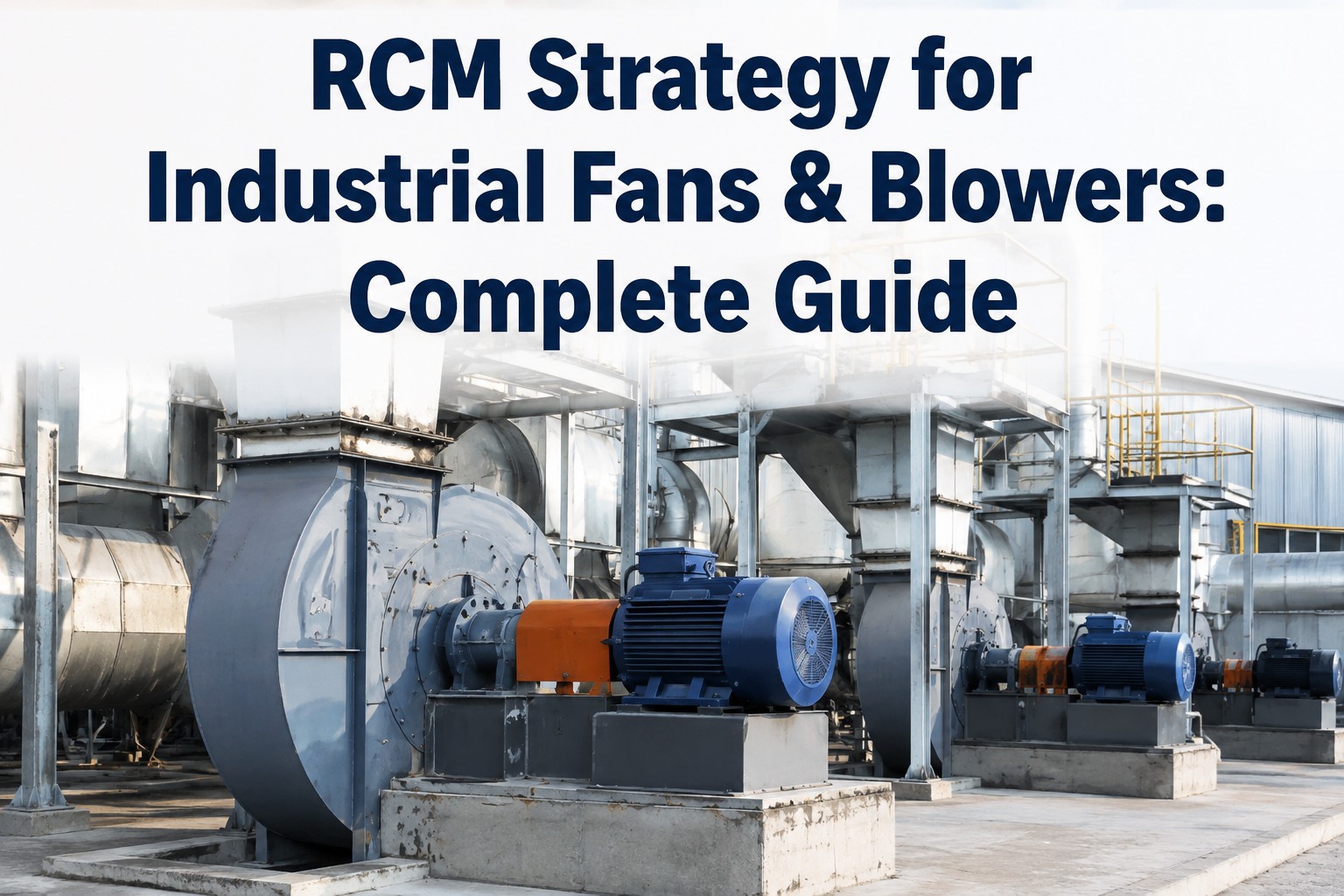
An industrial fan rarely dies without warning — it drifts. A bearing that carries a faint high-frequency signature today becomes a seized shaft and a stopped extraction line in six weeks, and most plants only notice once the noise is audible from the next bay. That drift is exactly what Reliability-Centered Maintenance is built to catch. RCM replaces calendar-based routines with a disciplined method: define what the fan must do, identify how it fails, judge the consequence of each failure, and assign the one maintenance task that actually addresses it. Done right on ID fans, FD fans, exhaust blowers, and process-air units, RCM cuts unplanned downtime while removing wasteful over-maintenance. This guide walks the full strategy — the seven SAE JA1011 questions, the failure modes specific to fans and blowers, the four task strategies, criticality ranking, and how a live condition-monitoring overlay keeps the analysis working instead of gathering dust in a binder. Book a live RCM demo against your own fan and blower assets.
JA1011
SAE standard defining a true RCM process — seven questions per asset
4 tasks
Every failure mode routes to one of four strategies by pattern and consequence
30–50%
Typical unplanned-downtime reduction when RCM drives condition-based tasks
Weeks
Warning vibration gives before bearing failure — the window RCM is designed to use
The Seven Questions · RCM Logic Applied to a Fan
SAE JA1011 defines what makes an analysis genuinely RCM: seven questions answered for each asset. Skip even one and the technical integrity of the program breaks. Here's how they read for an induced-draft fan.
Q1
Functions & performance standards
Move combustion air at the required flow and pressure, run stably, stay within vibration and temperature limits.
Q2
Functional failures
Fails to start, fails to reach speed, fails to hold airflow, or runs with unstable vibration.
Q3
Failure modes
Bearing damage, imbalance from impeller buildup, belt degradation, misalignment, motor winding issues, loose base bolts, damper faults.
Q4
Failure effects
What actually happens — airflow loss, secondary shaft damage, line stoppage, or a housing-destroying unbalance event.
Q5
Failure consequences
Safety, environmental, operational, or non-operational — this is what decides how much the failure is worth preventing.
Q6
Proactive task
The task that predicts or prevents the mode — vibration analysis for bearings, balancing for buildup, alignment checks for coupling.
Q7
Default action if no effective proactive task exists
Redesign, a scheduled failure-finding task for hidden functions, or a deliberate run-to-failure decision — chosen consciously, not by neglect.
Fan & Blower Failure Modes · The FMEA That Drives Everything
FMEA is the analytical engine inside RCM — it answers how the asset fails and what each failure causes. For fans and blowers, a handful of modes account for most downtime. The key column is detectability: whether the mode gives enough warning for a condition-based task to work.
Failure Mode
Consequence
Detectable Early?
Best Task
Bearing wear
Line stops; secondary shaft damage
Yes — weeks of warning
Vibration analysis
Imbalance (impeller buildup)
Vibration; can destroy housing
Yes — immediately obvious
Vibration + cleaning / balancing
Misalignment
Accelerated bearing & coupling wear
Yes — vibration signature
Alignment check on-condition
Belt / coupling degradation
Airflow loss; drive failure
Yes — inspection & vibration
Scheduled inspection / restoration
Motor winding fault
Immediate power loss; fire risk
Often sudden
Thermography / current + scheduled
Looseness (base bolts)
Compounds into bearing wear
Yes — vibration & visual
Inspection + torque restoration
See RCM Live on Your Fan Fleet in 30 Minutes
Working session with our reliability team — bring your fan and blower asset list. We'll rank them by criticality, map failure modes to tasks, and show how OxMaint auto-generates PM and condition-based work orders from vibration and thermal triggers.
The Four Task Strategies · Where Each Failure Mode Lands
The RCM logic tree routes every failure mode to one of four maintenance strategies, chosen by failure pattern and consequence. Matching the mode to the right strategy is the whole point — it's why RCM beats a flat PM schedule.
On-Condition
Predictive / Condition-Based
For modes with a detectable P-F interval. Vibration, thermal, or current trending catches the failure between potential and functional — the primary strategy for fan bearings and imbalance.
Scheduled Restoration
Time / Usage-Based
Restore or replace at a fixed interval before the wear-out point, used when a mode is age-related and predictable — belt replacement, coupling refresh, bolt re-torque.
Failure-Finding
Hidden-Function Check
Periodic tests for functions you can't see fail — dampers, protective interlocks, standby fans in smoke/purge duty — so a hidden failure doesn't surface only during a real demand.
Run-to-Failure
Deliberate Acceptance
A conscious choice for low-consequence, non-critical modes where prevention costs more than the failure — a utility fan in a secondary area, not the ID fan on the process heater.
Criticality Ranking · Not Every Fan Deserves the Same Analysis
RCM analysis is time-intensive, so it's spent where consequences justify it. The same exhaust fan is a run-to-failure asset supporting a restroom and a fully-analyzed critical asset in a smoke-purge system. Rank first, then invest the analysis depth accordingly.
CRITICAL
Production & Safety Fans
ID/FD fans on process heaters, extraction on continuous lines, smoke/purge units. Failure halts output or creates a safety hazard — full seven-question RCM plus condition monitoring.
IMPORTANT
Support & Process-Air Blowers
Fans with redundancy or a tolerable short outage. Targeted FMEA on the dominant modes, condition-based tasks on bearings, scheduled restoration on drives.
NON-CRITICAL
Utility & Comfort Fans
Low-consequence units where a short outage is a non-event. Simple inspection or a deliberate run-to-failure decision — no analysis overhead required.
The AI Overlay · Keeping the Analysis Alive
An RCM study is only valuable if it stays current. The failure mode that ranked "detectable weeks ahead" only helps if something is actually watching the vibration trend. This is where a live CMMS overlay turns a static study into an operating discipline.
Sensors Trend the Modes
IoT vibration and thermal sensors watch exactly the parameters the FMEA flagged as detectable — bearing frequencies, imbalance, hotspots.
Thresholds Fire Work Orders
When a reading breaches its limit, the system auto-generates a work order linked to the specific predicted failure mode — with the right parts and procedure staged.
Findings Feed Back
When technicians close the work order, measured findings return to the failure history — keeping the RCM analysis live and improving it over time, not archiving it.
How OxMaint Runs RCM for Fans & Blowers
OxMaint embeds RCM directly into maintenance execution — failure-mode libraries in the asset record, criticality scoring that drives task selection, condition-monitoring triggers, and auto-generated work orders at RCM-defined intervals, with audit-ready reliability reporting for ISO 55000 and internal programs.
FMEA
Live Failure-Mode Libraries
Fan and blower failure modes loaded into each asset record, linked to work-order templates and condition triggers — not stranded in a spreadsheet.
Criticality
Consequence-Driven Scoring
Rank and color-code every fan by operational criticality, so PM strategy selection follows risk instead of a flat calendar.
Condition
IoT & Vibration Triggers
SCADA, PLC, and sensor data convert vibration spikes and thermal alerts into prioritized work orders automatically — the P-F window put to use.
Work Orders
Auto-Generated by Interval
PM and condition-based tasks fire at RCM-defined intervals with parts and procedures staged — mobile-first for technicians in the field.
Feedback
Living Failure History
Closed-work-order findings feed back into the failure record, keeping the analysis current and continuously improving.
Reporting
Audit-Ready Reliability
Analytics dashboards for planners and reliability directors, with reports aligned to ISO 55000 and internal reliability programs.
Stop Maintaining Fans by Calendar. Start Maintaining by Risk.
Replace spreadsheet RCM with a live program that ranks criticality, maps failure modes to tasks, and turns vibration data into work orders before the fan fails. See OxMaint on your own assets. Free forever plan available.
Frequently Asked Questions
What is RCM and how is it different from preventive maintenance?
Reliability-Centered Maintenance is a structured framework that identifies the minimum, most effective maintenance tasks needed to keep an asset performing its function. Unlike a flat preventive-maintenance calendar, RCM drives every task from a specific failure mode and its consequence. A standard PM schedule might grease a fan bearing every month regardless of condition; RCM prescribes monthly vibration monitoring only because the failure mode's potential-to-functional interval allows it. The task is matched to the failure mode, operating context, and consequence — which is why RCM removes both unplanned failures and wasteful over-maintenance.
Book a demo to see it on your fans.
What are the main failure modes for industrial fans and blowers?
The dominant modes are bearing wear, imbalance from impeller buildup, misalignment, belt or coupling degradation, motor winding faults, and mechanical looseness such as loose base bolts. Most of these are detectable early through vibration analysis — bearing wear typically shows weeks of warning, and imbalance is often immediately obvious in the vibration signature. Motor winding faults are the exception, since they can occur suddenly with little warning, so they lean on thermography, current monitoring, and scheduled tasks rather than condition-based prediction alone.
What are the four RCM maintenance task strategies?
On-condition (predictive) tasks use vibration, thermal, or current trending to catch a failure in its detectable P-F interval — the primary strategy for fan bearings and imbalance. Scheduled restoration replaces or restores a component at a fixed interval before wear-out, suited to age-related modes like belts and couplings. Failure-finding tasks periodically test hidden functions — dampers, interlocks, standby fans — so a concealed failure doesn't surface only during a real demand. Run-to-failure is a deliberate choice for low-consequence modes where prevention costs more than the failure itself. The RCM logic tree routes each mode to the right one by pattern and consequence.
Do all fans need a full RCM analysis?
No — and that's a feature, not a shortcut. RCM analysis is time-intensive, so it's spent where failure consequences justify it. The same make and model of exhaust fan warrants full seven-question analysis in a smoke-purge system but only a simple inspection or a deliberate run-to-failure decision supporting a restroom. Rank your fans by criticality first, then match the depth of analysis to the consequence: critical production and safety fans get the full treatment plus condition monitoring, while non-critical utility fans get a light touch.
Sign up free to rank your fan fleet.
How does OxMaint support an RCM program for fans and blowers?
OxMaint embeds RCM into execution: failure-mode libraries live in each asset record linked to work-order templates and condition triggers, criticality scoring drives PM strategy selection, and IoT, SCADA, and vibration data auto-convert threshold breaches into prioritized work orders tied to the predicted failure mode. Tasks fire at RCM-defined intervals with parts staged, technicians close them mobile-first, and their findings feed back into a living failure history that keeps the analysis current. Reliability dashboards and ISO 55000-aligned reporting give planners and directors an audit-ready view. A free forever plan is available to trial the full workflow.