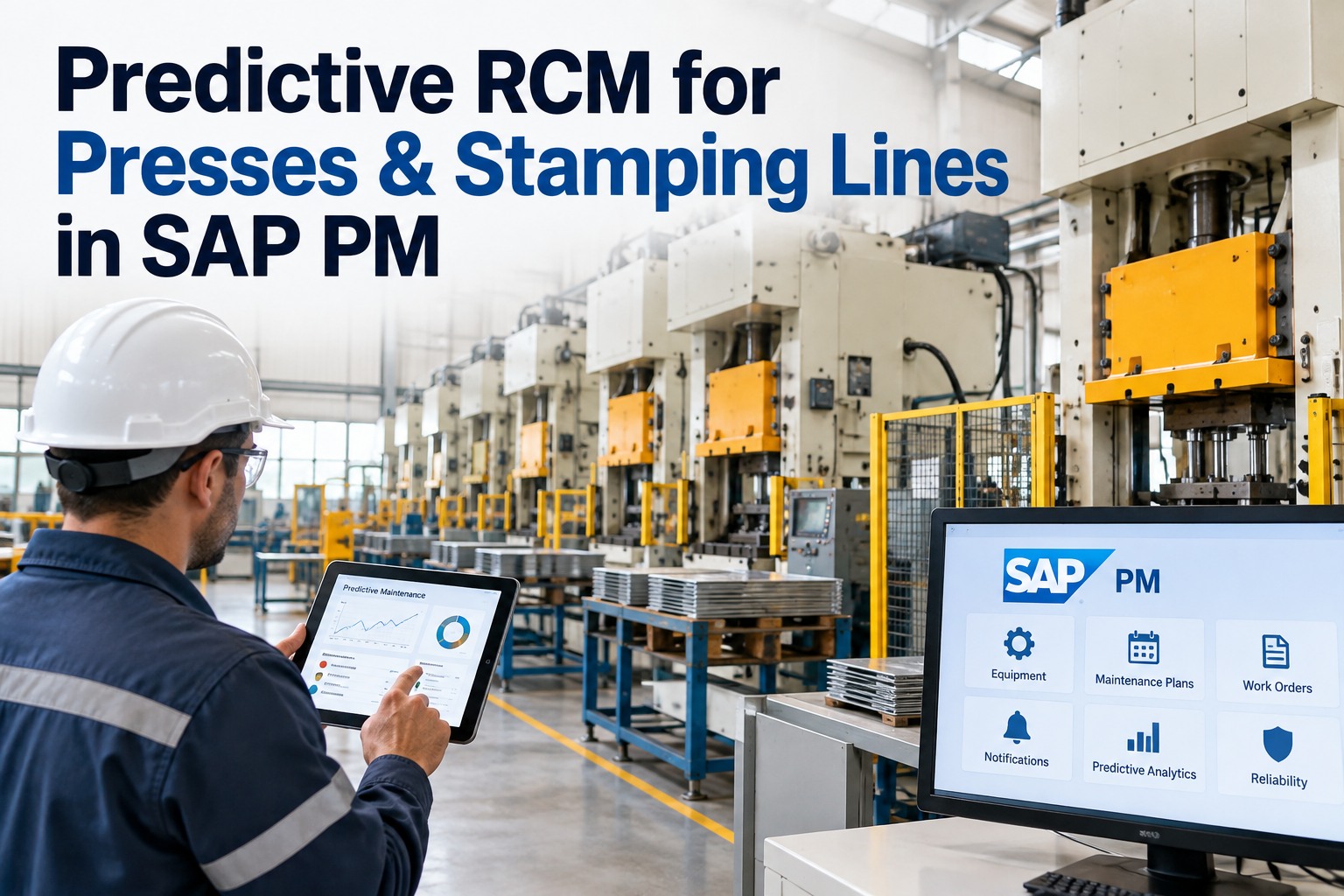
Nobody rips out SAP PM. It's the system of record — the place work orders, notifications, functional locations and cost postings live, and the place finance and audit trust. The problem isn't SAP PM; it's what SAP PM was never built to do: watch a press's vibration signature in real time, learn a stamping line's failure patterns, and decide on its own that a ram bearing is three days from failure. That's predictive RCM, and bolting it into SAP through custom development is exactly the multi-year project most reliability teams can't get funded. The modern move is an overlay — a thin AI-native layer that sits on top of SAP PM, does the prediction SAP can't, and writes finished work orders back into SAP where they belong. This guide shows how that architecture works for presses & stamping lines, and how OxMaint's maintenance management software becomes the reliability brain on top of your existing SAP backbone. Start free or book a demo.
Manufacturing · Presses & Stamping · Predictive RCM × SAP PM · 2026
Predictive RCM for Presses & Stamping Lines — Layered on SAP PM
Keep SAP PM as your system of record. Add an AI-native reliability layer on top that predicts press and stamping failures and writes finished work orders back into SAP — no rip-and-replace, no migration project.
The overlay architecture — at a glance
Reliability Layer
OxMaint — Predictive RCM & AI
Continuous RCM · live FMEA · condition monitoring · failure prediction
▲ predictions in · work orders down ▼
System of Record
SAP PM — unchanged
Work orders · functional locations · cost postings · audit trail
Signal Layer
Presses & stamping lines — IoT & vibration
Why SAP PM Alone Can't Do Predictive RCM
SAP PM is superb at recording and costing maintenance — and not designed to predict it. That's not a flaw; it's a scope boundary. These are the four gaps an AI-native overlay fills without touching the SAP core. Sign up free and OxMaint closes all four on top of your existing SAP.
Static PM, not condition-based
SAP fires PMs on a calendar or counter. A press bearing degrading faster than schedule fails anyway; one degrading slower gets serviced needlessly.
No live signal ingestion
Vibration, tonnage, die-temperature and current data have nowhere native to live in SAP PM, so the earliest failure signals never reach it.
RCM lives in spreadsheets
Failure modes and criticality sit in offline files that go stale the day they're saved — disconnected from the work SAP actually schedules.
Reacts, doesn't forecast
A notification is usually raised after something breaks. There's no engine turning a drifting signal into a work order before the line stops.
The Data Round-Trip: Signal to SAP Work Order
The overlay earns its place by closing a loop SAP can't close alone — from a raw press signal to a costed, closed SAP work order. Here's the round-trip, step by step. Book a demo to trace it on your lines.
1
Signal captured
Vibration, tonnage and current stream off the press and stamping line into the OxMaint layer.
▼
2
RCM model reads it
Live FMEA and criticality flag the pattern as a known degrading failure mode on a critical asset.
▼
3
Prediction raised
The engine forecasts time-to-failure and decides intervention is needed before the next production window.
▼
4
Work order written to SAP
A finished WO — asset, functional location, task, parts — posts into SAP PM automatically, in SAP's own structure.
▼
5
Executed & closed in SAP
Planner schedules, technician executes on mobile, costs post to SAP — the system of record stays whole.
You Don't Replace SAP. You Give It a Reliability Brain.
The fear with any new maintenance tool is a rip-and-replace that upends finance, audit and every trained planner. The overlay model removes that fear entirely: SAP PM stays the system of record, untouched. OxMaint adds only what SAP was never meant to do — read the signal, run the RCM, make the prediction — and hands the result back as a native SAP work order. Nobody re-learns SAP. The line just stops surprising you.
Press & Stamping Failure Modes the Overlay Predicts
Presses and stamping lines fail in patterns that show up in data long before the line stops — the exact patterns a calendar PM misses and a condition-based overlay catches. Start free and put these under watch.
Ram / slide bearing wear
Vibration & harmonic drift
Clutch & brake degradation
Stopping-time & temperature creep
Die & tooling wear
Tonnage signature shift, burr rate
Lubrication starvation
Oil pressure & temperature trend
Crankshaft / gib misalignment
Load imbalance across the bed
Feed & straightener faults
Servo current variance, mis-feed rate
SAP PM Alone vs. SAP PM + OxMaint Overlay
Same system of record, same planners, same audit trail — plus the reliability layer that changes what SAP can act on. Here's what the overlay adds. Book a demo to see it on your SAP.
How OxMaint Sits on Top of SAP PM
The overlay is a set of capabilities that plug into your SAP backbone rather than compete with it. Here's what does the work. Sign up free to layer it on.
Bi-Directional SAP PM Sync
Reads functional locations and assets from SAP; writes predicted work orders back into it — SAP stays the source of truth.
Continuous RCM & Live FMEA
Failure modes and criticality for every press and line stay current and drive the predictions — no stale spreadsheet.
Condition & Vibration Monitoring
Ingests IoT streams SAP can't hold, turning ram, clutch and tooling signals into the earliest failure warning.
Predictive Work-Order Engine
Converts a drifting signal into a finished, costed SAP work order before the line stops — the whole point of the overlay.
Mobile Technician Execution
Technicians see the SAP work order, history and parts on the phone at the press and close it cleanly back to SAP.
ISO 55000 Reliability Reporting
Audit-ready reliability and RCM reports layered over SAP data, for internal programs and external audit alike.
"
The mandate was absolute: SAP PM does not move. Corporate runs global maintenance costing through it and no plant gets to fork that. So every "predictive maintenance" pitch that meant replacing SAP was dead on arrival. The overlay approach was the first one that survived the room — SAP stays exactly as it is, and OxMaint just feeds it smarter work orders. We connected vibration on our two big transfer presses, and within a month it wrote a ram-bearing work order into SAP a week before we'd have felt anything on the floor. Planners scheduled it in SAP like any other job. Nobody had to learn a new system. That's why it got approved.
Reliability Director · Global Automotive Stamping Group
Frequently Asked Questions
Does adding OxMaint mean replacing SAP PM?
No. SAP PM stays your system of record, unchanged. OxMaint is an overlay that adds prediction and condition monitoring SAP wasn't built for, then writes finished work orders back into SAP in its own structure.
Why can't SAP PM do predictive RCM on its own?
SAP PM triggers maintenance on calendars and counters and has no native home for live vibration or tonnage data. Predicting a specific failure from those signals is a different capability — exactly what the overlay layer provides.
How do predicted work orders get into SAP?
The overlay writes a complete work order — asset, functional location, task and parts — directly into SAP PM through bi-directional sync, so planners schedule and cost it in SAP exactly like any other job.
Which press and stamping failures can it predict?
Ram and slide bearing wear, clutch and brake degradation, die and tooling wear, lubrication starvation, crankshaft misalignment and feed faults — each has a data signature that appears before the line stops.
How long does the overlay take to stand up?
Because there's no SAP migration, an overlay on a set of critical presses can go live in weeks — you connect signals and the SAP sync, not rebuild the maintenance backbone.
Sign up free to start.
Keep SAP PM. Add the Prediction It Was Never Built For.
Layer AI-native predictive RCM on top of SAP PM for your presses and stamping lines — live condition monitoring, real failure prediction, and finished work orders written straight back into SAP. No rip-and-replace, live in weeks. Start free — no credit card, unlimited users, forever. Or book a demo.