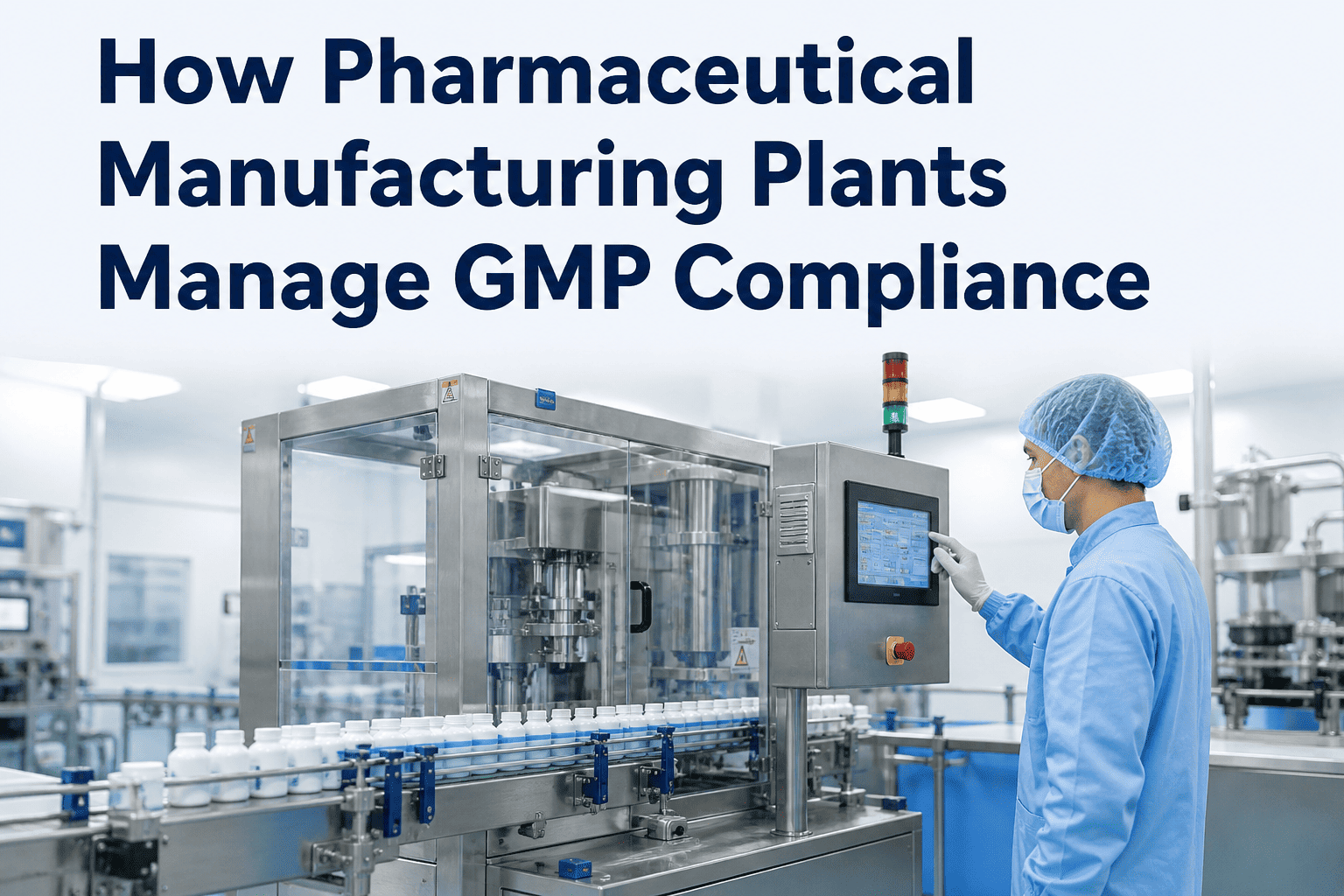
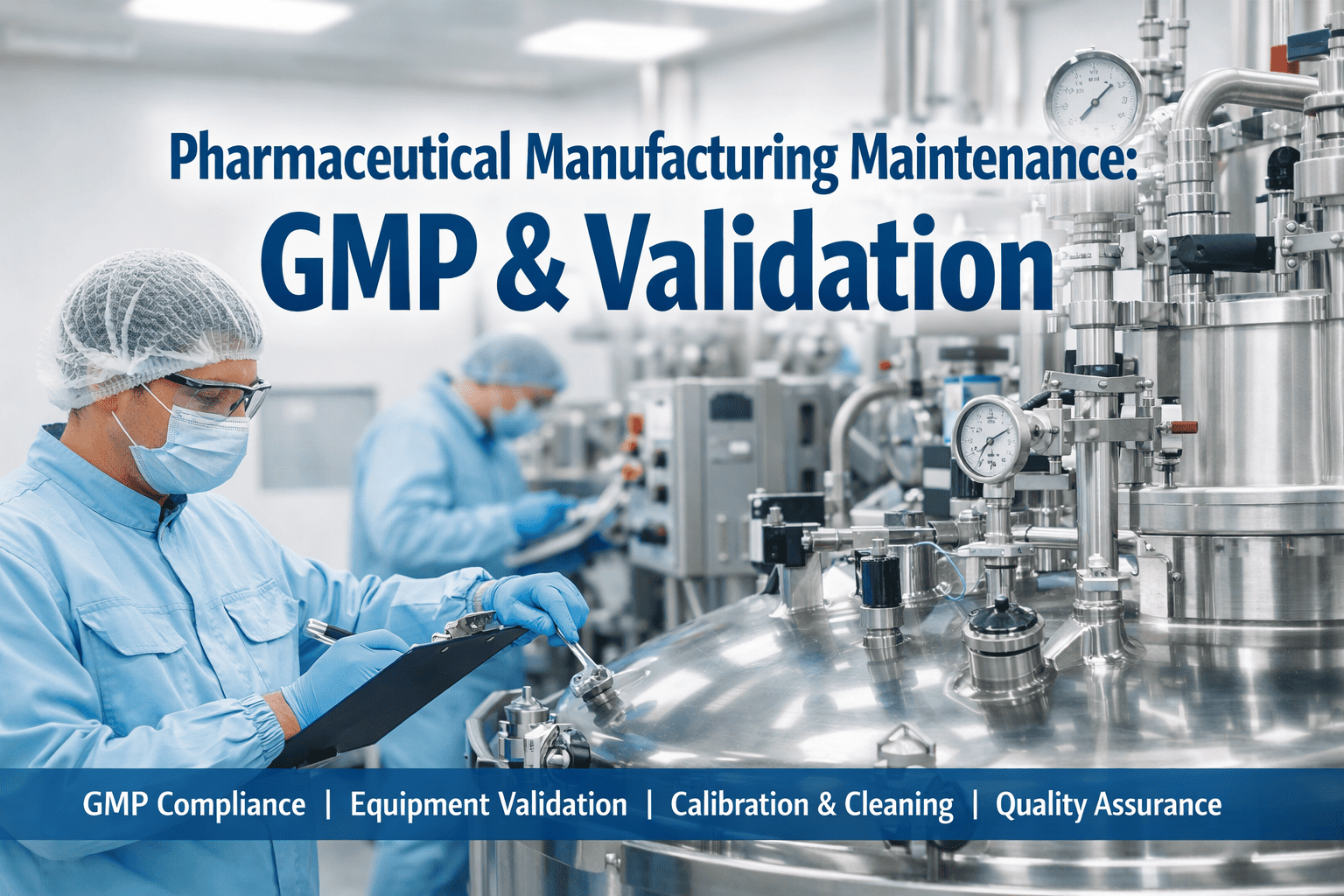
Pharmaceutical manufacturing maintenance operates under GMP rules that no other industry faces — every work order, calibration, and cleanroom intervention needs a fully documented, audit-ready trail. A GMP-compliant CMMS for pharma manufacturing plants ties equipment qualification records, change control, cleaning validation, and 21 CFR Part 11 e-signatures into one validated system so you can survive an FDA inspection without last-minute overtime. This pharmaceutical maintenance guide covers how to configure a pharma plant CMMS that keeps compliance air-tight while cutting unplanned downtime. You can explore the full platform with a Start Free Trial or book a personalized walkthrough below.
GMP CMMS for Pharma Plants
Can your maintenance records survive an FDA inspection tomorrow?
Pharma manufacturing plants lose an average of 240 hours per audit pulling paper records, recalibrating logs, and reconciling spreadsheets. A validated GMP CMMS turns that into a 15-minute query — with 21 CFR Part 11 e-signatures, equipment qualification links, and change control baked into every work order.
Why Pharma Maintenance Is Different
What makes GMP maintenance manufacturing uniquely demanding
In a typical factory, a missed PM is a reliability problem. In pharmaceutical manufacturing maintenance, a missed PM on a validated HVAC system, autoclave, or tablet press is a compliance violation that can shut down a production line and trigger a product recall. Every maintenance action — from a filter replacement to a full equipment requalification — must be traceable, time-stamped, electronically signed, and linked to the original qualification protocol.
Equipment qualification links (IQ/OQ/PQ)
Every asset in a pharma plant carries an Installation, Operational, and Performance Qualification record. A GMP CMMS must link each work order back to the qualification document so inspectors can trace any maintenance activity to the validated state of the equipment — no disconnected spreadsheets.
21 CFR Part 11 electronic signatures
Paper logbooks don't survive modern audits. A pharma manufacturing CMMS must enforce dual e-signatures (doer + verifier), audit trails that cannot be altered, and secure role-based access — all meeting 21 CFR Part 11 and EU Annex 11 requirements for electronic records.
Change control on every maintenance action
Replacing a gasket on a bioreactor isn't just a work order — it's a change that must be evaluated, approved, and documented through formal change control before execution. GMP plant maintenance software integrates change control workflows directly into the PM schedule so nothing slips.
Cleaning validation and environmental monitoring ties
Cleanroom maintenance schedules must align with cleaning validation cycles and environmental monitoring data. A pharmaceutical GMP CMMS triggers filter changes, surface decontamination, and particle-count sensor calibration based on validated intervals — not guesswork.
Worked Example
The real cost of paper-based pharma plant maintenance
Consider a mid-size sterile injectables facility running 320 validated assets — filling lines, lyophilizers, clean-in-place systems, and graded HVAC. They tracked PMs on paper logbooks and spreadsheets, with a dedicated QA-maintenance liaison spending 30+ hours per week reconciling records. During a pre-approval inspection, the team spent four days pulling calibration certificates for a single isolator because the PM record referenced a superseded SOP number.
QA liaison hours, audit prep overtime, paper storage, and 2 production days lost to inspection delays
Automated audit trails, instant record retrieval, and QA liaison reallocated to exception review only
Down from 96 hours — any asset's full maintenance history is one query away with linked qualifications
Drop in documentation-related observations after implementing e-signature workflows and automated PM triggers
That $107K annual saving doesn't even count the avoided cost of a single warning letter — which can halt product release for 6–12 months and cost $10M–$50M in lost revenue depending on the product portfolio.
How OxMaint Helps
How OxMaint configures a GMP-compliant pharma CMMS
OxMaint is built to handle the documentation density that pharmaceutical manufacturing demands. Every work order, PM trigger, and asset record is designed to serve as compliance evidence — not just an operational task. Here is how OxMaint maps directly to the four pillars of GMP maintenance:
Validated e-signature workflows
Every work order closure requires dual electronic signatures — technician and QA verifier — with tamper-proof audit trails meeting 21 CFR Part 11 and EU Annex 11. Outcome: eliminate paper logbooks and cut record-retrieval time from hours to seconds during inspections.
Asset-to-qualification linking
Each asset record stores IQ/OQ/PQ protocol numbers, requalification intervals, and calibration certificates — all searchable and linked to every PM and corrective work order. Outcome: any inspector question answered in under 2 minutes with full traceability.
Change control built into PM schedules
Maintenance actions that alter a validated state automatically route through a change control approval queue before execution — with impact assessment fields and QA sign-off. Outcome: zero unauthorized changes to validated equipment, cutting deviation rate by 40–60%.
Predictive maintenance on critical assets
AI-driven vibration, temperature, and pressure analytics predict failures on fillers, centrifuges, and HVAC 2–6 weeks in advance — so you schedule interventions during planned outages, not mid-batch. Outcome: cut unplanned downtime 30–50% and protect batch yield.
Implementation Roadmap
How to deploy a GMP CMMS in a pharma plant in 90 days
Pharma facilities often fear that CMMS validation will take a year and cost more than the software itself. OxMaint's pre-validated configuration templates and IQ/OQ documentation packages shorten the path from kickoff to go-live to a single quarter — without cutting compliance corners.
Month 1 — Asset hierarchy & qualification import
Load all validated assets, link IQ/OQ/PQ documents, import existing PM schedules and calibration intervals. OxMaint's migration tool maps spreadsheet columns to asset fields automatically, and every imported record gets a system-generated audit trail entry. Deliverable: a fully populated, searchable asset register with qualification links.
Month 2 — Workflow configuration & e-signature setup
Configure PM triggers, change control queues, dual e-signature rules, and role-based access for technicians, supervisors, and QA. Run parallel with existing paper system for 2 weeks to validate outputs. OxMaint provides a pre-written Validation Master Plan and IQ/OQ scripts. Deliverable: signed-off validation documentation.
Month 3 — Go-live, training & inspection readiness
Retire paper logbooks, train all shift teams on mobile work order closure with e-signatures, and run a mock FDA inspection using OxMaint's audit-reporting module. Most plants retrieve any asset's full maintenance history in under 90 seconds on day one. Deliverable: a mock-audit-clean, fully operational GMP CMMS.
Comparison
Spreadsheets vs. a validated pharmaceutical CMMS
Many pharma plants still run maintenance on validated spreadsheets or legacy CMMS platforms that were never designed for GMP environments. Here is what changes when you move to a purpose-built GMP maintenance CMMS like OxMaint:
| Capability | Spreadsheets / Paper | OxMaint GMP CMMS |
|---|---|---|
| 21 CFR Part 11 e-signatures | Manual sign-off, easily backdated | Enforced dual e-signatures with tamper-proof audit trail |
| Audit record retrieval | 4–96 hours per asset request | Under 90 seconds via searchable asset database |
| Equipment qualification links | Separate binder, often orphaned | IQ/OQ/PQ linked directly to every work order |
| Change control integration | Email approvals, no traceability | Approval queue built into PM execution workflow |
| Predictive maintenance | Not possible | AI failure prediction 2–6 weeks in advance |
| Validation documentation | Custom-built, 6–12 months | Pre-validated templates, 90-day deployment |
| Inspection readiness | Weeks of prep overtime | Always audit-ready, real-time reports |
See OxMaint on your validated assets — book a 30-minute demo
Walk through a live GMP configuration: e-signature workflows, qualification-linked work orders, and instant audit reports on a pharma asset hierarchy built to match your plant.
FAQ
Pharmaceutical CMMS and GMP maintenance — answered
Does a CMMS used in pharmaceutical manufacturing need to be validated?
Yes. Under GMP rules (21 CFR Part 11 and EU Annex 11), any computerized system that affects product quality — including a CMMS used for maintenance scheduling, work order documentation, and equipment qualification records — must be validated with documented IQ/OQ/PQ testing. OxMaint ships with pre-written validation documentation packages to reduce validation effort from months to weeks.
How does a pharma CMMS support 21 CFR Part 11 compliance?
A GMP-compliant CMMS enforces secure, role-based access, dual electronic signatures (doer and verifier), and unalterable audit trails for every record creation, modification, or deletion. OxMaint's Part 11 module logs who did what, when, and why — retrievable instantly during an FDA inspection. You can see it in action when you Start Free Trial.
What is the difference between a regular CMMS and a GMP CMMS for pharma?
A regular CMMS tracks work orders and PMs. A GMP CMMS adds equipment qualification (IQ/OQ/PQ) linking, change control workflows, cleaning validation ties, Part 11 e-signatures, and validation documentation. A pharma manufacturing CMMS must also survive periodic audits without producing documentation gaps — something spreadsheet-based systems cannot guarantee.
How long does it take to implement a CMMS in a pharmaceutical plant?
With a pre-validated platform like OxMaint, a typical 200–400 asset pharma plant goes live in 90 days: Month 1 for asset and qualification import, Month 2 for workflow configuration and validation testing, Month 3 for go-live and mock inspection. Legacy or custom-built systems often take 9–18 months because validation documentation is written from scratch.
Can OxMaint track cleanroom maintenance and environmental monitoring?
Yes. OxMaint links cleanroom HVAC assets, HEPA filter change-out schedules, and particle-counter calibration cycles to environmental monitoring data triggers. PMs for surface decontamination, filter replacement, and sensor calibration fire automatically based on validated intervals — so cleanroom compliance never depends on someone remembering a date.
Make your next FDA inspection the easiest one yet
Join the pharma plants using OxMaint to cut documentation time 80%, link every work order to qualification records, and predict equipment failures before they threaten a batch.
Free 14-day trial · No credit card


-guide-for-maintenance-teams.png)