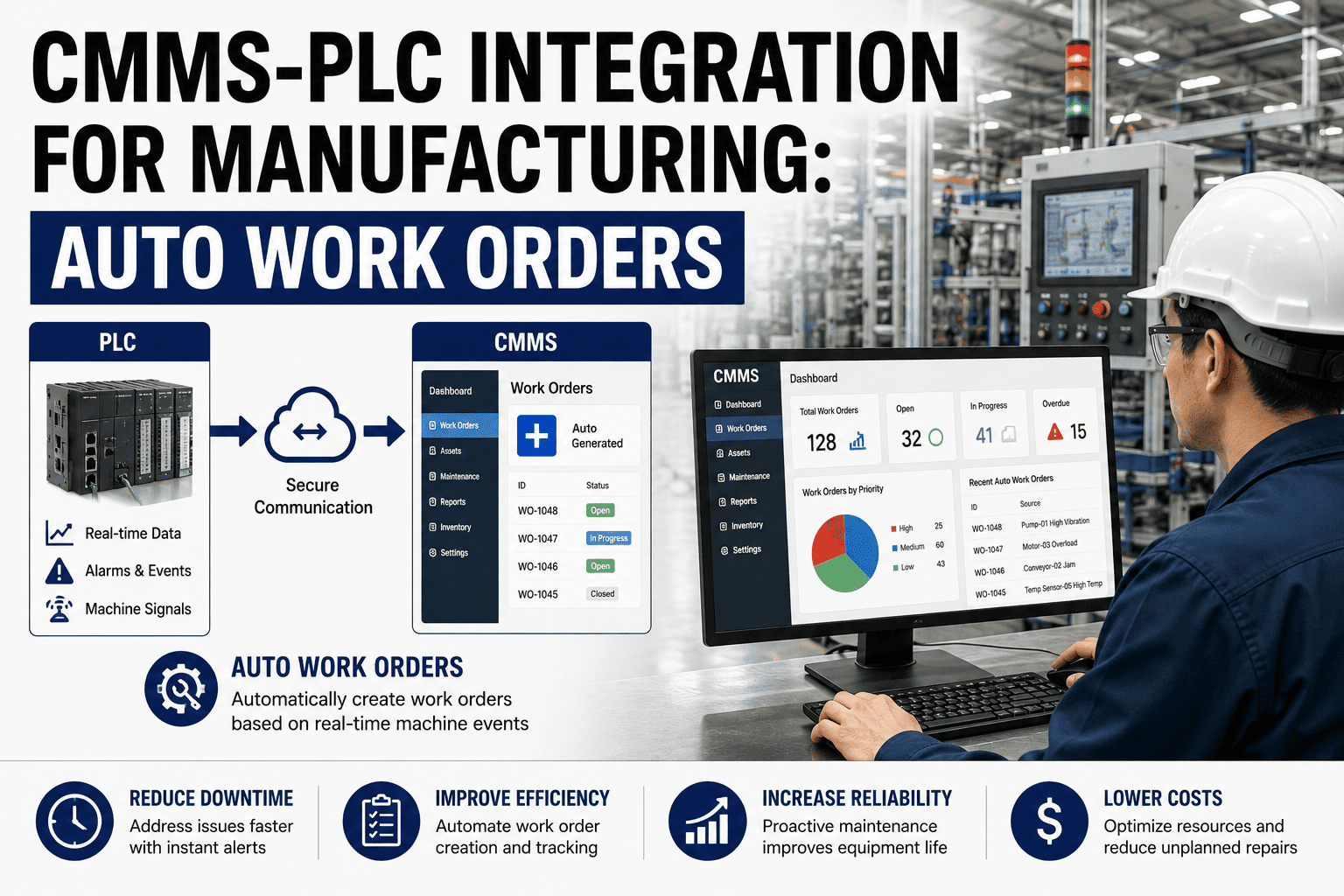
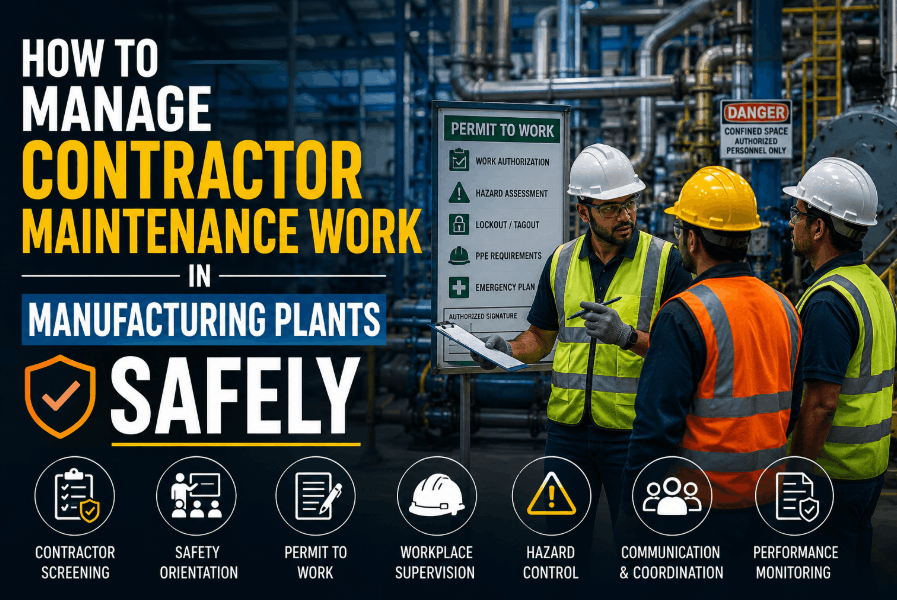
Every manufacturing plant runs a hidden second workforce — the maintenance contractors who show up for shutdown turnarounds, specialized OEM service calls, calibration campaigns, NDT surveys, roofing work, HVAC changeouts, and every scope the internal team either cannot do or cannot cover at peak volume. KPMG data across the industry shows nearly 70% of employers already rely on external resources equivalent to more than 5% of their workforce, and the trend is only accelerating. The problem is that no single OSHA regulation tells host manufacturers how to manage these contractors — leaving each plant to build its own program, and every gap in that program becomes a liability under the OSHA Multi-Employer Worksite Doctrine. A contractor injury on your site is your finding. A contractor's expired insurance is your exposure. A scope that was not documented becomes a dispute. Oxmaint is the CMMS software that runs the full contractor lifecycle inside the same system that runs internal maintenance — prequalification records, digital SOWs, safety induction tracking, mobile work orders, performance KPIs, and audit-ready documentation on every contractor at every plant. Start a free Oxmaint trial to run contractor management inside the maintenance software, or book a demo to see the contractor lifecycle CMMS mapped to your plant.
Manufacturing · Maintenance Strategy · Contractor CMMS
Maintenance Contractor Management for Manufacturing Plants — The 2026 Guide
Prequalification, scope of work, safety induction, job monitoring, and performance evaluation — the full contractor lifecycle on the same CMMS as internal maintenance.
-
70%
of employers rely on external resources equivalent to more than 5% of their workforce (KPMG)
-
5 Stages
of the Campbell Institute contractor lifecycle every host plant must run
-
Multi-Employer
OSHA doctrine — host plant and contractor share liability on shared worksites
-
One CMMS
contractors and internal team on the same work order platform, not two disconnected systems
Why Contractor Management Is Different
Why Managing Contractors Is Not the Same Problem as Managing the Internal Team
Internal maintenance runs on standard operating procedures, payroll systems, and safety programs the plant fully owns. Contractor management runs on legal contracts, insurance verification, safety orientation across employer boundaries, and performance metrics for work the plant did not directly perform. Four defining conditions separate the two disciplines — and every one carries a specific compliance and cost exposure if the program does not handle it.
-
01
Multi-Employer Liability
Under OSHA's Multi-Employer Worksite Doctrine, the host plant retains liability for hazards it controls even for contractor employees. A contractor injury from a hazard you controlled is your OSHA finding.
-
02
Insurance & Legal Exposure
Expired workers comp certificates, lapsed general liability, uncovered subcontractors. Every gap turns a contractor loss event into direct plant exposure through subrogation and defense costs.
-
03
Fragmented Scope & Payment
SOW ambiguity is the leading cause of contractor disputes. Undocumented change orders inflate invoices 15 to 40%. Loose acceptance criteria drag closeout for months.
-
04
No Single OSHA Standard
There is no unified OSHA regulation for contractor management. Programs must be built from PSM (1910.119), Multi-Employer Worksite guidance, and industry standards like Campbell Institute practice.
The Five-Stage Lifecycle
Every Contractor Runs Through the Same Five Stages
The National Safety Council's Campbell Institute identified the five-stage contractor lifecycle that every host plant should run — from prequalification through post-job evaluation. Skip any stage and the program has a documented gap. Oxmaint holds each stage as a gated workflow tied to the contractor record and the work order — so no contractor advances to job execution without passing the prior stage.
-
01
Prequalification
Insurance certificates, safety programs, EMR letters, training records, financial stability, references. Validated before any bid or work award.
-
02
Pre-Job Planning & SOW
Scope of work signed. Hazards identified. Job hazard analysis complete. Pricing model agreed. Acceptance criteria documented. Both parties own the same document.
-
03
Training & Site Orientation
Plant-specific hazards briefed. LOTO, permit-to-work, confined space procedures reviewed. Site-specific PPE issued. Attendance recorded per contractor employee.
-
04
Job Monitoring & Execution
Contractor works under mobile work orders with digital sign-off. Daily observations logged. Change orders documented. Progress and safety compliance visible to plant leadership.
-
05
Post-Job Evaluation
Performance scorecard against KPIs. Safety incidents logged. Quality accepted or rejected. Invoice reconciled. Scorecard feeds next-cycle prequalification renewal.
Prequalification Framework
The Six Documents Every Contractor Must Produce Before Award
Prequalification is the first gate — and the most common failure point in maintenance contractor programs. Six documents cover the exposure surface. Oxmaint holds each as a mandatory field on the contractor record with expiry tracking, so an expired document blocks work award until it is refreshed.
-
Q1
Certificate of Insurance
General liability, workers comp, auto, umbrella. Coverage amounts meet the plant threshold. Additional insured endorsement in favor of the host.
Expiry tracked
-
Q2
EMR & Safety Record
Current Experience Modification Rate letter from the contractor's insurance carrier. TRIR and DART rates from the last three years. OSHA citation history disclosed.
Annual refresh
-
Q3
Written Safety Program
Documented safety and health program including LOTO, confined space, hot work, fall protection, PPE. Reviewed by the host safety team before approval.
Version-controlled
-
Q4
Training Records
Employee-level records of OSHA 10 or 30, LOTO, confined space, hot work, and any task-specific certifications. Kept current per employee.
Per employee
-
Q5
Licenses & Trade Certifications
Electrical, mechanical, welding, refrigeration, boiler, elevator — every trade license required for the scope. State and municipal registrations confirmed.
By scope type
-
Q6
References & Financial Stability
Client references from comparable work. Basic financial health check. W-9 on file. Confirms the contractor can actually deliver a multi-week scope.
Every renewal
The SOW Anatomy
Every Scope of Work Runs on Six Structured Sections
Ambiguous scopes cause more contractor disputes than any other single factor. A working SOW template has six mandatory sections, and every one is a specific field inside Oxmaint tied to the contractor work order — not a Word document floating in an email chain.
Scope Definition
Exactly what is included and, equally important, exactly what is excluded. Equipment, systems, boundaries. No ambiguity about what is and is not in scope.
Deliverables & Acceptance
Every physical and documentation deliverable listed. Acceptance criteria defined objectively — pressure test result, calibration record, cleanliness class, torque values.
Schedule & Milestones
Start date, milestones, completion date. Working hours, plant shutdown windows, weekend work permissions. Delay and liquidated damages provisions.
Pricing Model
Fixed price, time and material with rate table, or unit rate. Change order process. Materials markup rules. Payment terms and retention.
Safety Requirements
Job hazard analysis attached. PPE requirements. Permit-to-work protocols. Site-specific safety rules. Incident notification and stop-work authority.
Roles & Communications
Plant single point of contact. Contractor site supervisor. Daily huddle protocol. Escalation path. Change approval authority levels.
The Shared Liability Reality
Under the Multi-Employer Worksite Doctrine, a Contractor Injury Is Your Finding Too
OSHA treats the host plant as retaining liability for hazards it created or controls, even when the injured worker is a contractor. Every gap in prequalification, orientation, or on-site safety supervision widens that exposure. Oxmaint runs the full lifecycle inside one system, so nothing sits in a shared drive nobody can find during an inspection.
Safety Induction
Four Stages Every Contractor Employee Must Complete Before Any Work
OSHA requires host employers to communicate hazards, site rules, and emergency procedures to every contractor employee. Four induction stages cover the requirement — and every one is tracked per employee inside Oxmaint, not per contractor firm. A contractor employee without the completion record cannot be assigned to a work order.
Stage A
Site Orientation
Plant layout, muster points, emergency numbers, sign-in and badge protocol, escort rules, restricted areas, entry and exit procedures.
Stage B
Hazard Communication
Site-specific chemical hazards. SDS locations. Signage system. Notifications required for plant operations. Adjacent process risks.
Stage C
Safe Work Practices
LOTO, permit-to-work, confined space, hot work, fall protection, PPE per area. How to obtain permits. Where to escalate.
Stage D
Emergency Response
Fire, medical, chemical release, evacuation. Alarm signals. Muster point. Radio channels. First aid and AED locations.
The Performance Scorecard
Five KPIs That Track Every Maintenance Contractor
Contractor renewal decisions are only defensible if they are based on data. Five KPIs cover the operational, safety, and financial dimensions of contractor performance. Oxmaint calculates each from work order data automatically and generates a scorecard at every post-job evaluation — feeding directly into the prequalification renewal cycle.
-
KPI 01
On-Time Completion Rate
Work orders closed within the SOW schedule. Missed milestones logged with reason code. Chronic late finishers surface immediately in trend view.
-
KPI 02
First-Time Quality Rate
Work accepted on first inspection versus rework required. Repeat callbacks per contractor. Quality score by scope type.
-
KPI 03
Safety Incident Rate
Recordables, near-misses, permit violations, PPE non-compliance. Any incident logged against the contractor record and factored into renewal.
-
KPI 04
Cost Variance vs SOW
Actual cost against contracted price. Change order volume and reasons. Ratio of scope-related versus contractor-error change orders.
-
KPI 05
Documentation Completeness
Whether the contractor closed the work order with required documentation — inspection records, sign-offs, red-lined drawings, waste manifests.
Where Manual Programs Break
Four Failure Modes Every Audit Finds First
-
01
Expired Insurance Not Caught
The COI in the vendor file lapsed nine months ago. The contractor keeps showing up. If an incident happens today, the plant is uninsured for the exposure.
-
02
Undocumented Change Orders
Work grew beyond the SOW. Nothing was formally approved. The invoice arrives with 40% variance. The plant either eats the cost or fights it for months.
-
03
Induction Not Per Employee
Orientation was given to the site super. New crew members show up who were never briefed. Under OSHA, that is uncontrolled contractor exposure on your worksite.
-
04
No Performance Data at Renewal
Contract comes up for renewal. Nobody can produce quality, safety, or on-time data for the last cycle. Renewal happens on relationship and inertia, not evidence.
Built for Manufacturing
How Oxmaint Runs the Full Contractor Lifecycle Inside the CMMS
-
Contractor Registry
Every Contractor as a Structured CMMS Record
Insurance, EMR, safety program, licenses, references stored on the contractor asset. Expiry dates trigger renewal alerts. Documents version-controlled.
-
Gated Award
Work Cannot Be Assigned Until Prequalification Passes
A work order cannot be assigned to a contractor whose insurance is expired or whose safety program is not on file. Software enforces the gate.
-
Digital SOW
The Six SOW Sections as Structured Fields
Scope, deliverables, schedule, pricing, safety, roles — each a field on the work order. Change orders logged. Acceptance criteria trackable at close.
-
Employee-Level Induction
Orientation Tracked Per Contractor Employee
Every contractor worker signs in with a badge. Induction attendance recorded per person. Work assignment blocked to any employee without current orientation.
-
Mobile Work Orders
Contractors Work Inside the Same CMMS
Not a paper packet, not a separate system. Contractors execute work orders inside the Oxmaint mobile app. Progress, findings, sign-off, all on one platform.
-
Auto Scorecard
Performance KPIs Calculated Automatically
On-time, quality, safety, cost variance, documentation. Five KPIs generated from actual work order data at every close. Renewal decisions run on evidence.
Measured Outcomes
What Manufacturing Plants Gain When Contractors Run on Oxmaint
-
Zero
Expired Insurance Exposures
Automatic expiry tracking blocks work assignment to any contractor with lapsed COI. Renewal alerts fire weeks before expiry.
-
15–40%
Change Order Cost Recovery
Structured SOWs and digital change order tracking eliminate the invoice disputes that cost plants 15 to 40% of contracted value in typical loose programs.
-
100%
Per-Employee Induction
Every contractor worker orientated before badge activation. No untrained worker on any work order. Multi-Employer Worksite exposure closed.
-
Data-Driven
Renewal Decisions
Every contractor renewal ranked on five KPIs from the last cycle. Underperformers surface. High performers earn preferred status.
Frequently Asked
Contractor Management & CMMS Questions
Does OSHA require a formal contractor management program?
There is no single OSHA regulation mandating a contractor management program for all industries — but the Multi-Employer Worksite Doctrine holds the host plant liable for hazards it controls even for contractor employees, and OSHA 29 CFR 1910.119(h) requires a formal program for facilities covered by Process Safety Management. Practical protection requires the same structured lifecycle regardless of PSM applicability. Sign up for Oxmaint to run the Campbell Institute lifecycle inside the CMMS.
How does Oxmaint handle insurance expiry tracking?
Every Certificate of Insurance uploaded to the contractor record carries a mandatory expiry date. Oxmaint tracks the date and fires alerts to the vendor manager weeks before expiry. The moment a COI lapses, work order assignment to that contractor is blocked at the software level. No manual audit needed.
Can contractors execute work orders directly in the CMMS?
Yes. Contractors are granted scoped access to their assigned work orders inside the Oxmaint mobile app. They see the SOW, log progress, capture findings, attach photos, and sign off at completion. Plant supervisors see the same data in real time — no separate tracking spreadsheet, no email chains. Book a demo to see contractor mobile workflows in Oxmaint.
How are contractor performance KPIs actually calculated?
On-time completion pulls from work order actual close date versus SOW target. Quality pulls from rework flags and callback records. Safety pulls from incident and permit violation logs against the contractor. Cost variance pulls from actual invoice against SOW price. Documentation completeness pulls from required attachment flags on the work order. All five calculate automatically at every close. Sign up for Oxmaint to generate contractor scorecards from work order data.
Qualify · Manage · Measure
Every Contractor Exposure Started With Something the Program Should Have Caught
The expired insurance certificate. The undocumented change order. The employee who never sat through orientation. The renewal decision made without data. Every one preventable with a CMMS that runs the full lifecycle in one place — same platform as internal maintenance, same visibility, same audit trail. Oxmaint is the maintenance contractor management software built for manufacturing plants.