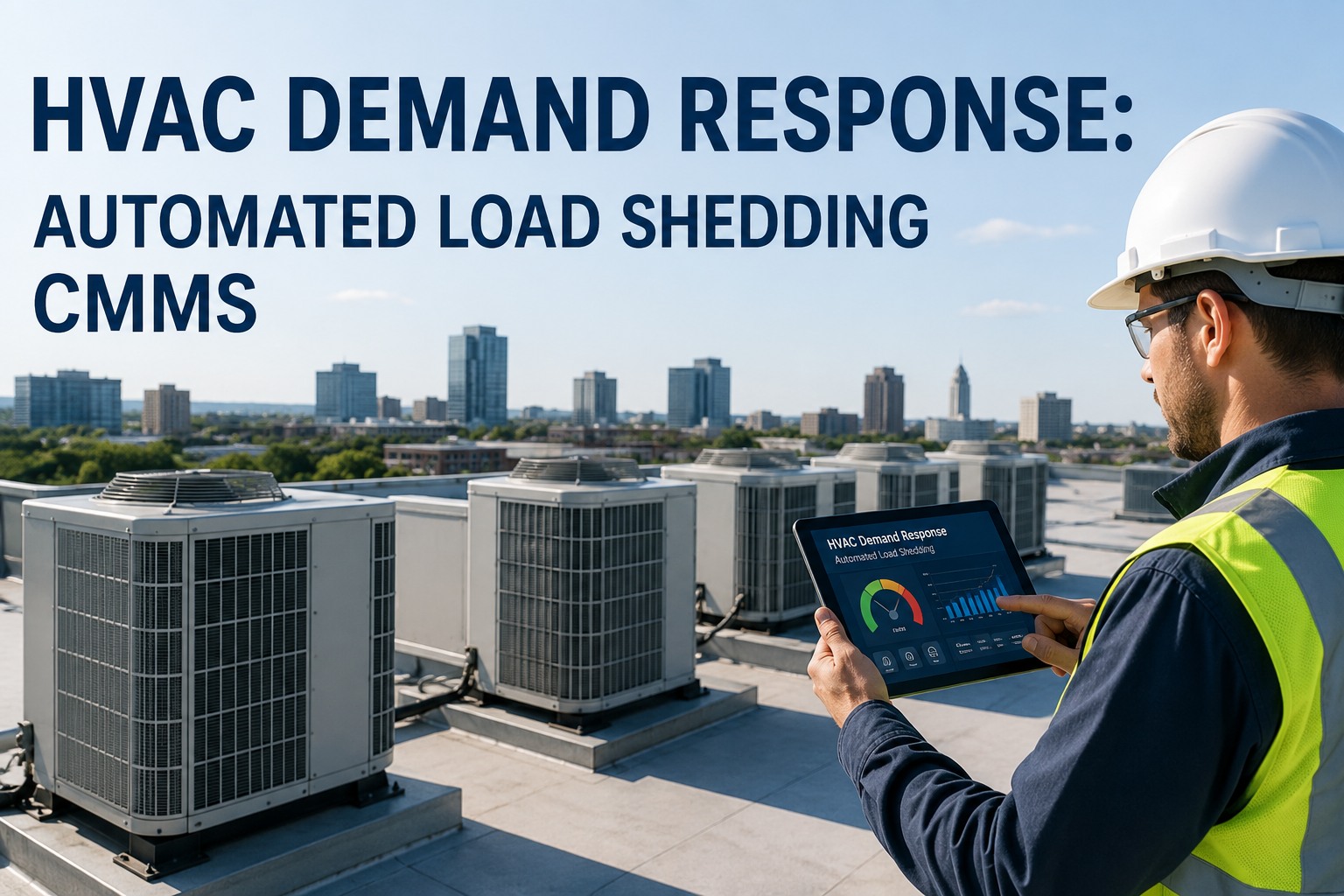
HVAC demand response is the strategy of reducing mechanical cooling and ventilation load during utility peak periods to slash demand charges, earn program incentives, and protect equipment from thermal stress — and when it is automated through a CMMS, the savings compound without manual intervention. This guide covers automated load shedding HVAC workflows, peak demand charge avoidance, utility program participation, and how a demand response CMMS orchestrates the entire event lifecycle. If your team is still shedding load by phone call and spreadsheet, consider this your roadmap to a 20–40% reduction in peak demand HVAC costs — then Start Free Trial to see the automation in action.
Can your HVAC system shed load automatically when the grid peaks?
Most facilities overpay demand charges because load shedding is manual, late, or forgotten. A CMMS-based demand response system detects peak windows in real time and executes your load-shedding sequence across every asset — no phone trees, no missed events, no guessing.
Why HVAC demand charges drain 30–70% of your utility bill
Commercial electricity bills in most U.S. rate structures are split into energy charges (kWh) and demand charges (kW or kVA). For HVAC-heavy facilities, demand charges routinely account for 30–70% of the total bill — and they are set by your highest 15- or 30-minute usage window during the billing cycle. One unmanaged peak afternoon can lock in a punishing demand charge for an entire month.
A facility hitting 950 kW peak at $18/kW pays $17,100/month — even if average load is only 420 kW.
Shedding 220 kW from the peak window at the same facility saves $3,960/month or $47,520/year.
The math is simple — yet most maintenance teams cannot act on it because they lack visibility into the peak window before it happens. A demand response CMMS closes that gap by integrating interval data, weather forecasts, and asset-level control logic so load is shed before the meter spikes, not after the bill arrives.
Automated load shedding HVAC sequence — a 6-step timeline
A CMMS-driven demand response event follows a deterministic sequence. Each step is logged, timestamped, and tied to specific work orders, so you have a full audit trail for utility program reconciliation and ISO reporting.
Signal detection
CMMS receives a demand response signal from the utility, ISO, or internal peak-prediction engine based on load forecasts and weather data.
Pre-cool and pre-stage
Chilled-water setpoints drop 2–4°F to thermal-bank the building; non-critical zones are identified for sequential shedding.
Load-shed work orders fire
Automated work orders dispatch to the BAS and on-site technicians: reset CHW setpoints, stage down chillers, raise supply-air temp 3–5°F, cycle exhaust fans.
Shed execution and monitoring
CMMS monitors real-time kW against the shed target. If the delta exceeds tolerance, secondary assets are auto-shed and technicians are alerted.
Recovery and ramp-up
Setpoints return to baseline on a staged ramp to avoid simultaneous restart inrush — which itself can trigger a new demand peak.
Reconciliation and reporting
CMMS generates a demand response report: kW shed, duration, $ saved, incentive earned, and equipment stress flags for the PM schedule.
Manual load shedding vs CMMS demand response
The gap between a clipboard-and-phone-call load-shed process and an automated CMMS-driven one is not just convenience — it is tens of thousands of dollars per year in charges that were never avoided because the response was 10 minutes too late.
| Capability | Manual / Spreadsheet | CMMS Demand Response |
|---|---|---|
| Peak detection | After bill arrives, 30+ days late | Real-time interval monitoring with forecast |
| Shed trigger time | 15–45 min after peak begins | 15–60 min before peak begins |
| Asset coordination | Phone calls, radios, sticky notes | Automated work orders to BAS and mobile |
| Audit trail | Incomplete or handwritten logs | Full timestamped event log for ISO/utility |
| Demand charge avoidance | 10–15% (unreliable) | 25–40% (consistent, verified) |
| Utility incentive capture | Often missed — paperwork gaps | Auto-generated compliance reports |
| Equipment stress | Hard restarts, chiller short-cycling | Staged ramp-up, PM-triggered post-event |
A 180-asset office campus spending $42K/yr on demand charges
This campus ran load shedding manually — a facilities manager monitored the utility portal and called the HVAC tech when kW spiked. Problem: the peak was already locked in by the time the call was made. After deploying a CMMS with automated demand response, the system began pre-cooling 60 minutes before forecasted peaks and fired shed work orders at T-minus 15. Result: peak kW dropped from 880 to 610, demand charges fell to $26K/yr, and the campus captured an additional $6,200 in utility program incentives. Total annual savings: $22,200. Payback on the CMMS subscription: under 4 months.
How OxMaint automates HVAC demand response end-to-end
OxMaint is an AI-powered CMMS and EAM platform that turns demand response from a scramble into a system. Four capabilities map directly to the load-shedding lifecycle — each delivering a measurable, defensible outcome.
Real-time peak prediction
OxMaint ingests interval meter data, weather forecasts, and historical load profiles to predict peak windows 60+ minutes ahead. Triggers pre-cool and shed sequences before the meter spikes — not after.
Outcome: 25–40% demand charge reductionAutomated load-shed work orders
When a peak signal fires, OxMaint auto-generates and dispatches work orders to your BAS and technician mobile app — setpoint resets, chiller staging, fan cycling — each with priority, asset, and SLA attached.
Outcome: 90% faster shed execution vs manualEquipment stress tracking and PM linkage
Every shed event logs thermal stress on compressors, chillers, and VFDs. OxMaint automatically adjusts PM schedules post-event — so a hard shed in July triggers a bearing inspection in August, not a failure in September.
Outcome: 30–50% less unplanned downtimeUtility program reconciliation
OxMaint compiles every event into a compliance-ready report: kW shed, duration, baseline comparison, and $ incentive earned. Submit to your utility or ISO with one click — no spreadsheet archaeology.
Outcome: 100% incentive capture, zero missed filingsWhat changes when demand response runs on a CMMS
"We were missing demand response windows by 20 minutes because someone had to notice the spike and make three phone calls. OxMaint cut that to zero — the shed sequence fires automatically and we cut $3,300/month off our demand bill. The utility incentive paperwork generates itself."
See OxMaint shed load on your assets — book a 30-min demo
We will map your facility's HVAC demand profile live and show exactly where automated load shedding will cut your next utility bill.
HVAC demand response — common questions
What is HVAC demand response and how does automated load shedding work?
HVAC demand response is the practice of reducing cooling and ventilation load during utility peak periods to lower demand charges and earn program incentives. Automated load shedding uses software — typically a CMMS integrated with the BAS — to detect peak windows in advance and execute a pre-programmed sequence of setpoint resets, chiller staging, and fan cycling without manual intervention. The result is a faster, more reliable shed that captures savings every peak event rather than only the ones someone happens to notice.
How much can I save on HVAC demand charges with a CMMS?
Most facilities see a 25–40% reduction in monthly demand charges when automated load shedding is triggered 15+ minutes before the peak interval. For a facility with a 900 kW peak at $18/kW, shaving 220 kW saves roughly $3,960/month or $47,520/year. You can Start Free Trial to model your own facility's savings in OxMaint, or book a demo and we will run the numbers with you.
Does load shedding damage HVAC equipment?
Improper load shedding — especially hard chiller cycling and simultaneous restarts — can accelerate wear on compressors, bearings, and VFDs. A well-designed CMMS demand response sequence avoids this by staging setpoint changes, pre-cooling the thermal mass, and ramping recovery on a delay. OxMaint also logs equipment stress per event and auto-adjusts preventive maintenance schedules so post-shed inspections happen before failures do.
What utility programs support HVAC demand response in 2026?
Most U.S. utilities and ISOs offer demand response programs — including capacity, economic, and reliability tiers — that pay $20–80/kW-season for committed load reductions, plus per-event energy payments. Participation requires a verifiable shed with timestamped logs and baseline comparisons. A demand response CMMS like OxMaint generates these reports automatically, so you capture 100% of eligible incentives without manual paperwork.
How is a demand response CMMS different from a building automation system?
A BAS controls equipment in real time but lacks the maintenance workflow, asset history, and reporting layer needed for a complete demand response program. A demand response CMMS sits above the BAS: it predicts peaks, generates and dispatches shed work orders, tracks equipment stress, adjusts PM schedules, and produces utility compliance reports. The BAS executes the commands; the CMMS orchestrates the strategy, the audit trail, and the long-term asset impact. You can Book a Demo to see how OxMaint integrates with your existing BAS.
Stop paying for peaks you could have shed
Deploy OxMaint's automated HVAC demand response in days — not months. Your next utility bill is the one that drops.
Free 14-day trial · No credit card