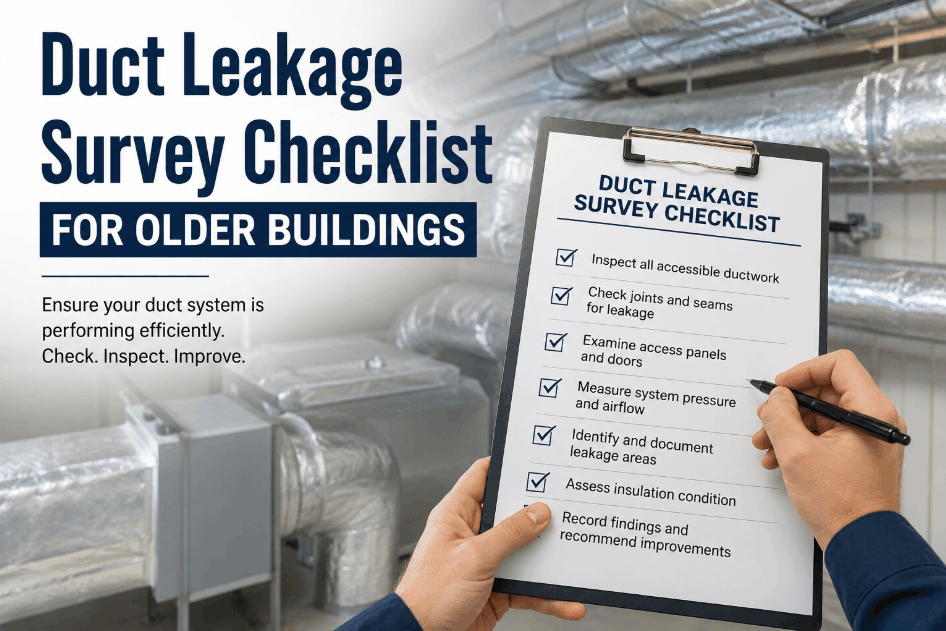
Duct leakage in older buildings rarely shows up as a single dramatic failure — it shows up as a chiller that runs longer than it should, a zone that never quite reaches setpoint, and an energy bill that doesn't match the equipment efficiency on paper. Decades of renovations, ceiling work, and tenant fit-outs leave joints resealed inconsistently, access panels replaced without matching gaskets, and dampers that no longer seat the way they did at original installation. The structural gap is familiar across older portfolios: no documented leakage baseline, no pressure testing on a defined interval, and no link between survey findings and repair prioritization. Sign Up Free on Oxmaint to give building engineers and facility teams a digital record of duct leakage survey findings, joint condition history, and repair status tied to each air distribution zone — so leakage gets quantified and tracked instead of estimated from energy bills alone. Book a Demo to see how Oxmaint connects duct survey results to repair work orders and PM scheduling, so the leakage driving up energy costs gets prioritized by actual measured impact. Use this checklist before your next building efficiency review or retrofit planning cycle.
1. Visual Joint & Connection Inspection
Most measurable duct leakage in older buildings originates at joints and connections rather than along straight duct runs. Confirm every accessible joint, takeoff, and flexible connection is visually inspected before relying on pressure testing alone to locate problem areas.
2. Access Panel & Damper Seal Verification
Access panels and dampers are frequently the source of leakage that visual joint inspection alone misses, especially after repeated service access or panel replacement that doesn't match the original gasket specification.
3. Pressure Testing & Leakage Quantification
Visual inspection identifies where leakage is likely, but pressure testing quantifies how much air is actually being lost. Confirm leakage is measured against a baseline rather than judged by appearance alone before prioritizing repair budget.
4. Insulation Condition & Vapor Barrier Assessment
Duct insulation and vapor barrier condition affect both energy loss and condensation risk, and both degrade gradually in ways that are easy to miss without a dedicated inspection step alongside the leakage survey.
5. Survey Documentation & Repair Prioritization Cadence
A duct leakage survey only improves building performance if findings are documented clearly enough to drive repair budget decisions. Confirm the survey process has a defined cadence and a direct link to prioritized repair work, not a report that sits unreviewed.


