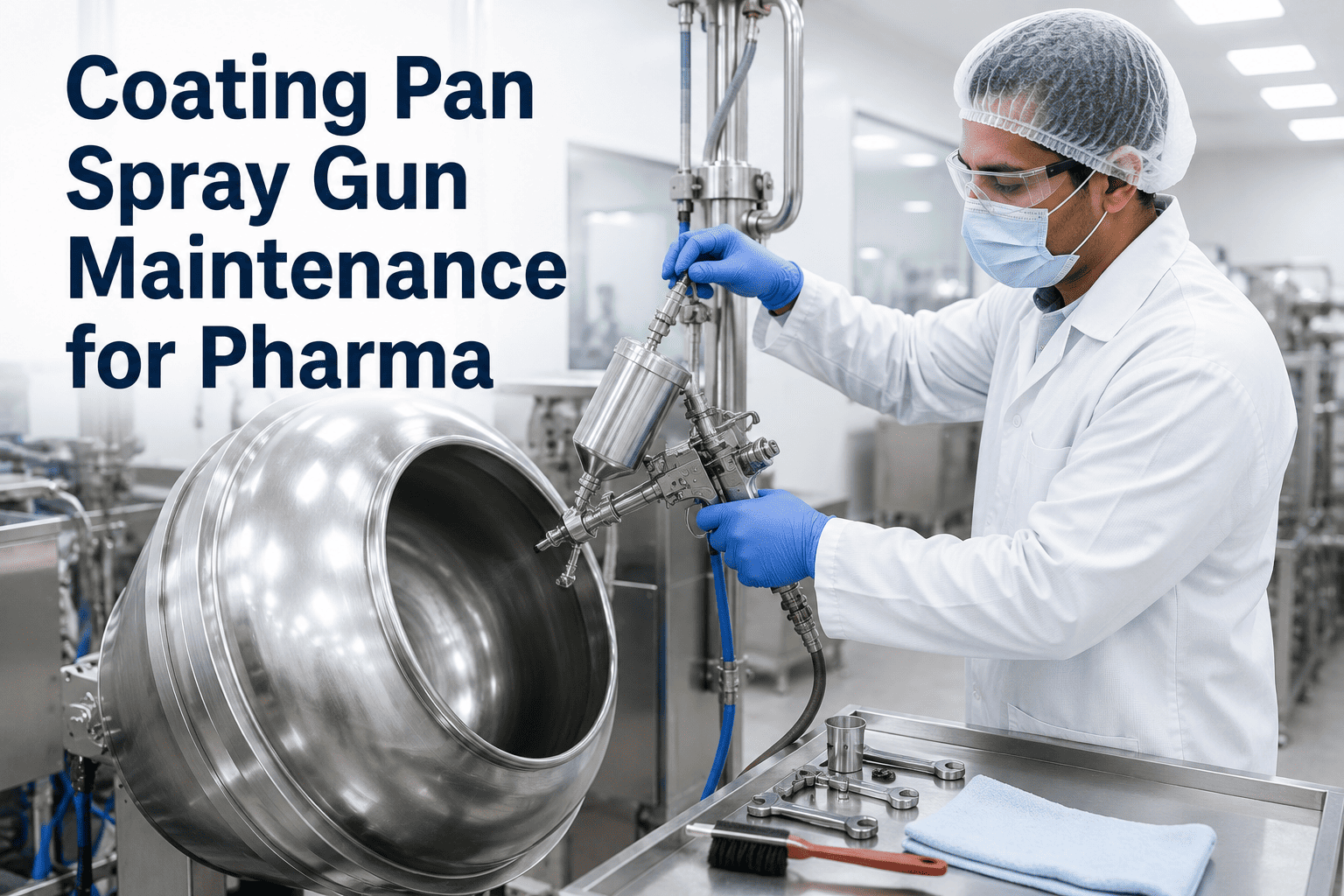
Tablet coating failures cost pharma manufacturers more than just a rejected batch — they trigger QA investigations, delay release timelines, and in severe cases generate FDA observations around process control documentation. Coating pan maintenance is where tablet defect prevention actually begins: spray system calibration, pan drive condition, airflow verification, and cleaning record integrity together determine whether your next coating run passes or fails. Start a free OxMaint trial or book a 30-minute demo to see how coating equipment PMs, cleaning schedules, and QA records run in one connected platform.
Pharma Article · Coating Equipment · Defect Prevention
Coating Pan Maintenance to Prevent Tablet Defects
Spray system checks, pan drive PMs, airflow verification, and cleaning documentation — the four pillars that keep coating defects off your batch records and out of your investigation backlog.
4
Pillars
Spray System
Pan Drive
Airflow
Cleaning
Root Cause Map
Which Defects Come From Which Maintenance Gap
Every coating defect has a maintenance root cause. Understanding the connection is what separates reactive batch investigations from a proactive PM program that stops defects before they form.
01
Twinning / Sticking
Spray rate too high relative to drying capacity — caused by atomizing air pressure drift or nozzle wear increasing droplet size
PM fix: Monthly nozzle orifice check, atomizing air pressure calibration
02
Picking / Roughness
Pan surface deposits or worn baffles creating irregular tablet-to-surface contact — maintenance contamination from a missed cleaning step
PM fix: Post-batch pan surface inspection, baffle integrity check
03
Color Mottling
Non-uniform spray pattern from partially blocked nozzles or uneven pan rotation caused by drive gear wear
PM fix: Nozzle spray pattern test before each run, gearbox backlash check quarterly
04
Cracking / Peeling
Inlet air temperature fluctuation or humidity excursion from clogged air handling filters reducing airflow uniformity
PM fix: Monthly inlet filter replacement, quarterly airflow balancing verification
05
Logo Bridging
Excess coating weight from flow meter drift — instrument calibration gap allowing over-spraying in deboss areas
PM fix: Flow meter calibration verification semi-annually, weight gain monitoring per batch
06
Cross-Contamination
Inadequate cleaning between products — CMMS cleaning record gap where status change to "cleaned" is manual or unverified
PM fix: Digital cleaning log with QA approval gate before status release
The 4 Maintenance Pillars
What Every Coating Pan PM Program Must Cover
The spray system is the highest-leverage maintenance point on a coating pan. Atomizing nozzle orifice wear changes droplet size directly. Nozzle-to-bed distance drift creates uneven coverage. Peristaltic pump tubing wear changes spray rate at a fixed setting — meaning your validated parameters are no longer what the machine is actually delivering.
Nozzle orifice diameter check against OEM tolerance
Atomizing air pressure calibration at manifold
Spray pattern test on dummy tablet bed before production run
Peristaltic tubing replacement on fixed interval or flow drift
Flow meter calibration verification — semi-annual minimum
Pan drive systems — motor, gearbox, drive gear, and pan shaft — determine pan speed accuracy and rotational uniformity. Speed variation beyond ±2 RPM of setpoint directly affects mixing and coating uniformity. Gearbox backlash increases silently over time; by the time it is audible, it has already altered coating behavior in multiple batches.
Pan speed accuracy verification against setpoint (quarterly)
Gearbox backlash measurement and documentation
Drive gear tooth wear visual inspection
Motor bearing vibration trending via handheld or mounted sensor
Gearbox oil sample (annual) — particle count and viscosity
Inlet and exhaust air management is what makes tablets dry uniformly during coating. A clogged HEPA filter reduces inlet airflow, dropping drying capacity and raising pan humidity — exactly the conditions that cause sticking and twinning. Most plants check air volume at annual qualification; maintenance PM should verify filter condition and airflow balance monthly to catch drift before it reaches batch release.
Inlet air HEPA filter ΔP monitoring — monthly log
Exhaust air damper position verification
Inlet air temperature sensor calibration (quarterly)
Airflow balancing verification after any filter replacement
Humidity sensor cross-check vs calibrated reference
Cleaning is a maintenance activity — and its records must be as complete as any mechanical PM. For coating pans, the cleaning record must capture detergent identity and concentration, contact time, rinse verification, and the name and signature of the person who performed the clean. Equipment status in the CMMS should only move to "released" after QA approval of the cleaning record, not on the technician's say-so alone.
Cleaning agent ID, lot, concentration logged per event
Contact time documented against SOP minimum
Rinse water TOC or conductivity result attached
Pan interior visual sign-off with photo capture
Equipment status update with QA approval gate in CMMS
Expert Review
"Coating defect investigations almost always trace back to a maintenance record gap — not a formulation problem. A nozzle that wasn't checked, a filter that wasn't replaced, a speed that wasn't verified. When maintenance records are complete and linked to batch records, investigations close in hours. When they're on paper across three departments, they drag for weeks."
Dr. Priya Nair
GMP Process Validation Lead · Solid Dosage Manufacturing
73%
Of coating batch failures linked to spray system or airflow maintenance gaps
2.9K
Monthly searches on coating pan maintenance — largely unmet by current content
Run Every Coating Pan PM, Cleaning Log, and Airflow Check in OxMaint
Pre-built coating equipment templates, batch-linked cleaning records, QA approval gates, and mobile closeout — all in one GMP-ready platform.
Frequently Asked Questions
Coating Pan Maintenance — What QA and Maintenance Teams Ask
How often should coating pan spray nozzles be inspected and replaced?
At minimum, nozzles should be inspected for orifice wear and blockage before each production run using a spray pattern test, and a dimensional check against OEM tolerance should be performed monthly. Nozzle replacement intervals depend on coating solution abrasiveness and run hours — most manufacturers replace or refurbish spray nozzles every 3–6 months under active production schedules. Any nozzle showing orifice diameter outside tolerance must be replaced before the next batch, with the replacement logged against the equipment and batch record.
Track nozzle replacement history per coating pan in OxMaint.
What is the GMP documentation requirement for coating pan cleaning between products?
Between different product campaigns, a full cleaning validation protocol must be followed — not just the standard intra-campaign clean. Documentation must include cleaning agent identity, concentration, and lot number; contact time with start and end timestamps; rinse verification results (TOC or conductivity); a visual inspection sign-off with photographs; and QA approval before the equipment status changes to "released for next product." The entire record set must be retrievable and linked to the production batch records of both the outgoing and incoming product.
See how OxMaint structures cleaning approval workflows in a demo.
How does airflow variation in the coating pan cause tablet defects?
Coating is a dynamic drying process where evaporation rate must keep pace with spray application rate. When inlet airflow drops — from a clogged HEPA filter, failed damper, or blower degradation — drying capacity falls below spray input, and the tablet bed becomes over-wetted. This directly causes twinning, sticking, and picking defects. On the other side, excessive exhaust restriction raises pan humidity and can cause premature coating film cracking. Monthly filter monitoring and post-replacement airflow verification are the most cost-effective defect prevention steps available to the maintenance team.
Can OxMaint link coating pan maintenance records directly to batch records?
Yes. OxMaint allows work orders to reference batch numbers and equipment IDs, so every PM, cleaning log, and calibration record completed on a coating pan can be retrieved by batch number during an investigation or release review. When a coating defect investigation opens, the QA team can pull every maintenance activity performed on that pan in the 30 days before the event — without calling maintenance to search paper logs.
Try OxMaint free — no credit card required.