
Biomedical risk classification is the backbone of every defensible PM interval assignment in modern healthcare maintenance. Regulators like CMS, The Joint Commission, and DNV surveyors expect clinical engineering teams to document exactly how equipment risk scores translate into specific preventive maintenance frequencies—and to prove those intervals are actually being followed in the field. A CMMS built for risk-tiered maintenance makes this traceable, automated, and audit-ready rather than a spreadsheet guessing game. This guide walks through the function, physical risk, and maintenance history scoring model, high/medium/low tier assignment, Alternative Equipment Maintenance (AEM) support, and the CMMS setup that ties it all together. Ready to replace paper logs with a fully documented, risk-based PM system? Start Free Trial and configure your first risk-tiered inventory today.
CMMS Biomedical Risk Guide
Is your biomedical PM interval assignment audit-ready — or just a guess?
Surveyors no longer accept calendar-based PM frequencies pulled from a vendor manual. They want documented risk scoring, defensible interval logic, and proof every high-risk asset was serviced on time. OxMaint turns that paper chase into automated, risk-tiered PM scheduling your team can prove in minutes.
Risk-Based PM Healthcare
Why biomedical risk classification drives PM interval — and what regulators expect
CMS, The Joint Commission, and DNV all require healthcare facilities to maintain a documented medical equipment management plan that classifies equipment by risk and assigns preventive maintenance accordingly. A missing or undocumented risk score is one of the most common survey findings — and it can trigger a Type I deficiency for an entire clinical engineering department.
The core expectation is simple in principle: higher-risk equipment gets more frequent preventive maintenance, lower-risk equipment gets less, and every decision is traceable to a scoring methodology. The problem most biomed teams face is not the scoring itself — it is keeping that scoring synchronized with PM schedules, work order completion records, and AEM adjustments across thousands of assets. That synchronization gap is exactly what a risk-tiered CMMS closes.
Biomedical PM Interval Guide
The three-factor risk scoring model: function, physical risk, maintenance history
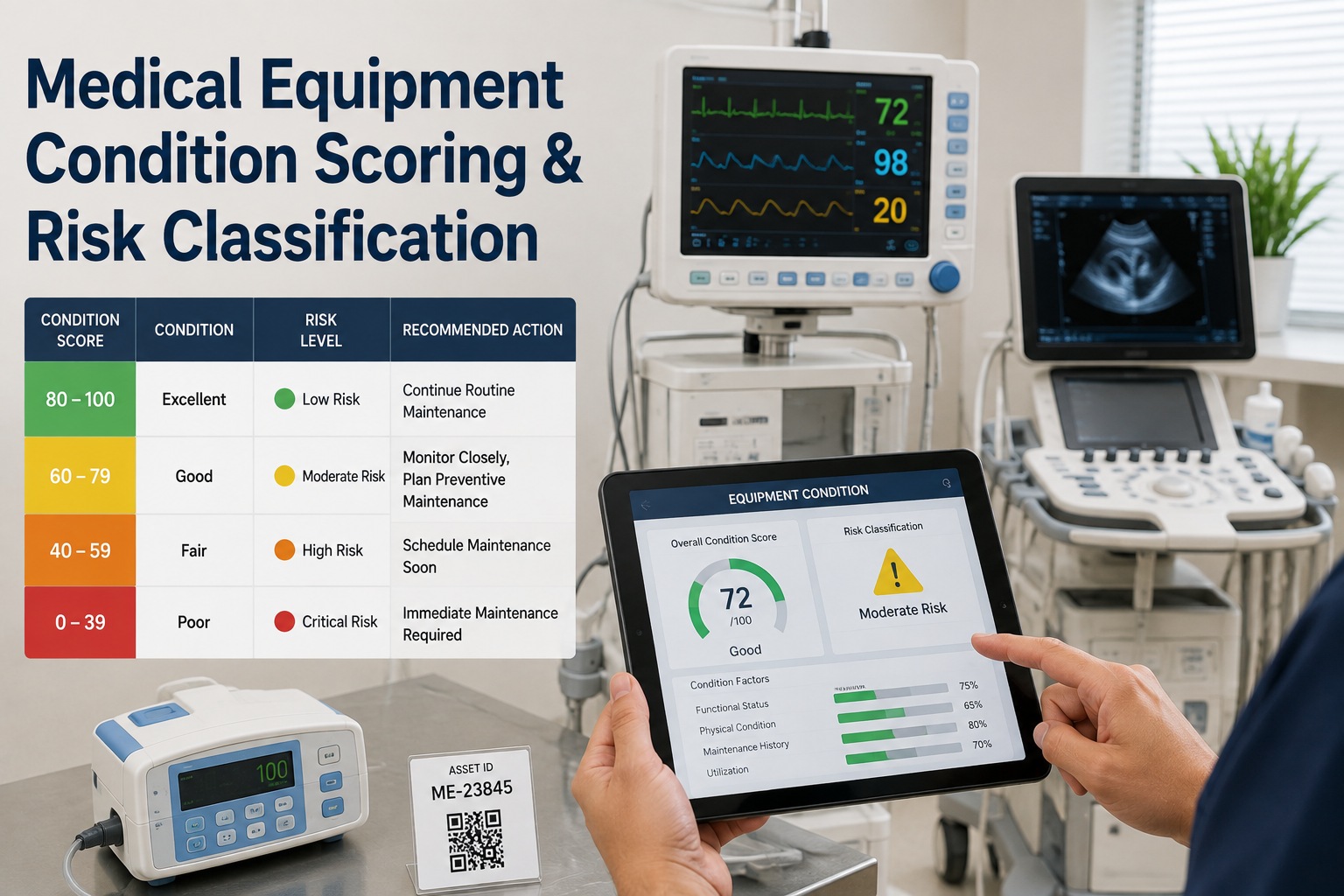
Most defensible biomedical risk classification systems used in U.S. healthcare today weigh three factors. Each factor is scored, the scores are combined, and the total maps to a risk tier that drives the PM interval. Here is the standard scoring framework OxMaint encodes into every asset record.
Equipment Function
What role does the device play in patient care? Life support and monitoring equipment (defibrillators, ventilators, anesthesia machines) score highest. Therapeutic and diagnostic equipment scores medium. Non-patient-care assets (lab analyzers, utility pumps) score lower.
Physical Risk
What is the potential for patient or staff harm if the equipment fails? Devices whose failure could cause serious injury or death (infusion pumps, electrosurgical units) score 8–10. Equipment with indirect or low harm potential scores 1–3.
Maintenance History
How has this equipment type performed over time? Asset classes with frequent PM failures, recurring corrective work orders, or manufacturer service bulletins score higher. Stable, low-failure equipment drops in risk priority.
Risk Classification Formula
Total Risk Score = (Function × 0.4) + (Physical Risk × 0.4) + (Maintenance History × 0.2)
Weightings are configurable per facility policy. OxMaint stores your scoring rubric at the system level so every asset is scored consistently and every score change is logged for audit.
CMMS Risk Tiered Maintenance
Risk tier to PM interval mapping: high, medium, and low classification
Once the total risk score is calculated, assets are assigned to a risk tier. Each tier carries a default PM interval, an inspection depth, and an AEM eligibility flag. Below is the standard mapping OxMaint applies out of the box — fully editable to match your facility's equipment management plan.
| Risk Tier | Score Range | Default PM Interval | Inspection Depth | AEM Eligible |
|---|---|---|---|---|
| High Risk | 8.0 – 10.0 | Every 3–6 months | Full performance & safety inspection | No — must follow manufacturer spec |
| Medium Risk | 4.5 – 7.9 | Every 6–12 months | Scheduled preventive maintenance + calibration check | Yes — with documented justification |
| Low Risk | 1.0 – 4.4 | Every 12–24 months | Visual safety inspection, functional check | Yes — interval may be extended up to 24 months |
Worked Example — 2,000-Asset Hospital
A clinical engineering department managing 2,000 biomedical assets classifies roughly 18% as high-risk (360 assets), 52% as medium-risk (1,040 assets), and 30% as low-risk (600 assets). On a paper or spreadsheet system, keeping 360 high-risk assets on a strict 6-month PM cycle — with documented completion proof for every one — typically requires one full-time FTE just for scheduling and tracking. In OxMaint, risk scores auto-generate PM work orders at the correct interval, completion data flows back into the risk score, and a single dashboard shows which high-risk assets are overdue in real time. The result: the same coverage with 60–70% less administrative overhead, and zero gap when a surveyor asks for proof.
Alternative Equipment Maintenance
How AEM support works in a risk-tiered CMMS
Alternative Equipment Maintenance (AEM) allows facilities to extend PM intervals beyond manufacturer recommendations for medium- and low-risk equipment — but only when supported by documented maintenance history data and ongoing monitoring. A CMMS that cannot track, justify, and flag AEM adjustments automatically is a compliance liability waiting to surface during a survey.
AEM Eligibility Auto-Flag
OxMaint automatically flags medium- and low-risk assets that meet your AEM eligibility thresholds — minimum 12 months of clean PM history, no corrective work orders in the prior cycle, and no open recalls. The biomed tech sees the flag at the asset level; no separate spreadsheet tracking is needed.
Interval Extension Documentation
When an interval is extended under AEM, OxMaint captures the justification, the approval signature, the prior interval, the new interval, and the risk score at time of approval — all attached to the asset record and printable as a survey-ready report.
AEM Monitoring & Auto-Reversion
If a corrective work order or PM failure occurs on an AEM-extended asset, OxMaint automatically reverts the PM interval to the original frequency and alerts the biomed manager. This closed-loop monitoring is exactly what surveyors check when reviewing an AEM program.
CMMS Biomedical Risk
How OxMaint makes risk-tiered PM intervals audit-defensible
OxMaint is an AI-powered CMMS and EAM platform designed for maintenance and reliability teams that cannot afford a missed PM on a high-risk asset. These are the capabilities that directly solve the biomedical risk classification and PM interval problem — each tied to a concrete, measurable outcome.
Automated Risk-Based PM Scheduling
Risk scores auto-generate PM work orders at the correct interval — 3 months for high-risk ventilators, 12 months for medium-risk infusion pumps, 24 months for low-risk exam lights. No manual calendar management. Outcome: 40–60% reduction in scheduling admin time and zero missed high-risk PMs.
Dynamic Risk Score Recalculation
Every PM completion, corrective work order, and recall notice feeds back into the asset's risk score. If a low-risk device starts failing, its score rises and the PM interval tightens automatically. Outcome: risk classification stays current without manual re-scoring — 100% of inventory continuously risk-adjusted.
One-Click Survey Audit Reports
Generate a complete risk classification register, PM completion summary, and AEM justification log for any date range in under 30 seconds. Sorted by risk tier, asset type, department, or facility. Outcome: audit preparation drops from days of spreadsheet assembly to a single export.
AEM Closed-Loop Monitoring
Automatic eligibility flagging, approval capture, interval extension logging, and auto-reversion on failure — the four components surveyors look for in a compliant AEM program. Outcome: extend intervals where safe, cut unnecessary PMs 20–35% on low-risk assets, and never lose documentation.
See OxMaint configure risk-tiered PMs on your actual biomedical inventory
Book a 30-minute demo and we will load a sample of your asset list, apply the three-factor risk scoring model, and show you exactly how PM intervals, AEM flags, and audit reports look in a live CMMS — before you commit to anything.
CMMS Risk Classification Biomedical — FAQ
Frequently asked questions about biomedical risk classification and PM intervals
What is biomedical risk classification and why does it matter for PM intervals?
Biomedical risk classification is a scoring methodology that assigns each medical device a risk level based on equipment function, physical risk to patients and staff, and maintenance history. That score determines how frequently preventive maintenance must be performed — high-risk assets like defibrillators get quarterly PMs, low-risk assets like exam lights may only need annual checks. It matters because CMS, Joint Commission, and DNV all require documented, risk-based PM scheduling as part of a compliant medical equipment management plan.
How often should PMs be performed on high-risk biomedical equipment?
High-risk biomedical equipment — typically scoring 8.0 or above on a 10-point risk scale — should receive preventive maintenance every 3 to 6 months. Life-support devices such as ventilators and anesthesia machines often follow the most aggressive interval unless manufacturer specifications require more frequent service. OxMaint auto-generates these PM work orders on schedule and flags any high-risk asset that approaches an overdue status so no critical inspection slips. Start Free Trial to automate your high-risk PM scheduling today.
What is Alternative Equipment Maintenance (AEM) and when can you extend PM intervals?
AEM is a CMS- and Joint Commission-recognized program that allows facilities to extend PM intervals beyond manufacturer recommendations for medium- and low-risk equipment when supported by documented maintenance history. To qualify, an asset typically needs at least 12 months of clean PM data, no recurring corrective work orders, and no open recalls. The extension must be approved, documented, and continuously monitored — if a failure occurs, the interval reverts automatically.
How does a CMMS support biomedical risk classification and audit defense?
A CMMS stores the risk scoring rubric, applies it consistently to every asset, auto-generates PM work orders at the correct interval, and logs every completion, failure, and interval adjustment with a timestamp. During a survey, the biomed manager can export a risk classification register, PM completion summary, and AEM justification report in minutes rather than assembling binders by hand. Book a Demo to see OxMaint generate these reports live.
What happens if a biomedical asset's risk score changes over time?
If an asset begins experiencing PM failures, corrective work orders, or a manufacturer recall, its maintenance history score rises — which can push it from medium-risk to high-risk and automatically tighten its PM interval. OxMaint recalculates risk scores dynamically as work order data flows in, so the PM schedule always reflects the asset's current risk profile rather than a score assigned five years ago and never updated.
Stop defending PM intervals with spreadsheets — start defending them with a CMMS
Every day without risk-tiered PM automation is a day your biomed team spends on scheduling instead of patient safety. OxMaint gets you live in days, not months — with your risk scores, PM intervals, and AEM documentation fully configured and audit-ready.
Free 14-day trial · No credit card


.png)

.jpeg)
