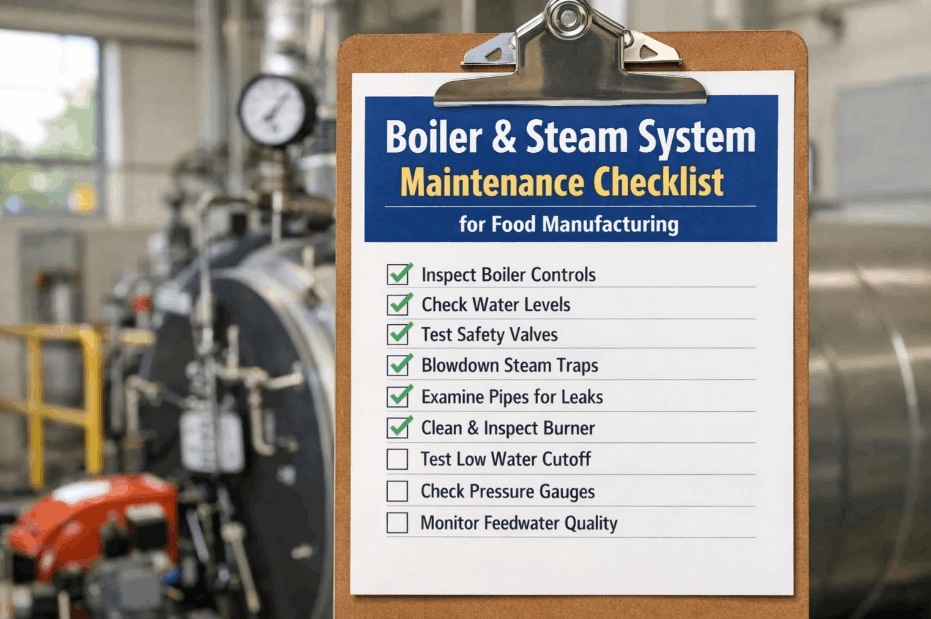
Two utilities keep a food plant running and neither one shows up on a maintenance whiteboard until it fails: the boiler that makes steam for cooking, CIP, and sanitation, and the compressed air network that drives every pneumatic valve, filler, and packaging arm on the line. Facilities without a structured steam trap program run failure rates of 15 to 25 percent, silently venting live steam every hour of every shift. Compressed air systems left unmonitored lose 20 to 30 percent of what the compressor generates before it ever reaches a nozzle. Both losses are invisible on a walkthrough and expensive on an energy bill. A CMMS that schedules boiler and compressed air PM the way it schedules conveyor and mixer PM is how plants find that money before the auditor or the utility bill does — see how at Oxmaint.
Utility Reliability · Boiler & Compressed Air PM · 2026 Playbook
The Two Utilities Nobody Owns Until They Fail
Production owns the line. Quality owns the CIP log. But the boiler room and the compressor house are often nobody's daily responsibility — which is exactly why they account for some of the largest preventable losses on a food plant's energy bill.
15–25%
Steam trap failure rate in plants without a structured inspection program
20–30%
Compressed air lost to leaks in an unmonitored distribution network
<5%
Trap failure rate considered best-in-class with scheduled ultrasonic surveys
90 days
Typical time for a CMMS-scheduled PM program to show measurable savings
Anatomy of a Utility Leak: Where Steam and Air Budgets Actually Go
Boiler and compressed air losses do not happen in one dramatic failure. They happen in dozens of small, quiet ones that compound across every shift until the fuel and electricity bill stops matching production output.
Steam Side
Failed-open traps
Vent live steam continuously into the condensate line. Invisible without ultrasonic or infrared testing — the discharge is not audible over plant noise.
Failed-closed traps
Block condensate return, causing water hammer, reduced heat transfer at the cooker or CIP heat exchanger, and slower batch cycle times.
Uninsulated lines and fittings
Any steam surface above 120°F left bare radiates energy around the clock — one of the most overlooked and cheapest losses to fix.
Unrecovered condensate
Condensate carries a meaningful share of the steam's total energy. Dumping it to drain instead of returning it to the boiler feed wastes fuel and treated water together.
Compressed Air Side
Fitting and hose leaks
The single largest controllable loss in a compressed air system. A quarter-inch leak at 100 psi can run into thousands of dollars a year on its own.
Open blow-off and sparging
Using a raw air line to clean a workbench or dry a surface consumes far more air than a purpose-built venturi nozzle for the same result.
Artificial demand
Compressors run harder to compensate for pressure drop from leaks, which raises the pressure feeding every other leak — a loop that only grows if nobody breaks it.
Dryer and filter neglect
A rising dew point or a clogged filter forces compressors to work harder for the same usable air, and in food plants risks moisture contamination at the point of use.
See it against your own utility data
Walk Through Your Boiler and Compressed Air PM Gaps in 30 Minutes
Bring your last trap survey or leak audit, if you have one. The Oxmaint team will map it against a CMMS-scheduled PM plan and show what a 90-day pilot would look like at your plant.
The PM Frequency Grid: What to Schedule, and How Often
Boiler and compressed air PM fail for the same reason most utility programs fail — the tasks exist on paper somewhere, but nothing forces them to happen on schedule. A CMMS closes that gap by turning each row below into a work order that fires itself.
Daily
BoilerBlowdown log, water level gauge check, burner flame inspection, gauge glass verification
AirCompressor room walk, condensate drain check, receiver tank drain, visible leak listen-check
Weekly
BoilerLow-water cutoff test, safety valve visual check, feedwater quality spot test
AirFilter differential pressure reading, dryer dew point log, auto-drain function test
Monthly
BoilerFull water treatment chemistry panel, refractory and combustion chamber inspection
AirUltrasonic leak spot-checks on high-priority zones, compressor oil and belt inspection
Quarterly
BoilerFull ultrasonic or infrared steam trap survey across every trap station
AirFull-facility ultrasonic leak survey, pressure band review, sequencer performance check
Annually
BoilerCertified inspection, safety valve bench test and re-certification, insulation audit
AirCompressor overhaul review, receiver tank inspection, dryer capacity re-verification
Utility Rounds on a Clipboard vs Utility Rounds in a CMMS
The tasks above rarely fail because nobody knew them. They fail because a paper log has no way to escalate, no way to prove it happened, and no way to turn a bad reading into a work order before the shift ends.
| What happens |
Clipboard and spreadsheet rounds |
CMMS-scheduled PM |
| Trap or leak survey trigger |
Whenever someone remembers, or after a complaint |
Auto-scheduled quarterly, assigned to a named technician |
| Failed trap or flagged leak |
Written on a form, re-entered later, sometimes never |
Work order generates the moment the reading is logged |
| Repair verification |
Assumed fixed unless someone checks again |
Closed with photo and reading, tracked to the original defect |
| Energy loss visibility |
Discovered once a year, if a consultant runs an audit |
Trend visible per boiler and per compressor every month |
| Audit and inspection prep |
Days spent pulling paper logs from a filing cabinet |
Full PM and repair history retrieved by asset in seconds |
What Scheduled PM Recovers in the First Year
The numbers below are what a mid-size food plant typically sees after moving boiler and compressed air PM onto a CMMS schedule, measured against the same plant's baseline before the program started.
Reactive utility repair share
Unplanned utility downtime hrs / month
Reference range compiled from published steam trap and compressed air survey data across food and beverage facilities. Individual plant results vary with boiler age, compressor fleet size, and current PM maturity.
From clipboard rounds to scheduled PM
Put Boiler and Compressed Air PM on the Same Schedule as the Rest of Your Plant
Oxmaint schedules trap surveys, leak checks, blowdown logs, and dryer PM alongside every other asset in your CMMS, with work orders that generate themselves the moment a reading crosses the line.
Frequently Asked Questions
How often should steam traps be surveyed in a food plant?
Quarterly ultrasonic or infrared surveys are the industry standard for plants that want to stay under a 5 percent failure rate. Facilities running once-a-year surveys, or none at all, typically show failure rates of 15 to 25 percent by comparison.
What compressed air leak rate should we be targeting?
Under 10 percent of total output is considered a well-managed system. Unmonitored networks commonly sit at 20 to 30 percent, and older or poorly maintained plants can exceed 40 percent of compressor capacity lost to leaks alone.
Can a CMMS really auto-generate boiler and compressed air work orders?
Yes — when trap surveys, leak checks, and blowdown logs are configured as scheduled PM tasks, any reading outside range can trigger a work order automatically instead of waiting for a technician to write one up later.
Start a free trial to see it configured against your own boiler and compressor list.
Do operators need special training to run this PM program from the app?
Most daily and weekly checks — blowdown logs, drain checks, visual inspections — are built for operators, not certified engineers. Quarterly surveys and certified inspections stay with qualified technicians, with results logged in the same system.
What kind of payback period should we expect?
Plants moving from ad-hoc rounds to scheduled PM typically see measurable energy savings within 90 days and full payback on the program within the first year.
Book a demo to map a realistic timeline against your boiler count and compressor fleet.
One CMMS · every boiler · every compressor
Stop Losing Steam and Air to Utility Rounds Nobody Owns
Boiler and compressed air losses are not a mystery — they are unscheduled maintenance. Oxmaint puts trap surveys, leak checks, and dryer PM on the same calendar as every other asset in your plant, with a work order the moment something drifts out of range.