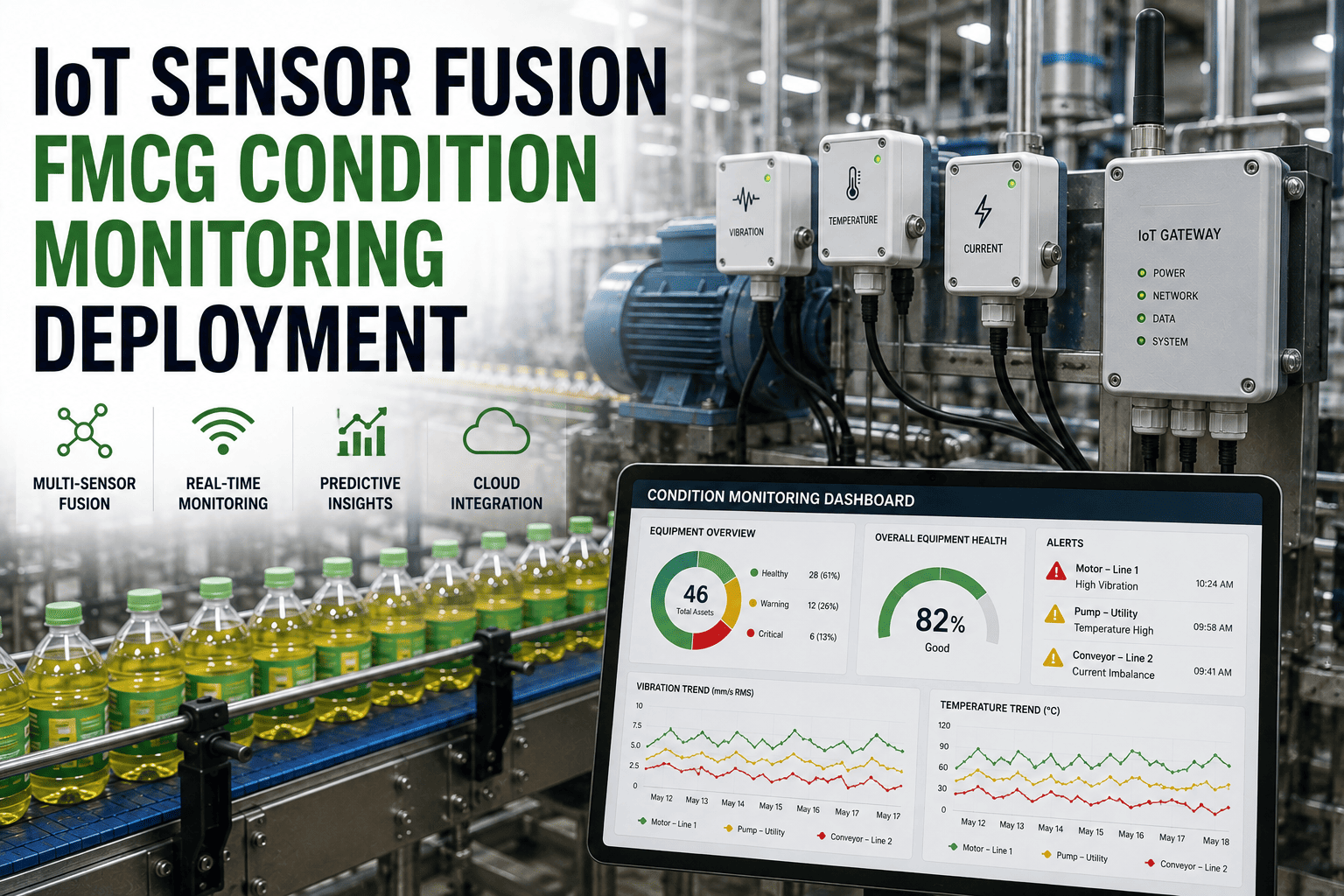
IIoT sensors are the cheapest line item in any predictive maintenance program and the line item with the highest hidden failure rate. A vibration sensor rated IP67 will look fine on the bench, get specified for a yogurt filling line, and fail within 90 days when the daily caustic CIP washdown drives water into the electronics. The plant team then concludes "IIoT does not work in FMCG" when the actual problem is sensor selection. The fix is rigorous specification: IP69K for washdown zones, intrinsically safe rated where flammable atmospheres exist, and matched to the failure mode you are actually monitoring. Combined with a CMMS that automatically converts sensor readings into priority work orders, FMCG plants routinely cut unplanned downtime 25-35% and lift mean time between failures by 40%+. To see how OxMaint ingests sensor data from any vendor and triggers work orders automatically start a free trial or book a demo with our team.
IIoT Sensors · IP69K Washdown · Predictive Maintenance
IIoT Sensors for FMCG Plants: Vibration, Temperature, Power, and Acoustic
IIoT sensors fail in 6 months without IP69K rating. See the vibration, temperature, power, and acoustic sensor selection that survives caustic CIP washdown and integrates with CMMS for automatic work order generation.
IP Rating Washdown Survival
25-35%
Reduction in unplanned downtime with IIoT
40%+
Increase in mean time between failures
8 mm/s
Vibration RMS threshold for FMCG rotating equipment
6-12 mo
Typical ROI on IIoT sensor deployment
Understanding IIoT Sensors
What Are IIoT Sensors and Why Does Sensor Selection Matter So Much in FMCG?
Industrial Internet of Things (IIoT) sensors are network-connected devices that continuously measure physical conditions vibration, temperature, current, pressure, acoustic emission, humidity and feed the data into an analytics or CMMS platform for early failure detection. In an FMCG plant, sensors typically monitor motors, pumps, gearboxes, bearings, compressors, refrigeration systems, and process tanks. The promise is straightforward: catch failures developing weeks before they cause downtime, schedule the intervention as planned work, and avoid the 4-5x cost premium of reactive repair.
FMCG environments are the most punishing for sensor hardware in all of manufacturing. Daily caustic CIP washdown, steam exposure on process equipment, high humidity in cold storage, and physical impact from cleaning hoses all kill sensors not rated for the environment. The default IIoT vendor sensor (typically IP67) is designed for general industrial use and fails fast in food and beverage. The structural solution is IP69K-rated stainless-steel sensors specifically designed for hygienic environments and CMMS integration that turns sensor data into automated maintenance work, not just dashboards. Start a free trial to see the sensor-to-work-order workflow, or book a demo.
Four Sensor Types for FMCG
Four IIoT Sensor Categories Every FMCG Plant Should Deploy
Different failure modes require different sensors. A vibration sensor will not catch a bearing race that is overheating without spalling first. An acoustic sensor will not detect a power factor problem on an aging motor. Most FMCG plants deploy at least three of these four sensor types in combination the cross-correlation between types lifts fault detection accuracy from 55-65% (single method) to 94%+ (combined).
Sensor Type 01
Vibration Sensors
Triaxial accelerometers measure motor, pump, gearbox, and bearing health. Standard 8 mm/s RMS threshold for rotating equipment. Early indicator of imbalance, misalignment, looseness, and bearing wear.
Detects 70%+ of mechanical failures
Sensor Type 02
Temperature Sensors
RTD and infrared sensors monitor bearings, motor windings, and process temperatures. Sudden rises indicate lubrication failure, overload, or cooling system problems before catastrophic failure.
Early warning 24-72 hours pre-failure
Sensor Type 03
Power and Current Sensors
Motor current signature analysis (MCSA) detects rotor bar damage, air gap eccentricity, and bearing problems by analyzing current waveform harmonics. Non-contact, no shutdown required to install.
Catches electrical failures vibration misses
Sensor Type 04
Acoustic Emission Sensors
Ultrasonic sensors detect bearing damage at the earliest stage weeks before vibration signatures appear. Also detect compressed air leaks, steam trap failures, and electrical arcing.
2-8 weeks earlier than vibration alone
Industry Pain Points
Why Most FMCG IIoT Sensor Deployments Disappoint
Most FMCG plants have tried at least one IIoT pilot. Few have scaled successfully. The failure pattern is consistent: wrong sensor for the environment, no CMMS integration, and data dashboards that nobody acts on. If your last IIoT pilot disappointed, start a free trial to see the sensor-to-work-order workflow, or book a demo.
01
IP67 Sensors in Washdown Zones
Vendor-default IP67 sensors fail in 3-6 months under daily CIP. The replacement cost erases ROI. IP69K is the only safe specification for hygienic environments.
02
Data Lakes Without Work Orders
Sensors stream data to a dashboard. Nobody watches it 24x7. Failures still happen, just with a chart afterwards showing the warning that nobody saw.
03
Single-Sensor Monitoring Strategies
Vibration-only deployments miss electrical failures. Temperature-only deployments catch failures too late. Combined-sensor strategies deliver 94% fault detection vs 55-65% single-sensor.
04
Wrong Threshold Settings
Default vendor thresholds generate alert fatigue. Plant-specific baselines are essential. The vibration profile of a healthy filler in Allentown is different from one in Bangalore.
05
No Integration With CMMS
Sensor platform and CMMS run as separate systems. Maintenance team has to manually transcribe alerts into work orders. The data link breaks, the program fails.
06
Cabling Costs Exceeding Sensor Costs
Plants install $200 sensors with $1,200 of conduit and Ethernet. Wireless industrial sensors with 5-year batteries collapse the TCO and accelerate scale-out.
How Oxmaint Solves It
How OxMaint Turns IIoT Sensor Data Into Automated Maintenance Work
OxMaint is sensor-agnostic. It ingests data from any vendor over MQTT, REST API, OPC-UA, LoRaWAN, or LTE-M, and turns sensor readings into asset-linked condition records with automatic work order generation when thresholds are breached. The integration eliminates the data-lake-without-action problem that kills most IIoT pilots. Start a free trial or book a demo to see the sensor-to-work-order flow.
Multi-Vendor
Universal Sensor Ingestion
Connect sensors from any vendor over standard protocols. No vendor lock-in. Mix vibration sensors from one vendor with temperature sensors from another unified in one asset record.
Auto Work Orders
Threshold-to-Work-Order Triggers
When vibration crosses 8 mm/s RMS or bearing temp exceeds 85C, OxMaint auto-generates a priority work order with the sensor reading, asset history, and SOP attached.
Baselines
Plant-Specific Threshold Learning
Per-asset baselines learned from 30-90 days of operating data. Thresholds set above normal operating variance to eliminate alert fatigue while catching real degradation.
Combined Strategies
Cross-Sensor Fault Detection
Vibration plus temperature plus current together produce 94%+ fault detection accuracy. OxMaint cross-correlates all three on critical assets to confirm before generating work orders.
Mobile Alerts
Push Notifications to Technicians
Critical-threshold breaches push directly to the assigned technician's phone. No need to watch a dashboard. The system reaches the right person at the right time.
Multi-Site
Portfolio Sensor Health
Cross-site dashboards show sensor uptime, data quality, alert volume, and predictive accuracy by plant. Sensor program health becomes a portfolio-managed metric.
IP67 vs IP69K Sensors
Wrong Sensor vs FMCG-Grade Sensor Selection: Side-by-Side
| Specification | General IP67 Sensor | FMCG-Grade IP69K Sensor |
| Water exposure rating |
1m submersion, 30 min |
80C, 1450 PSI water jet |
| Caustic resistance |
Limited or none |
Validated for CIP chemicals |
| Enclosure material |
Plastic or anodized aluminum |
316L stainless steel |
| Connector seal |
O-ring rubber |
Hermetic potted |
| CIP washdown survival |
3-6 months typical |
5-10 years typical |
| Cost premium |
Baseline |
+30 to +60% |
| True TCO over 5 years |
Higher (replacements) |
Lower (single install) |
| FMCG environment fit |
Wrong choice |
Correct specification |
ROI and Predictive Outcomes
What Correctly-Specified IIoT Sensor Programs Deliver
25-35%
Reduction in Unplanned Downtime
FMCG plants combining IP69K sensors with CMMS-integrated work order generation routinely reduce unplanned downtime 25-35% within 12 months of deployment.
94%
Fault Detection With Combined Sensors
Vibration plus temperature plus current monitoring lifts fault detection accuracy from 55-65% (single method) to 94%+ the structural reason combined strategies outperform.
40%+
Increase in Mean Time Between Failures
Early intervention from predictive sensors extends mean time between failures by 40%+ on monitored assets. Bearings, gearboxes, and motors last meaningfully longer.
4.8x
Avoided Cost of Reactive Repair
Sensor-detected interventions are scheduled as planned work, avoiding the 4.8x cost premium of reactive repair the underlying economic engine of every IIoT program.
Frequently Asked Questions
FMCG IIoT Sensor Common Questions
Which sensor type should we deploy first if we can only afford one?
Vibration sensors are the highest-ROI first deployment for FMCG plants. They detect 70%+ of mechanical failures on rotating equipment, are easy to install with magnetic mounts on motors and pumps, and have well-established threshold standards (8 mm/s RMS for general FMCG rotating equipment). Add temperature sensors second, then current monitoring third.
Book a demo to see the typical deployment sequence.Do we really need IP69K sensors, or is IP67 close enough?
In CIP washdown zones (filling, mixing, packaging, anything that gets cleaned with caustic), IP69K is the only safe specification. IP67 sensors fail in 3-6 months under daily CIP exposure and the replacement cost erases the IIoT business case. In dry utility areas (compressors, motor control centers, dry warehouse), IP67 is acceptable. The 30-60% upfront premium for IP69K pays back in avoided replacement.
Start a free trial to see the sensor specification framework.Are wireless or wired sensors better for FMCG?
Wireless sensors are the right default for FMCG. The cabling cost for wired sensors typically exceeds the sensor cost 4-6x. Wireless sensors with 5-10 year batteries (LoRaWAN or LTE-M) eliminate the conduit and Ethernet drop costs that block scale-out. Wired sensors make sense only when continuous high-frequency streaming is needed for critical assets.
How does OxMaint handle alert fatigue from too many sensor alerts?
Two ways. First, plant-specific baselines are learned from 30-90 days of operating data so thresholds match actual normal variance instead of generic vendor defaults. Second, multi-sensor confirmation requires concurrent threshold breach on at least two sensor types before generating a work order on critical assets. Together, these eliminate the alert noise that kills most IIoT programs.
IIoT Sensors · IP69K · Combined Strategies · Free to Start
Stop Buying Sensors That Die in the First CIP Cycle
IIoT works in FMCG when sensors survive the environment and CMMS turns the data into automated work. OxMaint ingests from any vendor, generates work orders from threshold breaches, and learns plant-specific baselines to kill alert fatigue. The combined-sensor strategy that delivers 94% fault detection is built in. Live in days, not months.