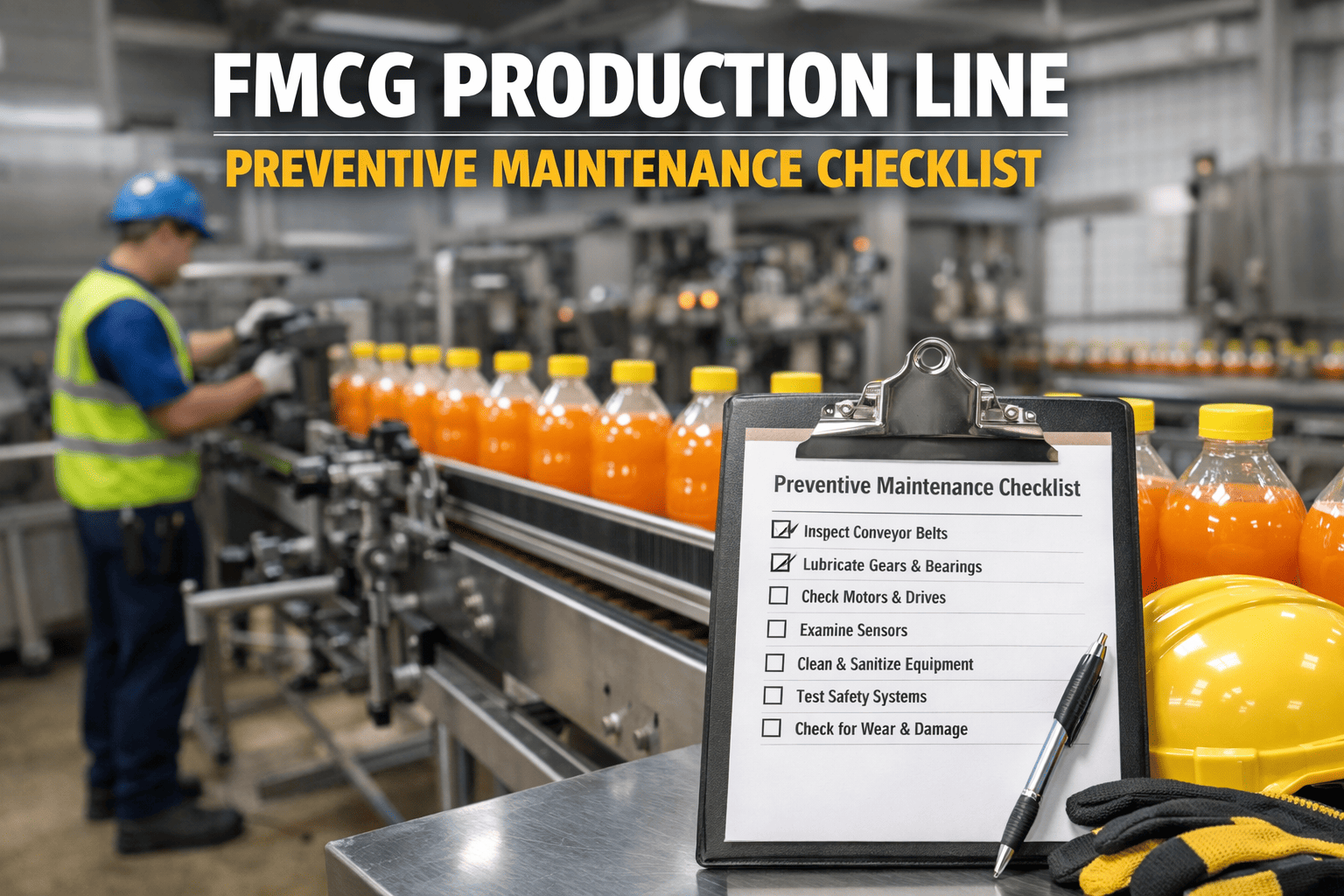
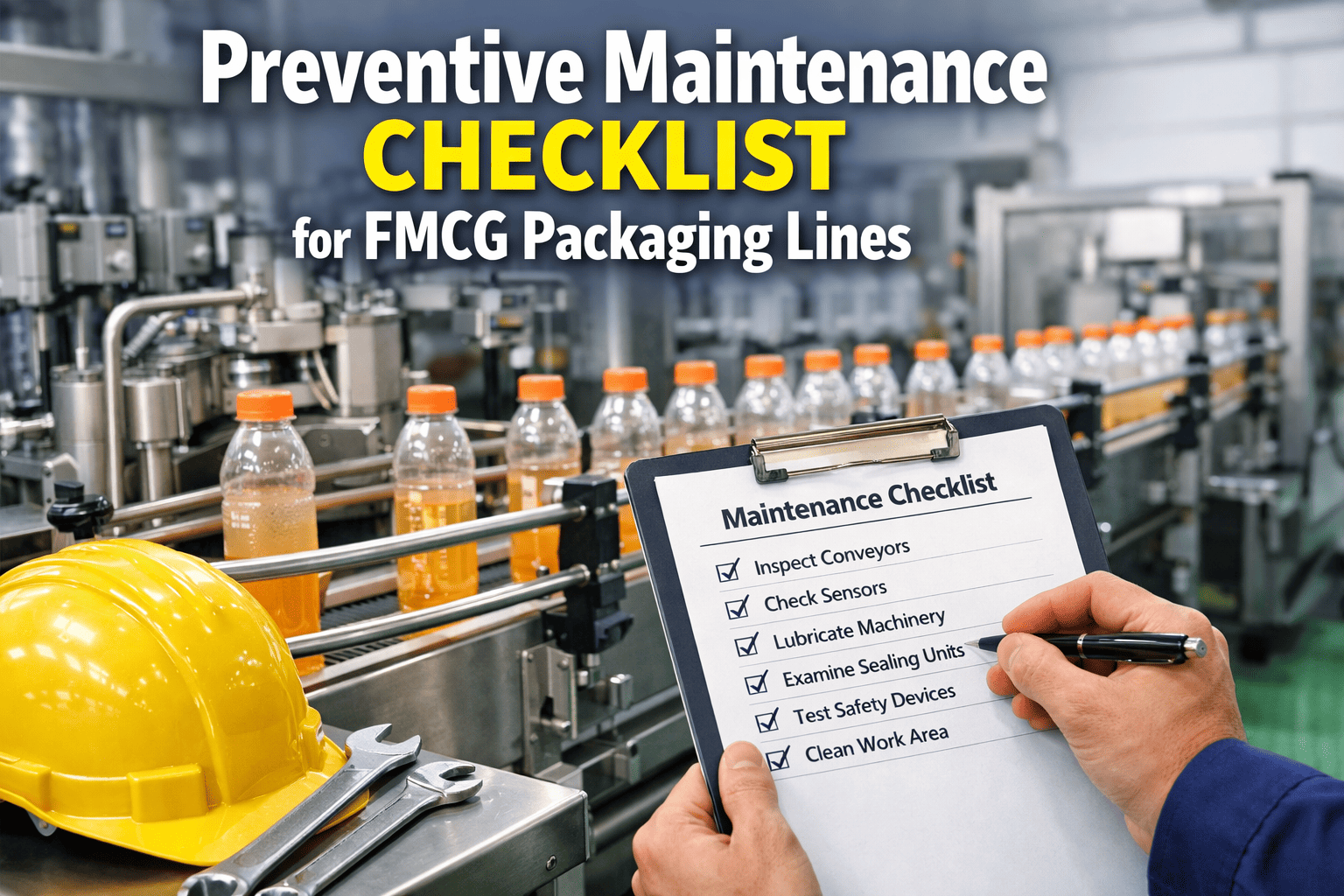
Packaging line maintenance is the operational foundation of FMCG production reliability. A filling line with 16-head nozzle cartridges, capping machine, conveyor system, labeler, case former, and palletizer represents 40+ critical maintenance points and 60+ preventive maintenance tasks per month. Without a structured checklist, maintenance becomes reactive: technicians respond to breakdowns instead of preventing them. With a documented, CMMS-tracked checklist, each equipment category has a specific maintenance rhythm. Fillers are inspected weekly and serviced monthly. Sealers are checked daily and recalibrated quarterly. Labelers are cleaned monthly and precision-tested quarterly. Coders are maintained on meter readings (every 50 million impressions). Conveyors are lubricated weekly and splice-inspected monthly. Palletizers are gripper-tested daily and mechanism-serviced semi-annually. When every task is documented in a CMMS, technicians can print their daily task list in the morning, execute it systematically, log completion digitally, and upload that proof to the compliance audit trail. FMCG plants using CMMS-tracked packaging line checklists reduce unplanned downtime by 40–50%, extend equipment life by 15–25%, and maintain audit readiness for BRC, SQF, and FSSC compliance. OxMaint's packaging line maintenance module provides pre-built checklists for every equipment type, customizable by manufacturer and model, with CMMS integration for task tracking, technician assignment, and compliance audit export.
FMCG Packaging Line Maintenance Checklist & CMMS 2026: Complete PM Guide
Complete packaging line maintenance checklist for FMCG plants: fillers, sealers, labelers, coders, conveyors, case formers, palletizers. Daily, weekly, monthly, and quarterly PM tasks organized by equipment type. CMMS-tagged production-safe vs. production-disruptive maintenance scheduling. Track every task completion, maintain compliance-ready documentation, achieve 40–50% downtime reduction through systematic preventive maintenance. Transform packaging lines from breakdown-prone to reliability-focused production assets.
Packaging Line Equipment Breakdown: Seven Critical Systems & Their Maintenance Demands
A typical FMCG packaging line consists of seven interdependent systems: (1) Filling system—pumps, nozzles, cartridges, fill accuracy sensors, clean-in-place (CIP) system. (2) Sealing system—seal jaws, temperature controls, timing cams, pneumatic cylinders, seal quality sensors. (3) Labeling system—label dispensers, adhesive systems, label detect cameras, applicator head, strip sorter. (4) Coding/Marking system—inkjet printer or laser coder, printheads/optics, fluid systems, cleaning systems. (5) Conveyor system—drive motors, reducer gearboxes, belt/chain, splices, idler rollers, diverters. (6) Case forming/Packing—glue application, folder mechanics, case erect, pack density sensors. (7) Palletizing system—robot arms, grippers, suction cup systems, precision positioning. Each system has distinct maintenance demands. Fillers and sealers require frequent calibration and precision verification (nozzle alignment, seal temperature, fill volume repeatability). Labelers require daily inspection and weekly deep cleaning to prevent adhesive buildup. Coders require maintenance on meter readings and frequent printhead cleaning to prevent blockage. Conveyors require constant lubrication and splice monitoring for wear. Palletizers require gripper maintenance and positional verification daily. The challenge for FMCG plant managers is: how do you create a unified maintenance program that accounts for seven different equipment types, each with different maintenance intervals, different technician skill requirements, and different compliance implications? The answer is an equipment-organized CMMS checklist where each equipment category has predefined PM tasks, those tasks are scheduled weekly/monthly/quarterly based on manufacturer intervals, technicians can filter their daily assignment to show only tasks relevant to their shift focus, and task completion automatically generates compliance documentation.
Filling Head Wear Monitoring & Preventive Replacement: The Most Common Packaging Line Failure
Filling head nozzle cartridge wear is the single most frequent cause of unplanned packaging line downtime in FMCG plants. A 16-head filler produces fill volume variability as cartridges age: head 1–3 remain accurate (±1%), heads 4–10 drift to ±2–3%, heads 11–16 drift to ±4–6%. Operators notice the drift in fill volume tolerances when QA flags weight variability. By that point, 5–8 cartridges are already significantly worn. Replacement of worn cartridges during production stoppage takes 4–6 hours (line down time, parts cost, labor). Preventive cartridge replacement—replacing all 16 cartridges proactively every 12 months or after 15 million doses filled, whichever comes first—costs $1,200 in parts, takes 2 hours during scheduled shutdown, and can be planned weeks in advance. The cost escalation from proactive to reactive is 5–7x: preventive = $1,600 total cost (parts + labor); reactive = $8,000–$12,000 (emergency parts expedited shipping, emergency labor premium, production downtime). CMMS checklist approach: track cumulative doses per filler monthly (from production reports), calculate days since last cartridge replacement, generate "cartridge replacement due" work order when 80% of 12-month interval is reached or 80% of 15 million dose target is reached. This proactive trigger gives plant 4–8 weeks to schedule replacement during a natural maintenance window, avoiding emergency conditions. Technician can plan the cartridge replacement task, order parts with standard lead time, and execute during a planned line shutdown. Fill volume variability never reaches critical levels; production quality stays consistent.
CMMS Checklist Benefits: From Paper to Digital Compliance Tracking
Paper-based packaging line maintenance checklists are printed weekly, completed by hand, stored in a binder, and retrieved for compliance audits. Digital CMMS checklists are generated from predefined tasks, assigned to technicians via mobile app, completed with digital timestamp, and automatically uploaded to compliance audit trail. The difference in audit readiness: Paper approach requires 4–6 weeks manual assembly before compliance audit ("pull all maintenance records, organize by month, create summary"). Digital approach requires <2 minutes automatic report generation ("export maintenance compliance report"). Paper checklists cannot track task completion rates or identify which technicians skip tasks. Digital checklists show: Technician A completes 95% of assigned tasks on time; Technician B completes 72% (needs coaching). This visibility enables performance management and training. Paper checklists cannot alert technicians that a task is due. Digital checklists push mobile notifications: "Your 3 daily tasks are due: Filler nozzle inspection, Sealer jaw test, Labeler camera alignment." This reminder increases completion rates from 68% (paper) to 94% (digital). Paper checklists cannot be accessed during shift if they're in the office. Digital checklists work offline on mobile devices and sync to cloud when connectivity returns. This flexibility means night shift technicians always have current task list regardless of WiFi conditions. CMMS packaging line checklists also enable maintenance scheduling optimization: if Monday requires 8 tasks, Tuesday requires 6, Wednesday requires 10, CMMS can suggest rearranging tasks to smooth workload: Monday gets 8, Tuesday gets 8, Wednesday gets 8. This load-leveling reduces technician fatigue and improves task quality.
Packaging Line Maintenance Checklist FAQ
"OxMaint's packaging line checklist eliminated our fill head crisis. Before, we'd get surprised by cartridge wear mid-production. Now the system alerts us at 80% of life, we schedule replacement during planned downtime, parts arrive on schedule, and we never have emergency fill head failures. It's a simple thing—just disciplined maintenance scheduling—but it's saved us thousands in unplanned repairs and dozens of production hours per month."
— Vikram Singh, Production Engineer, FMCG Beverage Manufacturer, Maharashtra
Master Packaging Line Maintenance with CMMS-Tracked Checklists
OxMaint provides pre-built maintenance checklists for every packaging line equipment type: fillers, sealers, labelers, coders, conveyors, case formers, palletizers. Daily, weekly, monthly, quarterly tasks organized by equipment, assigned to technicians via mobile app, tracked with digital completion proof, and automatically exported for compliance audits. Stop reactive breakdown maintenance. Start predictive preventive discipline. Reduce downtime 40–50%, extend equipment life 15–25%, maintain zero compliance gaps. Deploy in 48 hours.