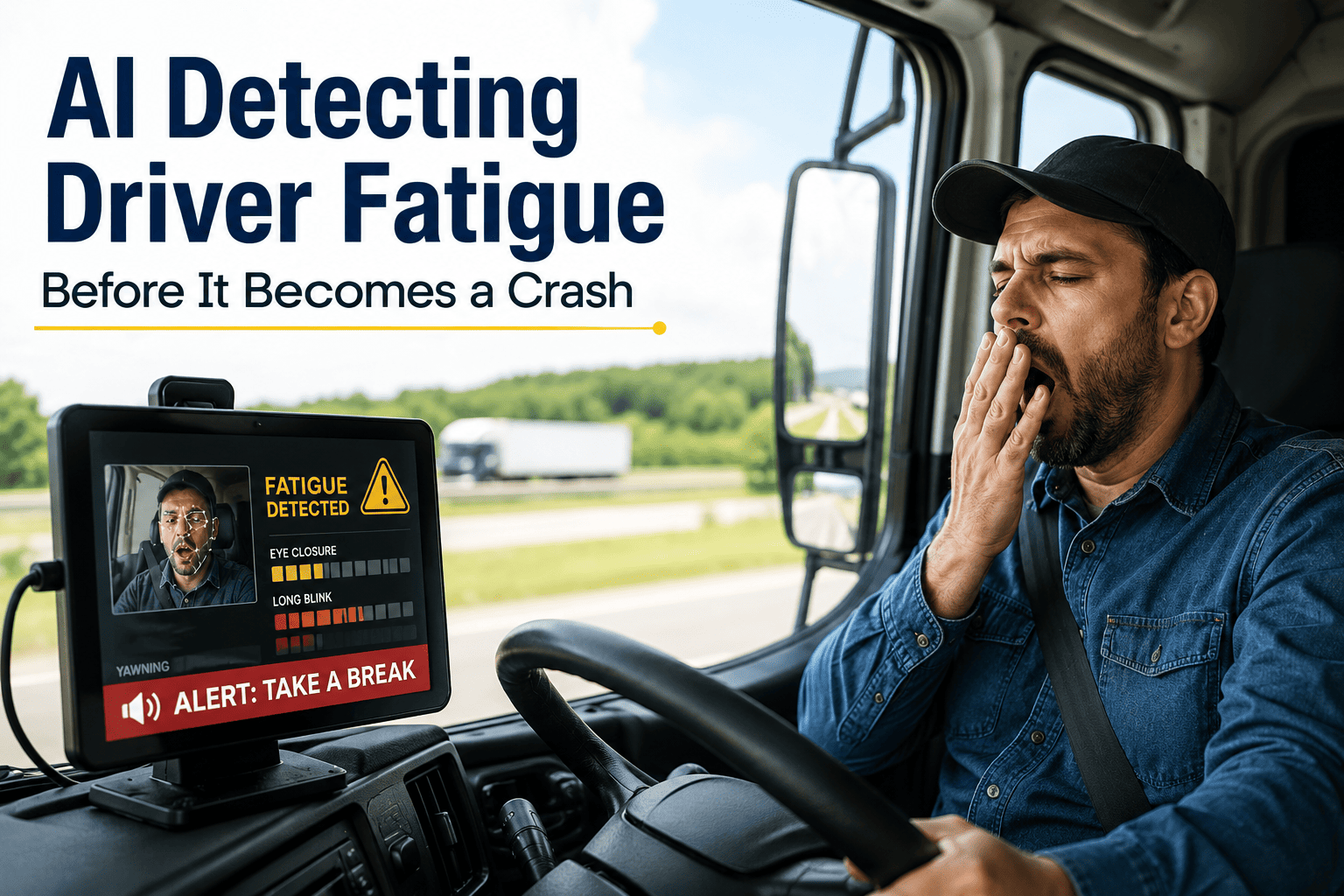
A driver can pass every pre-trip inspection, stay fully compliant with Hours of Service rules, and still be seconds away from a preventable crash — because fatigue and distraction leave no mark on a vehicle checklist. Drowsy driving is linked to more than 100,000 crashes a year in the United States alone, and a driver texting behind the wheel of a commercial vehicle is roughly 23 times more likely to be involved in a safety-critical event. These are not rare edge cases; they are the two risk categories fleet safety programs most often manage reactively instead of systematically. If your fleet is still relying on Hours of Service compliance alone to catch fatigue, start a free trial with Oxmaint to see how a structured program closes the gap.
Fleet Fatigue & Distraction Risk Management: The Two Causes Inspections Can Never Catch
Fatigue and distraction do not show up on a maintenance sheet, a pre-trip checklist, or a compliance audit. They show up in the crash report — after the damage is done. Managing this risk means combining Hours of Service data, in-cab behavior signals, and a coaching workflow into one system instead of three disconnected ones.
Why Fatigue and Distraction Slip Past Standard Safety Checks
Most fleet safety programs are built to catch what a checklist can see: worn tires, cracked mirrors, expired documents. Fatigue and distraction are behavioral, not mechanical, and behavioral risk only becomes visible after a near-miss or a claim. A driver can be fully rested on paper and dangerously impaired in practice, because Hours of Service tracks time off duty — not sleep quality, sleep disorders, or how monotonous a route actually is.
What a Single Fatigue or Distraction Incident Actually Costs
The reason this risk gets underfunded is that it is invisible right up until the moment it becomes very expensive. Per-fatality crash costs to employers commonly exceed $750,000, employer crash costs across US fleets total an estimated $60 billion a year, and roughly one in five fleet vehicles is involved in a crash annually. Insurance carriers price all of this in, which is why premiums keep climbing for fleets that cannot show a documented safety program.
Relative Crash Risk by Driving Condition
Not every hour on the road carries the same risk. Fatigue and distraction compound with specific conditions — time of day, shift length, and route type — and fleets that schedule around these patterns see measurably fewer incidents than fleets that treat every hour as equal risk.
Turn Fatigue and Distraction From a Post-Incident Report Into a Preventable Signal
Oxmaint connects HOS data, telematics behavior scoring, and maintenance work order history into one asset and driver record — so a fatigue or distraction pattern surfaces as a coaching alert, not a crash report.
The 6 Pillars of a Fatigue and Distraction Risk Program
A defensible fatigue and distraction program is more than a dashcam and a policy memo. It is a closed loop that turns raw behavior data into a specific corrective action for a specific driver, tracked over time.
How Risk Builds Across a Single Shift
Fatigue risk is not constant — it climbs predictably as a shift progresses, which is exactly why scheduling data matters as much as monitoring data.
How a Fatigue or Distraction Flag Turns Into a Fixed Behavior
Detection technology only has value if what happens after the alert is just as structured as the alert itself. This is the sequence that separates fleets that reduce incidents from fleets that just collect data nobody reviews.
Fatigue and Distraction Detection Approaches Compared
Fleets typically layer more than one detection method. Knowing what each one actually catches — and what it misses — determines whether the program closes gaps or just adds data nobody reviews.
| Detection Method | What It Catches | What It Misses |
|---|---|---|
| HOS / ELD Logs | Hours driven, mandated rest periods | Actual sleep quality during rest |
| Telematics Behavior Data | Harsh events, lane drift, following distance | Root cause behind the behavior |
| Cabin-Facing AI Detection | Eye closure, head nod, phone use in real time | Fatigue building before visible signs appear |
| Coaching Workflow + CMMS | Pattern trends across time and links to incident history | Nothing — this is the layer that closes the loop |
What Oxmaint Automates for Fatigue and Distraction Risk
Fatigue and distraction data is only useful if it reaches a person who can act on it before the next shift starts. Oxmaint routes that data automatically instead of leaving it buried in a telematics export.
Frequently Asked Questions
Can Hours of Service compliance alone prevent fatigue-related crashes?+
What is the single biggest source of distraction in commercial fleets?+
How much can a structured fatigue program actually reduce incidents?+
Does cabin-facing AI detection replace driver coaching?+
Should scheduling be adjusted based on fatigue risk data?+
Stop Managing Fatigue and Distraction After the Incident Report Arrives
HOS integration, telematics behavior scoring, coaching workflow automation, and incident-to-corrective-action tracking — all in one system built to catch the risk inspections never see.