A single mixed-use asset can hold a residential tower expecting concierge-level quiet, a retail podium expecting extended weekend hours, and an office floor expecting weekday-only HVAC — all sharing one roof, one loading dock, and one facilities budget. Generic FM playbooks built for single-use buildings break down fast here, because a repair that is routine for retail can be a lease violation for residential, and a shared chiller failure becomes three different tenant conversations at once. The operational question is never just "what broke" — it is which service level applies, who pays for it, and which tenant agreement governs the response. Portfolios that get this wrong end up with cost disputes that outlast the maintenance ticket itself. OxMaint's multi-use facility platform applies the correct SLA and cost allocation automatically based on which zone raised the request.
Multi-Use Operations · Facility Management
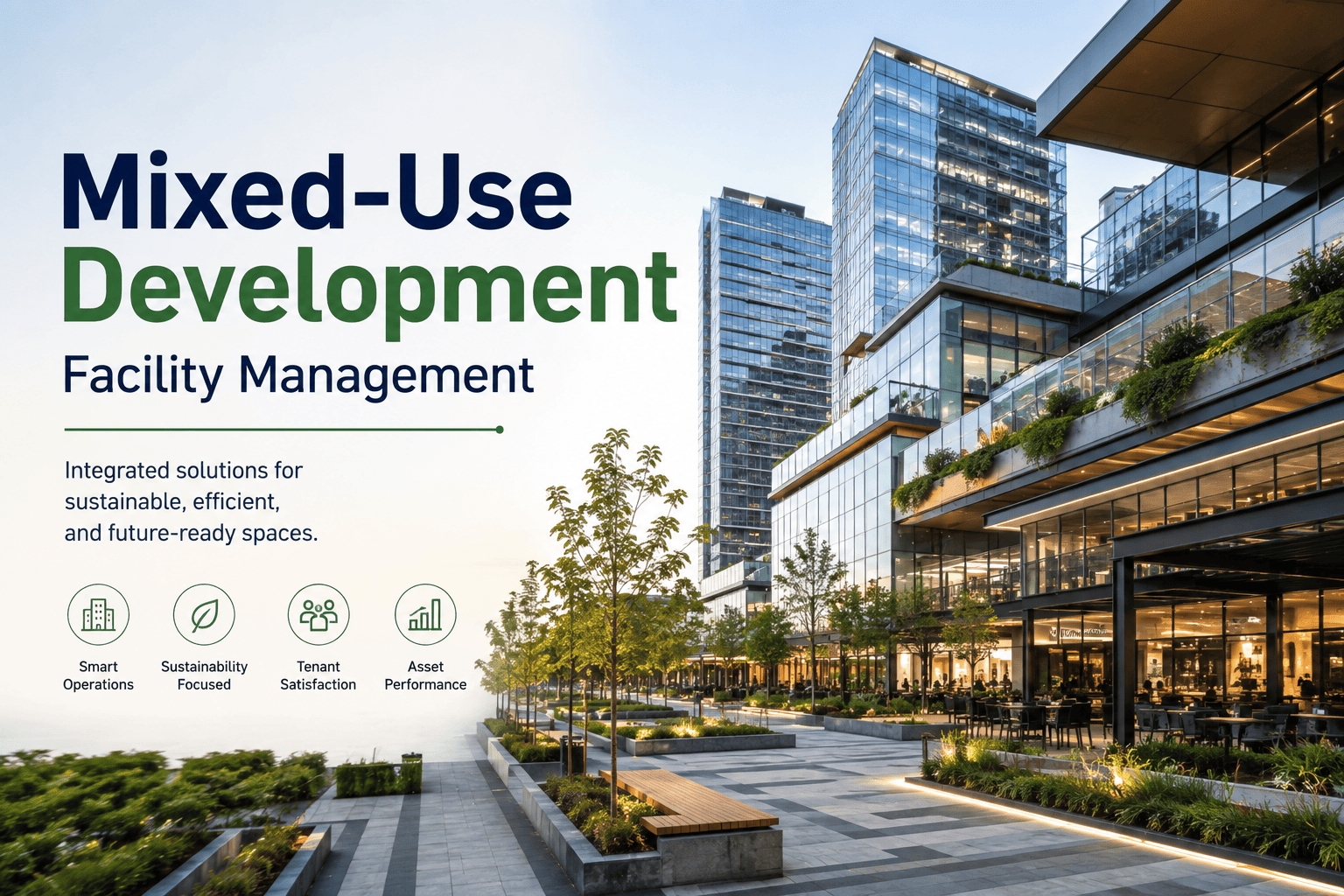
Mixed-Use Development Facility Management
Residential, retail, office, and amenity spaces under one roof — each with different SLAs, hours, and cost owners.
4+
Distinct service tiers typically running in one mixed-use asset
30%
Of CAM disputes traced to unclear shared-cost allocation
24/7
Coverage typically required across at least one zone
One Roof, Four Different Rulebooks
Each zone in a mixed-use asset carries its own expectations for response time, hours of coverage, and who ultimately pays the bill.
Residential
Coverage: 24/7 emergency, business-hours routine
Cost owner: HOA / building operating budget
Sensitivity: noise, access notice, quiet hours
Access rule: 24-hour tenant notice for non-emergency entry
Retail
Coverage: extended, weekend and holiday peaks
Cost owner: tenant lease + CAM split
Sensitivity: zero downtime during trading hours
Access rule: after-hours work only, before store opening
Office
Coverage: weekday business hours, after-hours by request
Cost owner: tenant lease + base building split
Sensitivity: HVAC comfort, elevator uptime
Access rule: tenant escort required for suite entry
Amenity & Hospitality
Coverage: extended, event-driven scheduling
Cost owner: shared operating budget
Sensitivity: guest-facing appearance standards
Access rule: work scheduled around booked events
Where Mixed-Use Operations Break Down
The same friction points show up across most mixed-use portfolios, usually at the boundary between two zones or two tenant agreements.
Shared Asset Disputes
A rooftop unit serving both retail and office space raises the question of who pays before repair can even start.
Conflicting Work Windows
Noisy repair work scheduled for retail hours can violate residential quiet-hour clauses one floor above.
Vendor Access Confusion
A single vendor dispatched for one zone needs different credential and escort rules to enter another.
CAM Reconciliation Delays
Year-end CAM reconciliation stalls when cost allocation was tracked manually across separate spreadsheets.
Where Shared Costs Actually Split
Common area maintenance, security, and central plant costs need a defensible allocation method before the first invoice goes out — not after a tenant disputes it.
Central Plant (HVAC, chillers)
Split by conditioned square footage
Security & Concierge
Split by zone headcount and access points
Common Area Cleaning
Split by shared square footage
Landscaping & Exterior
Split evenly across all zones
Elevator & Vertical Transport
Split by floor count served per zone
Fire & Life Safety Systems
Split evenly across all zones by code requirement
Service Level Matrix by Zone
Response commitments only work when they are written down and applied automatically at the moment a request comes in.
| Zone | Emergency Response | Routine Response | Coverage Window | Escort Required |
| Residential |
30 minutes |
24 hours |
24/7 |
No, with notice |
| Retail |
20 minutes |
4 hours |
Extended + weekends |
No, after hours only |
| Office |
45 minutes |
Same business day |
Weekday business hours |
Yes, tenant staff |
| Amenity |
30 minutes |
8 hours |
Event-driven |
No, scheduled around events |
Expert Review
The mixed-use assets I see run into trouble almost always have the same root cause — one work order system treating a retail HVAC call and a residential HVAC call as identical tickets. They are not identical. The SLA, the notice period, and the invoice destination are all different, and a system that cannot tell them apart forces the facility manager to manually re-route every single request. Getting zone logic built into the intake process is what actually lets a lean team run a complex asset.
Marcus Webb, CFM — 17 years managing mixed-use and transit-oriented developments
Stop manually re-routing every request. OxMaint applies the correct SLA, coverage window, and cost allocation automatically based on which zone a request comes from.
Frequently Asked Questions
Can we set different SLAs for each zone within the same building?
Yes, SLAs, coverage windows, and escalation rules are configured per zone and applied automatically the moment a request is logged.
Sign up free to configure zone-level SLAs.
How does shared cost allocation get calculated for CAM billing?
Allocation rules — square footage, headcount, or even split — are set once per cost category and applied consistently across every invoice, removing the manual spreadsheet step.
Book a demo to see CAM allocation in action.
What happens when a shared asset like a chiller serves multiple zones?
Shared assets carry their own cost-split rule so a single repair invoice divides automatically across every zone it serves, with the split visible on the work order itself.
Can residential tenants and retail tenants use the same request portal?
Yes, one portal handles all zones. The system reads the requester's zone and applies the matching SLA and notice requirements without extra configuration.
Start free to set up your request portal.
How do after-hours events in amenity spaces get scheduled and staffed?
Event-driven coverage can be scheduled ahead of time so staffing and vendor dispatch adjust automatically for known peak dates instead of relying on standing coverage.
Run Every Zone on Its Own Rules — In One System
Automatic SLA routing, defensible cost allocation, and a single request portal for residential, retail, office, and amenity space.