Open-book and fixed-price FM contract models represent two fundamentally different approaches to facility management pricing — and the choice you make directly affects cost transparency, vendor behavior, and long-term budget control. In an open-book FM contract, every labor rate, material markup, and overhead percentage is visible to the client, while a fixed-price facility management agreement bundles those costs into a single periodic fee that hides the vendor's margin but shifts cost-overrun risk to the provider. FM cost transparency has become a board-level priority as portfolios grow, with organizations increasingly weighing open-book vs fixed-price facilities contracts to align commercial structure with asset performance goals. This guide compares both FM contract pricing models, explores when each protects your budget, and shows how OxMaint's AI-powered CMMS gives you the data infrastructure to enforce whichever model you choose — you can Start Free Trial today to see it in action.
Is your FM contract pricing model hiding margin — or hiding risk?
Fixed-price facility management agreements cap your spend but obscure true cost drivers. Open-book FM contracts expose every line item — but only if you have the asset-level data to verify it. OxMaint gives you the work-order and cost telemetry to negotiate, audit, and enforce either model with confidence.
How do open-book and fixed-price FM contracts compare?
The core difference between an open-book FM contract and a fixed-price facility management agreement is who bears cost-variation risk and how much pricing detail the client can inspect. Understanding this distinction is the first step toward FM pricing transparency.
Open-Book FM Contract
Every cost element — labor hours, wage rates, material invoices, subcontractor charges, overhead, and management fee — is disclosed and auditable. The client pays actual costs plus an agreed margin or fee percentage.
- Cost visibility: Full — every line item traceable
- Risk holder: Client absorbs cost variation
- Best for: Complex, variable, or high-trust portfolios
- Incentive: Vendor earns fee on actual work; no incentive to under-deliver
Fixed-Price FM Contract
The vendor quotes a single periodic fee (monthly or annual) covering a defined scope of services. Internal costs, margins, and risk buffers are bundled into that price and are not itemized to the client.
- Cost visibility: Low — margin and buffers hidden
- Risk holder: Vendor absorbs cost overruns within scope
- Best for: Stable, well-defined, repetitive service scopes
- Incentive: Vendor keeps savings from efficiency gains
Open-book vs fixed-price FM: full commercial model comparison
Beyond visibility and risk, the two FM commercial models differ across budgeting, auditability, change-order mechanics, and vendor behavior. Use this comparison to align the facility contract pricing model with your portfolio's risk profile.
| Dimension | Open-Book FM Contract | Fixed-Price FM Contract |
|---|---|---|
| Cost transparency | Full — actual labor, material, and overhead visible | Opaque — single bundled fee, no line items |
| Budget predictability | Variable — monthly costs fluctuate with actual work | High — same fee each period regardless of volume |
| Vendor margin | Disclosed fee % (typically 3–8% management fee) | Embedded and hidden (often 15–25% buffer) |
| Auditability | High — every invoice traceable to a work order | Low — client sees scope completion, not internal cost |
| Change-order handling | Transparent — change priced at agreed rates | Contentious — vendor incentivized to classify work as "out of scope" |
| Efficiency incentive | Shared — client benefits when vendor reduces hours | Vendor-only — savings retained as margin |
| Best use case | Variable demand, aging assets, mixed-use portfolios | Stable scope, mature assets, routine janitorial/HVAC |
| Switching cost | Moderate — requires robust work-order data to manage | Low to manage, high to exit (scope arguments) |
When does each FM contract pricing model protect your budget?
A 1.2-million-sq-ft corporate campus spending $1.4M annually on FM services illustrates the trade-off. Under a fixed-price agreement, the client pays $116K/month regardless of whether 400 or 700 work orders are completed. Under an open-book model with verified data, the same campus paid $92K in a low-activity month and $134K in a peak month — averaging $108K, a 7% annual saving driven by transparent pricing alone.
Choose open-book when demand is variable
If your portfolio has aging assets, seasonal demand swings, or mixed-use buildings where reactive maintenance volume is unpredictable, open-book prevents you from paying a flat margin on work that doesn't happen.
Choose fixed-price when scope is stable
Routine janitorial, landscape, and preventive maintenance on mature, well-documented assets suit fixed-price. You gain budget certainty and let the vendor absorb minor cost fluctuations.
Hybrid models are increasingly common
Many portfolios now use fixed-price for routine scheduled services and open-book for reactive/emergency work — splitting the FM commercial model to optimize both predictability and transparency.
Neither model works without data
Open-book requires work-order-level cost verification; fixed-price requires scope-completion tracking to prevent under-delivery. Both demand a CMMS with real-time asset and cost telemetry.
How OxMaint enforces FM cost transparency under any contract model
Whether you run an open-book facility contract or a fixed-price agreement, OxMaint's AI-powered CMMS and EAM platform gives you the asset-level data, work-order tracking, and cost analytics to audit vendor invoices, verify scope completion, and negotiate from a position of evidence — not assumptions.
Work-order cost tracking
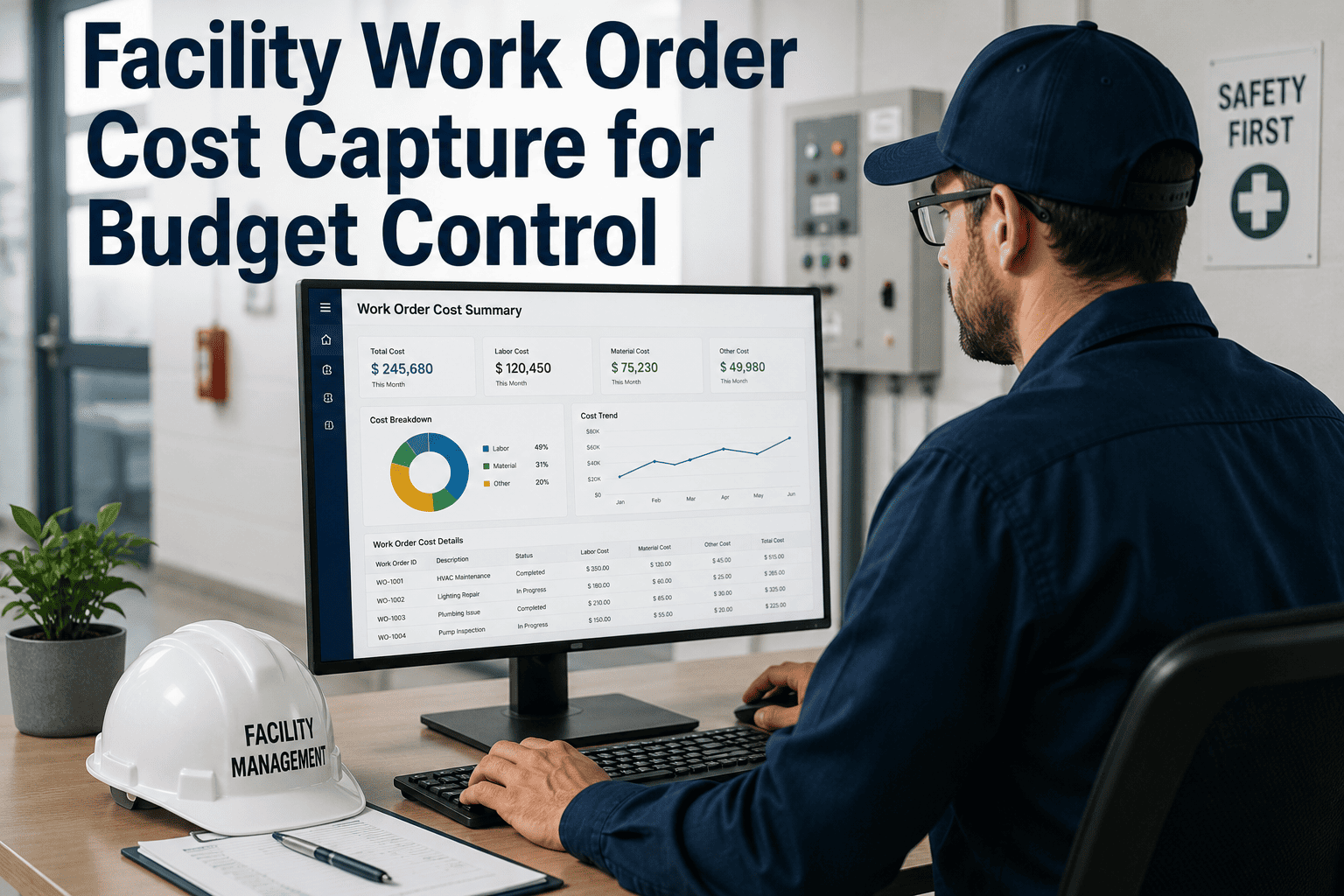
Every work order captures labor hours, parts consumed, and subcontractor costs in real time. Open-book invoices can be matched line-by-line to actual work performed — eliminating 90%+ of invoice disputes and exposing phantom charges.
Outcome: Cut invoice reconciliation time by 70%Cost analytics dashboards
Real-time dashboards break down spend by asset, site, trade, and vendor. Spot cost anomalies, compare actual spend to fixed-price scope, and validate that you're receiving the services you're paying for.
Outcome: Identify 12–18% in overbilling or under-deliveryAsset & equipment tracking
Full asset hierarchy with maintenance history, warranty status, and lifecycle cost per asset. Verify that fixed-price PMs were actually performed on the correct equipment — and track which assets drive the most cost under open-book.
Outcome: 30–50% reduction in unplanned downtimePredictive maintenance AI
OxMaint's AI analyzes asset sensor data and work-order history to predict failures before they happen. Under open-book, this reduces reactive labor spikes; under fixed-price, it prevents the vendor from classifying avoidable failures as "out of scope" emergencies.
Outcome: 25–40% fewer emergency work ordersWhat happens when you switch from fixed-price to open-book with data?
A 180-asset manufacturing facility spending $420K/year under a fixed-price FM contract transitioned to an open-book model after implementing OxMaint. Here's what changed in 12 months:
With OxMaint we could finally see that 31% of our fixed-price invoice was padding for risk we never experienced. Moving to open-book with real work-order data saved us $94K in year one — and our vendor relationship improved because every charge was verifiable.
— Facilities Director, 180-asset manufacturing plant
See exactly where your FM budget goes — book a 30-min demo
OxMaint shows you every work order, every cost line, and every asset in real time — so you can negotiate open-book rates, verify fixed-price scope, and stop paying for work you can't see.
Open-book vs fixed-price FM contracts — your questions answered
What is the difference between open-book and fixed-price FM contracts?
In an open-book FM contract, all costs — labor rates, material invoices, overhead, and management fees — are disclosed to the client, who pays actual costs plus an agreed margin. In a fixed-price facility management contract, the vendor charges a single bundled fee that includes an undisclosed margin and risk buffer. Open-book maximizes transparency; fixed-price maximizes budget predictability but hides true cost structure.
When should I choose an open-book facility contract?
Choose open-book when your maintenance demand is variable, your assets are aging or complex, or you have the data infrastructure to verify vendor invoices. Open-book works best when you can track work-order-level costs in real time using a CMMS like OxMaint — without that visibility, you cannot confirm whether the charges are accurate. You can Start Free Trial to test the tracking workflow on your portfolio.
Is a fixed-price FM contract more expensive?
Not always on the surface, but fixed-price contracts typically embed a 15–25% risk buffer and profit margin that the client never sees. If your actual maintenance demand is lower than the vendor estimated, you overpay. If demand is higher, the vendor may cut corners or reclassify work as out-of-scope to protect their margin. The hidden cost of fixed-price is the lack of efficiency-sharing.
Can I use a hybrid open-book and fixed-price FM commercial model?
Yes — and many large portfolios do. A common hybrid approach places routine, predictable services (janitorial, scheduled HVAC preventive maintenance, landscaping) under fixed-price for budget certainty, while reactive, emergency, and project work runs open-book so you only pay for actual labor and materials. This split requires a CMMS that can track and report costs by service category, which OxMaint provides out of the box.
How do I audit an open-book FM contract without a CMMS?
Auditing open-book invoices manually — matching paper work orders to timesheets, material receipts, and subcontractor invoices — is slow, error-prone, and typically catches only the most obvious discrepancies. A CMMS with digital work orders, real-time labor tracking, and automated cost matching can reduce reconciliation time by 70% and catch discrepancies that manual review misses. Book a demo at calendly.com/oxmaintapp/30min to see the audit workflow.
Take control of your FM contract costs today
Whether you're negotiating a new open-book agreement or auditing an existing fixed-price contract, OxMaint gives you the asset data, work-order tracking, and cost analytics to make every dollar verifiable. Start your free trial or book a personalized demo with our team.
Free 14-day trial · No credit card