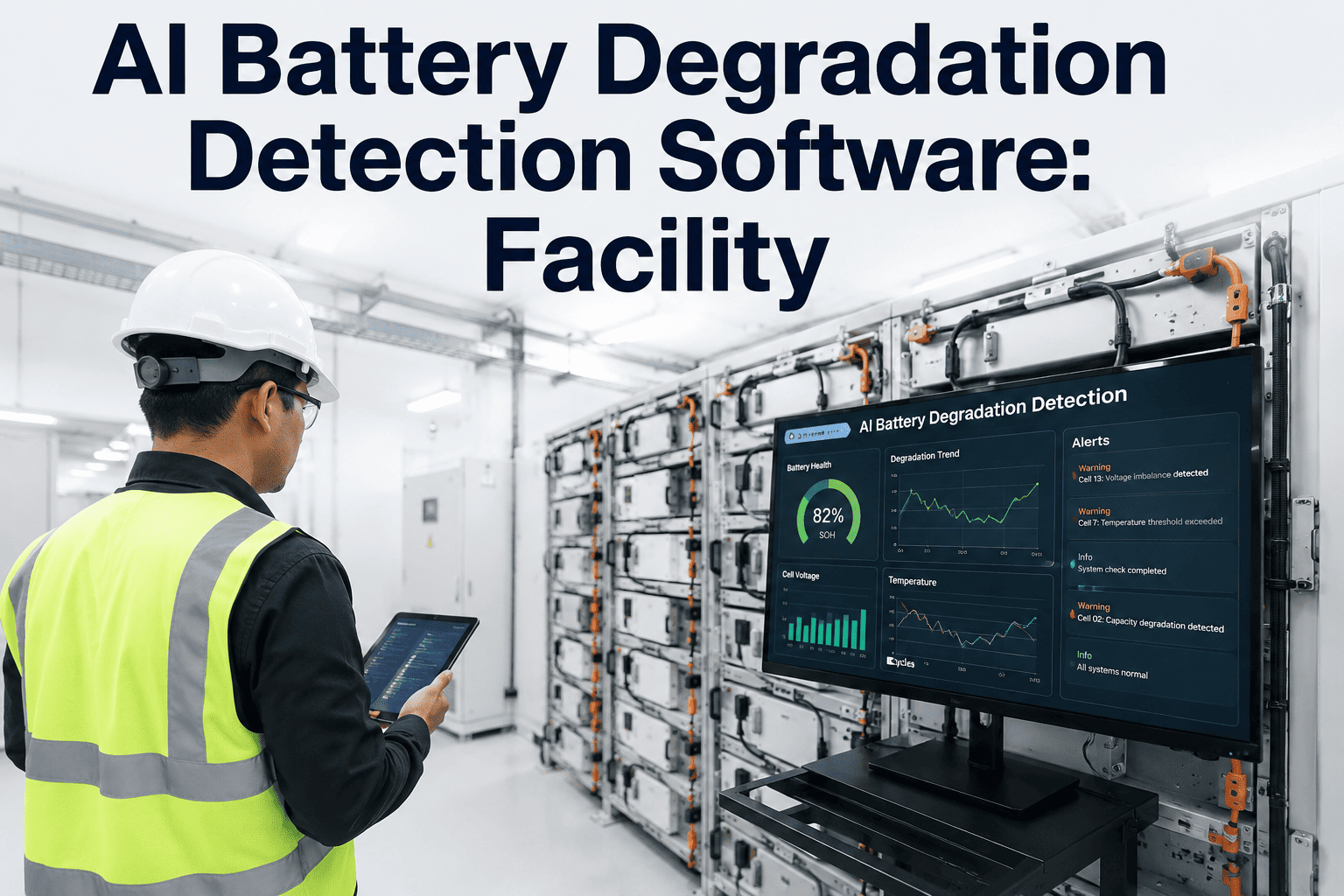
The worst time to discover a dying UPS battery is during the outage it was supposed to cover. Internal resistance climbs for months before a voltage sag ever shows up on a routine load test, and by the time a technician catches it manually, the battery is often days away from failure. Facility teams running UPS banks, diesel generator starting batteries, and BESS installations are realizing that periodic manual checks simply cannot catch degradation early enough to prevent an outage. Talk to our team about catching battery degradation weeks before it becomes a failure.
Battery Health Intelligence — 2026
AI Battery Degradation Detection Software for Every Facility Asset
From UPS strings to diesel generator starters to BESS racks, battery failure is rarely sudden — it is a slow drift in resistance, capacity, and voltage response that AI can catch long before a technician's next scheduled test.
Internal Resistance Drift
Capacity Fade Tracking
Cell Imbalance Alerts
End-of-Life Prediction
MonthsAdvance warning before a manual load test would catch degradation
3 TypesUPS, diesel generator, and BESS batteries covered in one dashboard
24/7Continuous monitoring instead of quarterly or annual checks
PredictiveReplacement scheduling based on remaining useful life, not calendar age
Where Battery Degradation Hides From Manual Testing
Battery failure is a process, not an event. It moves through predictable stages, but most facilities only test at fixed intervals, which means degradation can pass through several stages completely undetected between checks.
1
Healthy Baseline
Voltage, internal resistance, and capacity all sit within manufacturer-rated tolerances under load and at rest.
2
Early Resistance Drift
Internal resistance begins rising slightly, invisible on a simple voltage check but detectable in continuous impedance data.
3
Capacity Fade
Runtime under load starts shrinking, sulfation or cell imbalance sets in, and recharge times gradually lengthen.
4
Voltage Sag Under Load
The battery can no longer hold voltage during a discharge event, the point most manual tests finally catch the problem.
5
Failure Risk Window
Thermal runaway risk rises in Li-ion systems, and starter batteries may no longer crank a generator when called on.
By the time stage four shows up on a scheduled inspection, the facility has already been running on a battery bank that would not have survived an actual outage. AI-based detection is built to flag stage two and three behavior long before that gap becomes a real risk.
How AI Detection Closes the Gap
01
Continuous Signal Capture
Sensors record voltage, temperature, internal resistance, and charge cycles from every battery string around the clock.
02
Pattern Recognition
Machine learning models compare live readings against healthy baselines and known degradation curves for the battery type.
03
Remaining Life Estimation
The system calculates a projected remaining useful life for each battery, not just a pass or fail status.
04
Automated Work Order
Flagged batteries automatically generate a replacement or inspection work order in the CMMS before failure risk peaks.
Stop Finding Out About Dead Batteries During an Outage
OxMaint tracks every UPS, generator starter, and BESS battery continuously, flagging degradation weeks before a scheduled test ever would.
Manual Load Testing vs AI-Based Degradation Detection
The difference between scheduled testing and continuous AI monitoring becomes clear once you compare how early each approach actually catches a failing battery.
| Detection Factor | Manual Load Testing | AI-Based Detection |
| Testing frequency |
Quarterly or annual |
Continuous, 24/7 |
| Earliest detectable stage |
Voltage sag under load |
Early resistance drift |
| Remaining life estimate |
Not typically available |
Projected per battery |
| Replacement planning |
Reactive, after failure |
Scheduled, before failure |
| Data trail for audits |
Manual log entries |
Automatic digital history |
Battery Types Covered in One Dashboard
UPS Battery Strings
Tracks per-cell voltage, internal resistance, and float charge behavior across VRLA and lithium UPS banks protecting critical IT and building loads.
Diesel Generator Starters
Monitors cranking voltage and state of charge so a generator does not fail to start the moment utility power drops.
BESS Racks
Watches cell-level imbalance, thermal signatures, and coulombic efficiency across battery energy storage system racks.
Rollout Path From Manual Checks to Predictive Monitoring
Facilities do not need to replace their entire battery fleet to start benefiting from predictive detection. Most sites move through the same five-step rollout.
01
Battery Inventory Audit
Catalog every UPS string, generator starter, and BESS rack across the portfolio along with age and last service date.
02
Sensor Integration
Connect voltage, temperature, and resistance sensors to the CMMS for continuous, automated data capture.
03
Baseline Calibration
The model learns healthy performance ranges specific to each battery chemistry and application before flagging anomalies.
04
Automated Alerting
Degradation signals trigger tiered alerts and auto-generated work orders based on projected remaining useful life.
05
Predictive Replacement Planning
Capital planning shifts from calendar-based replacement to data-driven scheduling tied to actual battery health.
From the Field: A Data Center Facilities Lead
We used to run quarterly load tests on our UPS strings and call it good practice. Twice we still had a string fail during an actual utility event because degradation had crept in between test cycles. Once we moved to continuous monitoring, the system flagged a resistance drift on one string almost two months before it would have shown up on our normal schedule. We replaced it during a planned maintenance window instead of during an outage, and that alone justified the investment.
Facilities Lead, Enterprise Data Center Operations
Battery degradation does not wait for your inspection calendar, and neither should your detection strategy. The facilities seeing the fewest surprise failures are the ones treating battery health as a continuous data stream rather than a quarterly checklist item. Start a free trial to see how early your own fleet's degradation signals actually start.
Frequently Asked Questions
01
How early can AI detect battery degradation compared to manual testing?
Continuous monitoring can flag early resistance drift and capacity fade weeks to months before a scheduled load test would catch the same battery approaching failure.
02
Does this work across UPS, generator, and BESS batteries?
Yes. The platform supports VRLA and lithium chemistries across UPS strings, diesel generator starters, and BESS racks in a single
connected dashboard.
03
What sensors are needed for degradation detection?
Voltage, temperature, and internal resistance sensors at the string or cell level provide the continuous data the detection models rely on.
04
Can this reduce unnecessary early battery replacements?
Yes. Remaining useful life estimates let teams keep healthy batteries in service longer instead of replacing on a fixed calendar schedule regardless of actual condition.
05
How does this integrate with existing maintenance workflows?
Flagged batteries automatically generate work orders inside the CMMS, so degradation alerts flow directly into technician schedules without manual handoffs.
See Battery Health Across Your Entire Portfolio
One dashboard for every UPS, generator, and BESS battery, with degradation flagged before it becomes downtime.