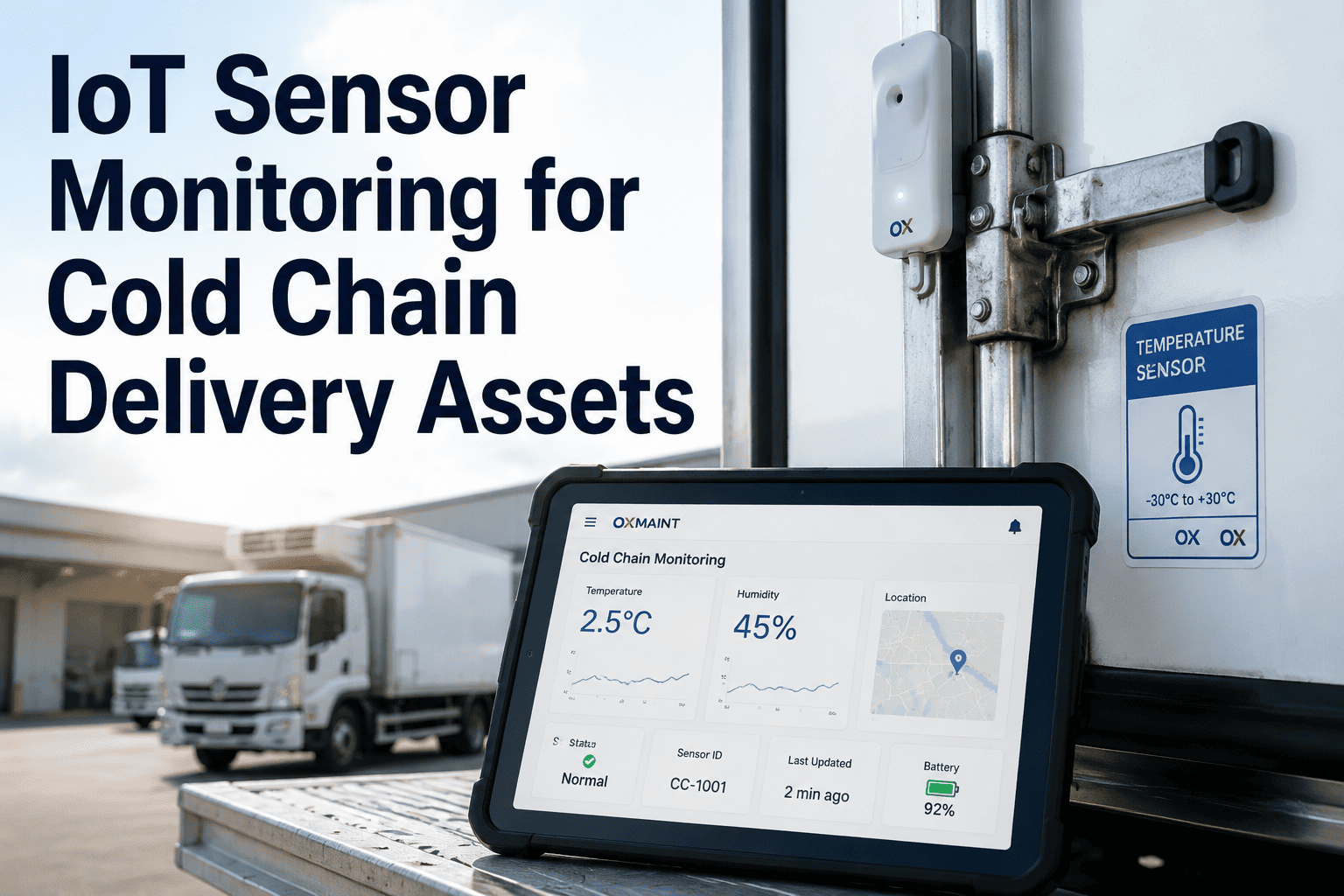
A temperature sensor that has failed does not stop talking — that is the part most delivery operations miss. It keeps sending numbers, the dashboard stays green, and the driver finishes the route believing the cold chain held. A drifting probe, a battery sagging in cold weather, or a logger stuck repeating its last reading all look identical to a healthy shipment until the product arrives warm. Cold chain failures cost the broader food and pharma supply chain more than $35 billion a year, and a meaningful share of that traces back not to a broken compressor but to a sensor nobody knew had already stopped telling the truth. OxMaint.ai exists to close that exact gap — catching the failure in the sensor before it becomes a failure in the shipment.
The Reading Looked Fine. The Sensor Was Already Lying.
Sensor drift, dead batteries, and stuck loggers don't announce themselves — they report plausible numbers right up until the product fails an audit or a customer call. AI monitoring inside OxMaint.ai watches the sensor's behavior, not just its output, so the silent failures stop being silent.
Five Ways a Temperature Sensor Fails Without Ever Throwing an Alarm
Sensor drift is a known, documented problem in temperature monitoring — accuracy degrades gradually from aging components, vibration, or environmental exposure, and once it starts, recalibration alone cannot undo the error. The five patterns below cover almost every silent failure mode operations teams encounter on delivery routes.
Gradual Calibration Drift
The most common and hardest to catch. The sensor's output slowly diverges from the true temperature, day after day, in one consistent direction. Because the change is gradual, no single reading looks wrong — only the long-term trend reveals it.
Frozen or Repeating Readings
A logger loses its sensing element or its firmware hangs, and it keeps transmitting the last value it recorded. The feed looks perfectly stable — suspiciously stable — while the box's real internal temperature climbs unmonitored.
Battery Sag in Cold Conditions
Lithium cells lose effective capacity as ambient temperature drops, and a sensor running on a weakening battery can report intermittent or rounded values right before it drops off the network entirely, often mid-route.
Sensor Moved Off the Product
A probe taped near a vent or door seam reads ambient air, not product temperature. The number is accurate for where the sensor sits — just not for what it is supposed to be protecting.
Connectivity Gaps Mistaken for Calm
A dropped cellular or Bluetooth link can mean the dashboard simply has nothing new to show — which a glance-and-go check can misread as "nothing happening" instead of "nothing reporting."
A Quiet Sensor Is Not the Same as a Quiet Shipment.
OxMaint.ai watches sensor behavior across your whole delivery fleet, not just the number on screen, so a drifting probe gets flagged as a maintenance issue long before it gets flagged as a customer complaint.
From Drifting Probe to Closed Work Order — How the Alert Actually Moves
Catching a failing sensor is only half the job. The other half is making sure the alert turns into an action before the next route leaves the depot. Here is the path a flagged sensor takes inside OxMaint.ai, end to end.
Behavioral Baseline Established
Every sensor on every vehicle and cold box builds a rolling baseline — typical variance, response speed after door openings, and recovery time after loading. This baseline is specific to that unit, not a generic spec sheet number.
Deviation Detected in Real Time
AI models compare incoming readings against the unit's own baseline and against peer sensors on similar routes. A probe that has gone unnaturally flat, lagged in response, or diverged from its peers gets scored as suspect immediately.
Work Order Generated Automatically
A flagged sensor creates a maintenance work order tied to the exact asset ID — not a generic "check temperature" ticket, but one naming the vehicle, the box, and the suspected failure mode.
Mobile Inspection Closes the Loop
A technician receives the work order on mobile with the sensor's recent trend chart attached, inspects or swaps the unit, and logs the result — feeding back into the baseline so future detection gets sharper.
What Sensor Failure Actually Costs a Delivery Operation
The dollar figures below reflect documented industry patterns from cold chain operators dealing with undetected sensor and equipment degradation. Book a demo to see how these costs map onto your own fleet size and route mix.
| Failure Caught At | What Happens | Typical Cost Impact |
|---|---|---|
| Pre-route inspection | Sensor swapped before the vehicle leaves the depot | Cost of the replacement sensor only |
| Mid-route, AI flagged | Driver redirected to backup unit or cooler at next stop | Partial route delay, product retained |
| Delivery, customer flags it | Product rejected, redelivery or credit issued | Full shipment value plus redelivery cost |
| Post-delivery, no one notices | Spoiled or compromised product reaches end use | Shipment loss, contract risk, audit exposure |
What Reliable Sensor Monitoring Actually Looks Like Day to Day
Daily Pre-Trip Verification
Each sensor checked against a known reference point before the vehicle leaves — a thirty-second step that catches dead batteries and obvious failures before they ever touch a route.
Continuous Behavioral Scoring
Every reading scored in the background against the unit's own history, not just compared to a fixed acceptable range that a drifting sensor could still fall inside.
Scheduled Physical Recalibration
Sensors pulled for verification on a fixed interval rather than waiting for a failure to surface, since most probes show no outward sign of drift until it is already significant.
Cross-Fleet Pattern Comparison
Sensors on similar routes and vehicle types compared against each other, so a single unit behaving differently from its peers stands out even when it is not technically out of range.
Mobile-Logged Replacements
Every swap, repair, and recalibration logged against the asset record on the spot, building the history that makes next quarter's predictions sharper than this quarter's.
Audit-Ready Trend History
Full sensor performance history retained and exportable, so a regulatory or customer audit gets answered with data instead of a shrug.
Frequently Asked Questions
The Next Sensor Failure Is Already Drifting. Catch It Before It Reports a Normal Day.
OxMaint.ai turns sensor behavior into work orders, inspections, and a clean audit trail — before a quiet dashboard becomes a customer's spoiled delivery.