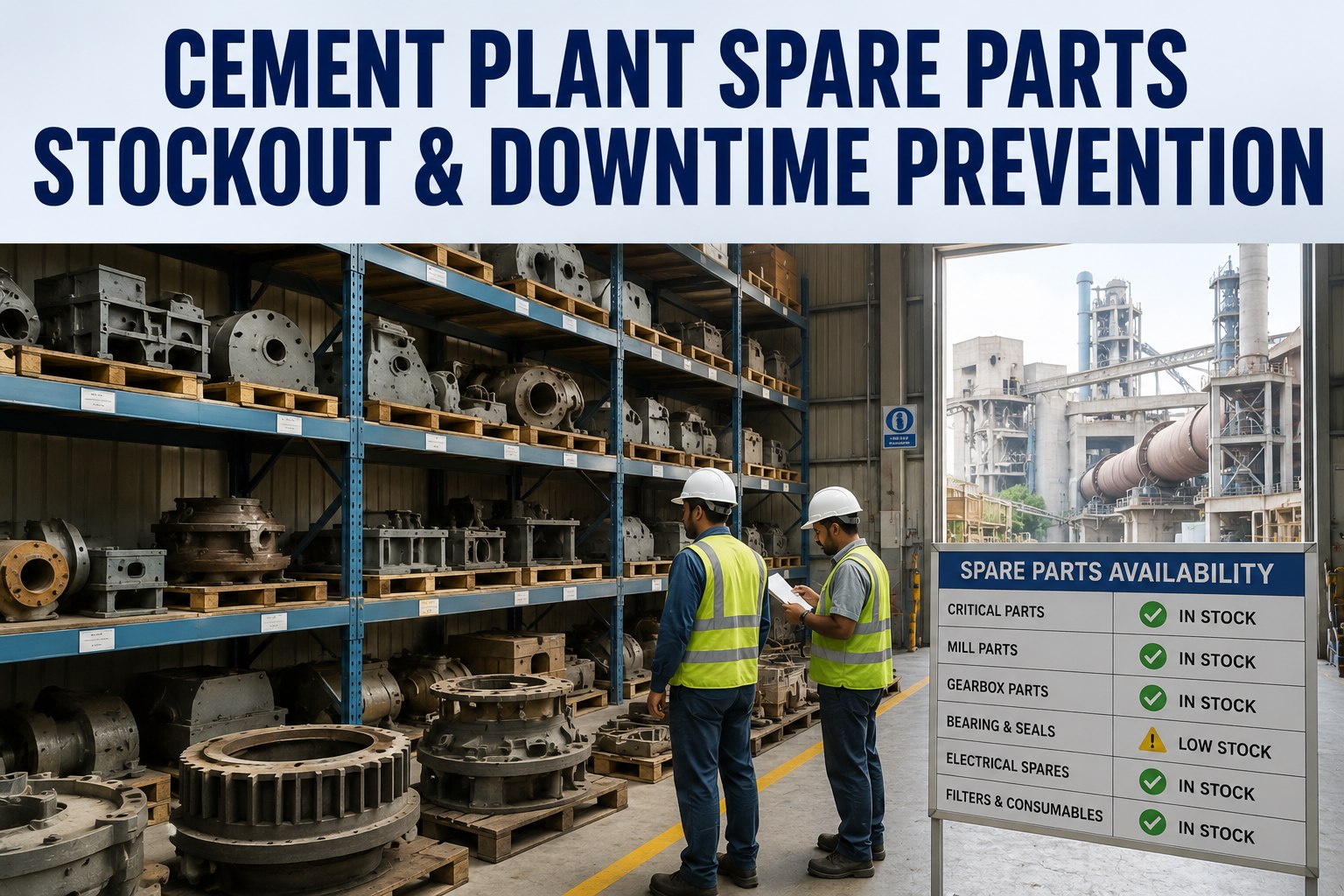
A single 10-hour kiln stoppage caused by a missing bearing can cost a cement plant between $800,000 and $1.5 million in lost production — more than the annual software license cost of an entire CMMS platform. Yet across the industry, 20 to 30 percent of all maintenance delays trace back to a stockout: the right part was not on the shelf when the crew needed it. This is not a procurement failure. It is a visibility failure. Plants that know what is on the shelf, what is consumed per week, and what lead time each supplier carries do not suffer stockouts — because the reorder trigger fires weeks before the shelf runs empty. OxMaint Inventory Alerts continuously monitor your cement mill spare parts levels, detect depletion trends, and trigger reorders at the correct time for every part that matters. Start a free trial and set your first stockout alert today.
INVENTORY — CEMENT MILLS
The Part That Stops a Mill Costs 3,000× More Than Keeping It in Stock
OxMaint Inventory Alerts monitor bearing, gearbox and liner levels across your cement mills — triggering reorders before stockouts occur and eliminating the emergency freight bills that inflate every reactive repair.
The Stockout Math Your Finance Team Needs to See
The Stockout Scenario
Ball mill trunnion bearing fails
Day 0
No stock — emergency procurement initiated
+2 days
Air freight: bearing at 3.8× standard cost
+$14,000
Mill down: 8 days total at $45,000/day lost output
$360,000
Total cost of one stockout event
$374,000+
With OxMaint Inventory Alerts
Stock reaches reorder threshold — alert fires
6 weeks out
Bearing ordered at standard cost, standard freight
+$3,700
Bearing on shelf — planned replacement during PM window
2-hr stop
Zero unplanned downtime, zero emergency freight
$0
Total cost managed with OxMaint
$3,700
ONE PREVENTED STOCKOUT PAYS FOR YEARS OF CMMS
Your Stockout Risk Is Higher Than You Think — See It Before It Hits
OxMaint maps every cement mill spare part to its asset, tracks consumption against history, and sets reorder triggers that account for supplier lead times — so the alert fires with enough time to act, not the day the shelf runs dry.
High-Risk Parts Across Cement Mill Equipment
Ball Mill
Trunnion bearings
Critical
8–14 wk lead
Shell liners
High
4–6 wk lead
Diaphragm plates
High
4–8 wk lead
Girth gear lubricant spray nozzles
Moderate
2–3 wk lead
Vertical Roller Mill
Roller tyres / grinding segments
Critical
8–12 wk lead
Table segments
Critical
6–10 wk lead
Separator rotor blades
High
4–6 wk lead
Dam ring sections
High
3–5 wk lead
Main Gearbox and Drive
Pinion gear bearings
Critical
10–16 wk lead
Input shaft seals
High
2–4 wk lead
Coupling elements
High
3–6 wk lead
Gearbox oil filter elements
Moderate
1–2 wk lead
How OxMaint Prevents Stockouts — Step by Step
Each spare is tagged by criticality tier, lead time, and minimum safe stock level. Critical parts like trunnion bearings and roller tyres carry zero-tolerance stocking rules — never depleted to zero under any circumstance.
02
Track Real Consumption
Every work order in OxMaint records actual parts consumed against the asset. Reorder triggers are calculated from real consumption frequency, not arbitrary min-max levels set years ago and never updated.
03
Alert at the Right Time
OxMaint calculates when to fire the reorder alert based on supplier lead time plus a safety buffer. A bearing with a 10-week lead time triggers reorder when stock reaches 12 weeks of coverage — not when the shelf hits zero.
04
Auto-Generate the Order
When a threshold is breached, OxMaint creates a purchase requisition — in the system directly or via SAP MM integration. The planner reviews and approves; they do not have to discover the gap manually.
Frequently Asked Questions
How does OxMaint set reorder points — do we define them manually?
You can set reorder points manually or let OxMaint calculate them from consumption history and supplier lead times. For parts with at least three months of consumption history, OxMaint recommends a reorder quantity and minimum stock level that you can accept or adjust.
Start a free trial to build your parts catalogue and reorder rules.
What if we have parts shared across multiple mills or plants?
OxMaint supports multi-location inventory visibility. Parts shared across two mills or two plant sites show combined stock levels with location breakdown — so a planner can see that three trunnion bearings sit at Site B before ordering from a supplier at premium freight.
Book a multi-site inventory demo to see shared stock visibility.
Can OxMaint alert us on abnormal consumption — not just low stock?
Yes. OxMaint monitors consumption rate against historical baseline. If a ball mill suddenly consumes three times the normal volume of seal kits in a week, the system flags it as an abnormal consumption event — an early indicator of a developing equipment problem that normal min-max alerts would miss entirely.
How does OxMaint handle high-value insurance spares like main gearboxes?
Insurance spares — components costing $50,000 to $500,000 that sit on the shelf for years — are managed as a separate tier with annual review triggers and risk-based stocking decisions. OxMaint tracks their location, condition, and storage requirements, and flags when holding cost review is due.
Does OxMaint show which stockouts are costing us the most production time?
Yes. OxMaint links each stockout event to the work order it affected, recording the delay in hours and the production loss cost assigned to that asset. The reporting dashboard ranks your highest-impact stockout risks so you can prioritise stocking decisions by financial exposure, not alphabetical order.
See the stockout risk dashboard in a free trial.
OXMAINT — CEMENT MILL INVENTORY ALERTS
Stop Discovering Stockouts When the Mill Is Already Down
OxMaint tracks bearing, gearbox, and liner inventory across your cement mills — alerting at the right time for every lead time, triggering reorders automatically, and eliminating the emergency freight cost that follows every stockout your team finds too late.