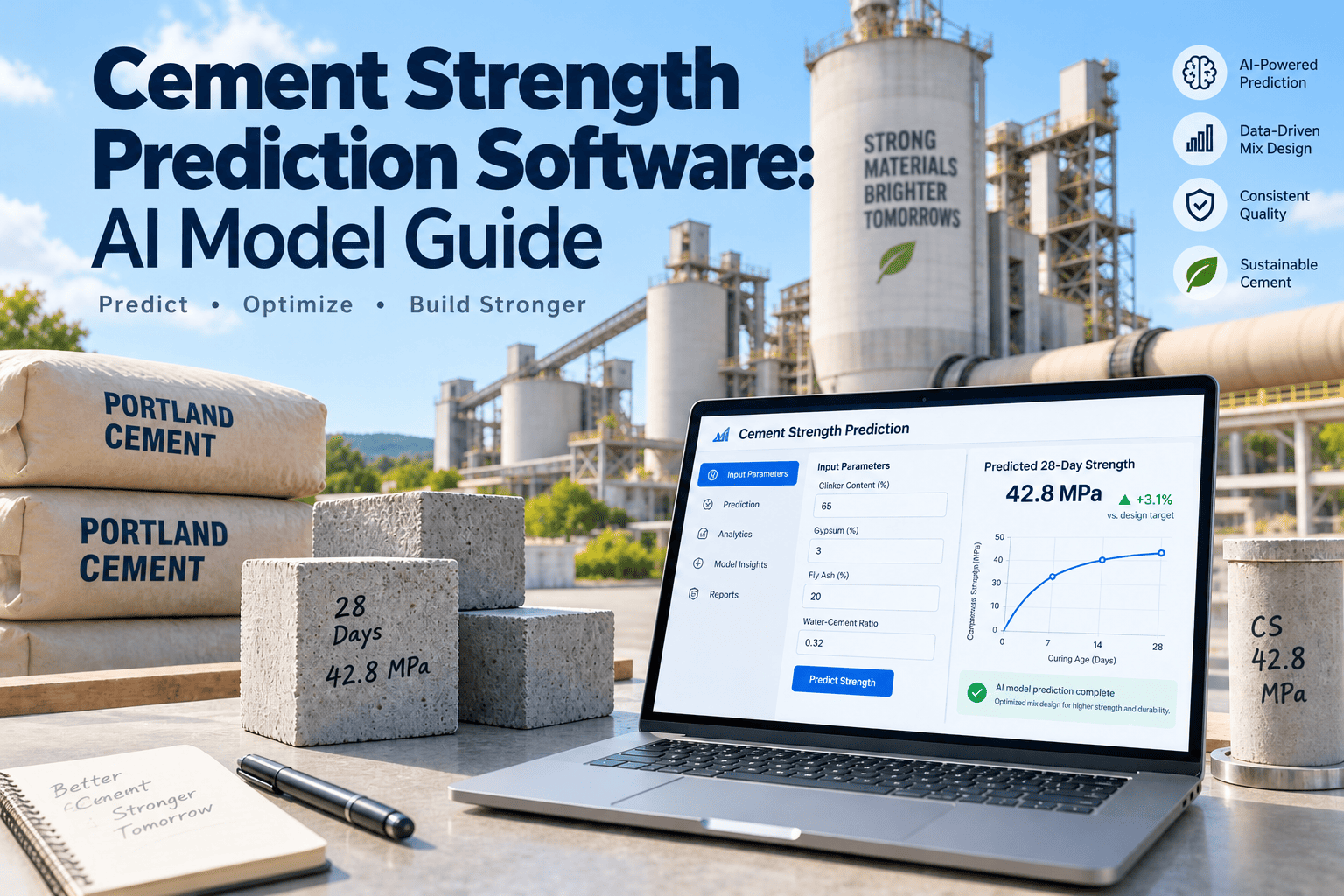
Cement Strength Prediction Software: AI Model Guide

By Corin Hale on September 12, 2026

cement-strength-prediction-software-ai-model-guide

Every batch of cement carries a 28-day question mark. The clinker is burned, ground, and shipped, but the one number that actually defines quality — 28-day compressive strength — is not confirmed until a full month after production, by which point thousands of tonnes have already left the plant. Quality teams have lived with this lag for a century, correcting kiln chemistry and grinding fineness based on a lab result that describes cement made four weeks ago rather than cement being made right now. AI strength prediction models change that timeline by combining clinker chemistry, Blaine fineness, and early-age strength readings into a live estimate of 28-day performance, often within 2 MPa of the eventual lab result. The plants adopting this fastest are not replacing the 28-day test — they are using prediction to catch a drifting batch days earlier than the test ever could. This guide breaks down what actually goes into a cement strength prediction model, how accurate today's approaches really are, and how OxMaint connects that prediction to your quality workflow batch by batch.

Cement Quality Control · AI Strength Prediction · CMMS Guide 2026

Cement Strength Prediction Software: The AI Model Guide

How clinker chemistry, Blaine fineness, and early-age data combine to forecast 28-day compressive strength within 2 MPa — days before the lab result ever comes back.

28
Days a plant traditionally waits to confirm final compressive strength on any given batch
<2 MPa
Prediction error achieved by the best current AI models forecasting 28-day strength
3x
Typical strength increase from early-age readings around 18 MPa to 28-day results near 52 MPa
0.96
Highest R-squared reported by ensemble machine learning models predicting compressive strength
The 28-Day Problem

Why Waiting a Full Month for Strength Data Is So Expensive

Compressive strength testing under ASTM C150 and EN 197-1 requires curing cement mortar cubes for 28 days before a final class-confirming result is available. That standard is not going away — it is the basis of cement grading worldwide — but it means any process drift that quietly lowers strength is invisible for a month, during which the plant keeps shipping product built on the same drifting inputs.

Day 0
Cement Is Ground and Shipped
Clinker chemistry, Blaine fineness, and gypsum dosage are locked in at this point, and everything downstream about the cement's eventual strength is already determined.
Day 1-7
Early Strength Data Becomes Available
One-day and seven-day mortar cube results start to reveal the hydration trend, offering the first real signal of where the batch is headed relative to specification.
Day 28
Final Strength Result Confirms Quality
The official class-confirming result arrives, by which point the plant has already produced and often shipped the next month's worth of cement using the same unverified process settings.
What Feeds the Model

The Data an AI Strength Model Actually Needs

Strength prediction is not guesswork dressed up as AI — it is a regression problem built on well-understood cement chemistry, and the accuracy of the model depends almost entirely on the quality and completeness of these five inputs.

Bogue Phase Composition
Calculated alite (C3S), belite (C2S), aluminate (C3A), and ferrite (C4AF) percentages are the strongest chemical predictors, since alite drives early-to-mid strength and belite governs long-term gain.
Blaine Fineness
Finer cement hydrates faster and develops early strength more quickly, making Blaine one of the single strongest fineness descriptors correlated with 28-day results.
Free Lime Content
Elevated free lime signals under-burnt clinker and is one of the most reliable early warning signs of a batch that will underperform its strength target.
SO3 and Gypsum Dosage
Sulfate content controls setting behavior and early strength development, and models that ignore it consistently underperform ones that include it.
Early-Age Strength Readings
One-day and two-day mortar cube results, when available, sharpen a 28-day forecast dramatically since they capture real hydration behavior rather than composition alone.
Bulk Density and PSD
Particle size distribution percentiles and bulk density round out the fineness picture beyond a single Blaine number, especially for blended cements with supplementary materials.
Cement Strength Prediction CMMS

See Strength Drift Before the 28-Day Test Confirms It

OxMaint connects clinker chemistry, Blaine readings, and early-age strength data into one quality record, so a drifting batch shows up as a flagged prediction instead of a surprise a month later.

Strength Development Curve

How Compressive Strength Actually Builds Over 28 Days

Cement does not gain strength on a straight line. The steepest gains happen in the first week as alite hydrates rapidly, while belite continues contributing strength well past 28 days — which is exactly why early-age data is such a powerful predictor when fed into a model correctly.


Day 1
~18 MPa

Day 3
~28 MPa

Day 7
~38 MPa

Day 28
~52 MPa
Values shown reflect typical median strength development patterns and vary by cement type, clinker chemistry, and curing conditions.
Model Accuracy Comparison

How Different AI Approaches Compare on Strength Prediction Accuracy

Modeling Approach Typical Error R-Squared Strength Best Fit
Gene Expression Programming ~3.7 MPa ~0.93 Produces a readable equation Teams wanting interpretability
Support Vector Regression ~5.0 MPa ~0.94 Stable on smaller datasets Plants with limited historical data
Artificial Neural Network ~5.4 MPa ~0.96 Captures nonlinear chemistry effects Plants with rich composition data
Transformer + Ensemble Models Under 2 MPa Highest reported Combines chemistry, fineness, and early strength High-volume plants with continuous data logging
From Lab Data to Live Prediction

How OxMaint Turns Quality Data Into an Early Warning System

01
Every Batch's Chemistry Logged Automatically
Clinker Bogue composition, Blaine readings, free lime, and SO3 results from the lab are attached directly to the batch record the moment they are entered, building the dataset a prediction model depends on.
02
Early-Age Results Feed the Forecast
One-day and seven-day mortar cube data update the 28-day forecast in real time as results come in, sharpening the prediction with every additional data point.
03
Drift Alerts Reach Quality Teams Before Shipment
When a batch's forecasted 28-day strength drifts toward a specification limit, an alert routes to the quality team with the contributing chemistry factors already identified.
04
Full Batch History Ready for Audit
Every prediction, lab result, and corrective action is stored against the batch record, giving quality managers a complete, exportable history for customer or certification audits.
One Record, Every Batch

Connect Clinker Chemistry to Strength Outcomes Automatically

OxMaint keeps chemistry, fineness, and strength testing data attached to every batch record, giving quality and production teams a shared, always-current view of where each product stands against its target class.

Common Questions

Cement Strength Prediction — Frequently Asked Questions

How accurate is AI-based cement strength prediction?+
The best current models, typically transformer or ensemble approaches combining chemistry, fineness, and early-age data, achieve prediction errors under 2 MPa against actual 28-day lab results, which is precise enough to support real production decisions.
What data does a cement strength prediction model actually need?+
The strongest models combine Bogue phase composition, Blaine fineness, free lime content, SO3 and gypsum dosage, and early-age mortar cube results, since chemistry alone leaves out real hydration behavior that early strength data captures.
Does AI prediction replace the 28-day compressive strength test?+
No — standards like ASTM C150 and EN 197-1 still require the 28-day physical test for class certification. Prediction is used alongside it, giving quality teams an early warning days or weeks before the official result confirms a problem.
How does OxMaint support cement strength prediction workflows?+
OxMaint attaches clinker chemistry, fineness, and strength test results to every batch record, updates forecasts as early-age data arrives, and alerts quality teams when a batch trends toward a specification limit. Start a free trial to connect your lab data.
Which chemical factor has the biggest impact on 28-day strength?+
Alite, or C3S, is generally the strongest single driver of early-to-mid strength gain, while belite, or C2S, contributes more to long-term strength, which is why models using full Bogue composition consistently outperform ones using a single strength indicator. Book a demo to see the full input model.
OxMaint · Cement Strength Prediction CMMS

Know Where Every Batch Is Headed Before the Lab Confirms It

OxMaint gives cement quality and production teams one platform to log clinker chemistry, fineness, and strength test data, track early-age trends against 28-day targets, and catch a drifting batch while there is still time to act.

Share This Story, Choose Your Platform!