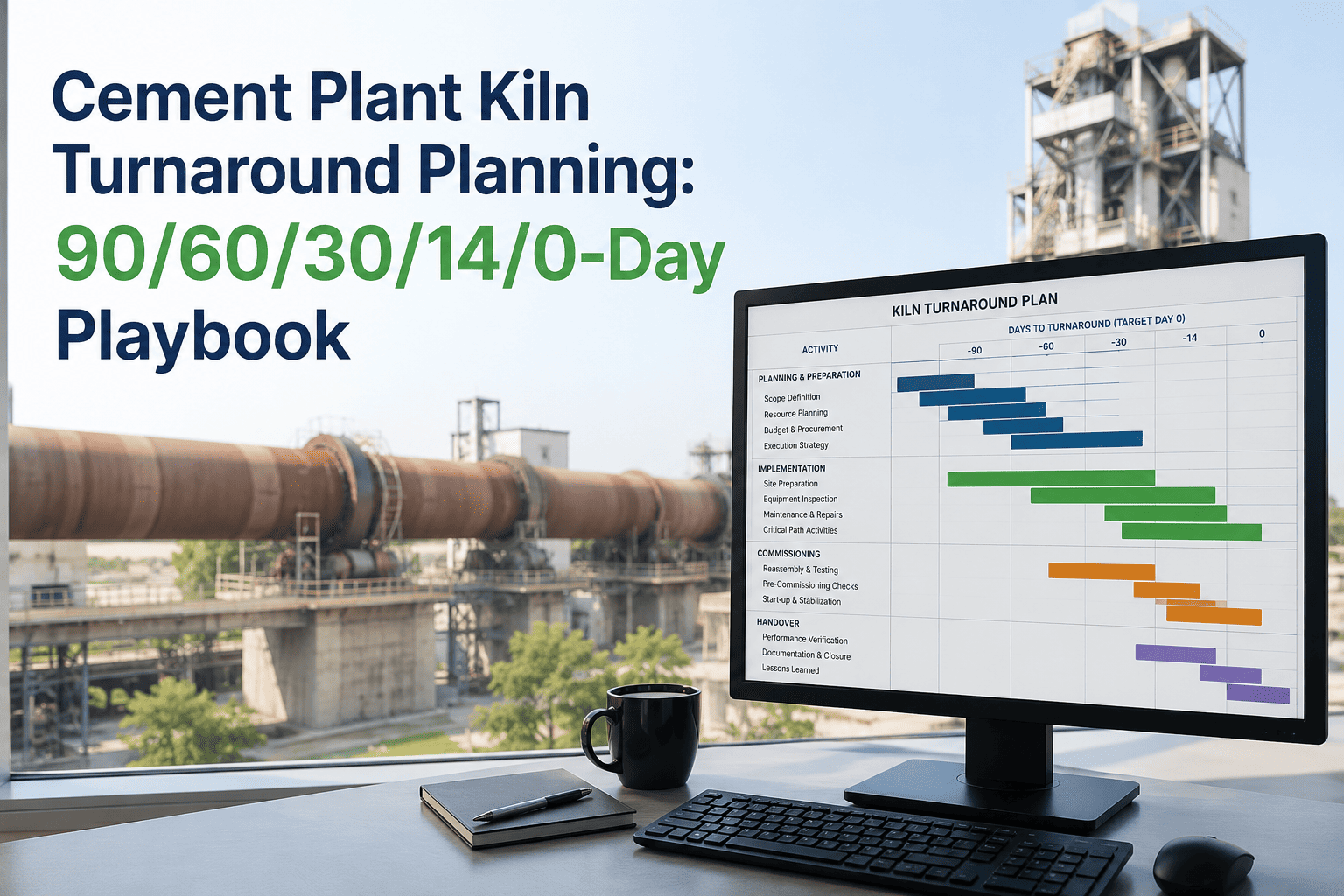
A cement kiln turnaround is the single most expensive 14 days on the maintenance calendar — and the single biggest opportunity to claw back production capacity for the year ahead. When the burning zone hits 1,450°C and a 60-metre rotating cylinder is bleeding refractory brick at an unplanned rate, every hour of slip costs $6,000 to $17,000 in lost clinker margin and 3.2× procurement premiums for emergency parts. The plants that finish 2 days under schedule are not lucky — they ran a disciplined 90-day countdown with scope locked, parts kitted, and contractor crews mobilised against a synchronised playbook. The ones that overshoot by 4 days are still discovering scope creep on Day 1 because their turnaround prep lives across email threads and three different spreadsheets. Oxmaint replaces all of it with a single digital outage workspace built specifically for cement turnaround managers.
The 90 / 60 / 30 / 14 / 0 day countdown that finishes kiln outages on time
Scope lock, parts kitting, contractor mobilisation, permit readiness, and CMMS-anchored execution records — sequenced into five enforceable milestone gates so your next refractory campaign comes in under the planned window.
Five milestone gates from scope kickoff to first feed
Every cement plant that finishes kiln turnarounds on schedule runs the same five-gate countdown. Skip a gate and the failure mode is predictable: parts arriving Day 3, contractor crews idle on Day 1, scope creep on Day 5, and a missed restart window that costs more than the entire planned scope. Each gate below has hard exit criteria that must be met before the next phase unlocks.
Every approved task, owner, duration estimate, and acceptance criterion enters a centralised scope library. Refractory zones are mapped, kiln shell scan data is reviewed, deferred PMs are pulled in, and capital projects are sequenced against the outage window.
Drag-and-drop sequencing with dependency rules surfaces every conflict before it reaches the field. The refractory reline almost always sits on critical path — every other task is sequenced around it. Contractor scopes of work are issued with quantified deliverables and daily milestone markers.
Pre-assembled kits for every work order land in zone staging areas — refractory brick by ring, mill liners by section, fan rotor balancing kits with all consumables. The material readiness dashboard tracks percentage staged by zone and flags any package with outstanding items.
Refractory contractor lead supervisors arrive for walk-throughs. Scaffolding subs begin pre-build outside the kiln. Confined space entry permits, hot work permits, and lockout-tagout protocols are pre-populated in CMMS so Day 1 is execution, not paperwork. Toolboxes and cribbing are positioned at each work zone.
Every crew sees their daily task list with location, prerequisites, and parts staging confirmation on tablets. Field completions stream into the CMMS in real time. The critical path dashboard updates by the hour. Heat-up follows the refractory supplier curve at 25°C per hour to 900°C, then 50°C per hour to working temperature.
Where the refractory reline sits on the 14-day window
If the kiln refractory campaign slips, the whole turnaround slips. Every other workstream is sequenced around the burning-zone reline. The strip below shows how a well-run 14-day window is structured against the critical path.
Critical path tasks shown in primary navy. Parallel workstreams in amber accent. Slip in any critical path bar pushes the restart date one-for-one.
The recurring pains that cost cement turnarounds millions
Vendor crews arrive Day 1 to find scaffolding incomplete, permits not signed, or upstream tasks not closed. Idle crews burn $80K to $200K per day with nothing to show for it.
Refractory brick, mill liners, or fan blades found short on Day 3 of outage. Emergency procurement costs 3.2× planned price and pushes the critical path 18 to 48 hours.
"While we are in here" jobs added during outage with no formal change control review. Result: 12 to 25% budget overrun and the critical path shifts out by days.
No formal post-turnaround review means crew conflicts, parts shortages, and sequencing errors repeat next campaign. Same mistakes, same costs, every cycle.
The Day-Minus-Seven readiness dashboard your turnaround manager needs
Seven days before kiln stop, every metric below must be green. If anything sits amber or red at T − 7, you are guaranteed to slip. This is the dashboard cement turnaround managers run during the final mobilisation week.
| Readiness Metric | Target at T − 7 | Slip Threshold | Owner |
|---|---|---|---|
| Scope register frozen | 100% | Any open scope items | Turnaround Manager |
| Long-lead parts received | 100% | Any item past PO date | Procurement Lead |
| Material kitting verified | 98% of work packages | Below 95% | Warehouse Supervisor |
| Contractor SOWs signed | 100% | Any open SOW | Contracts Manager |
| Permits drafted in CMMS | 100% pre-populated | Any blank permit | EHS Manager |
| Scaffolding pre-build | External structures done | External structures pending | Scaffolding Sub |
| Lockout-tagout plan | Approved and posted | Any energy source unmapped | Electrical Supervisor |
| Refractory installer on site | Lead supervisor confirmed | Supervisor not booked | Refractory Vendor |
| Critical path baseline | Published, distributed | Pending sequencing conflicts | Planning Lead |
Tip: When this dashboard is run inside CMMS rather than on paper, every metric updates in real time and slip warnings fire automatically as the gate dates approach.
Stop running kiln turnarounds out of spreadsheets and email threads
Oxmaint gives turnaround managers a single digital outage workspace — scope register, critical path, parts kitting, contractor coordination, mobile execution, and post-turnaround review — purpose-built for cement plants. Start your free trial and scope your next campaign in the same week.
What gets captured at every gate — and why finance, audit, and the next turnaround all need it
Every task in scope at Gate 1, every change request after Gate 1, who approved it, what the cost and time impact was. The audit trail that explains why this turnaround took 14 days and the next can take 12.
Brick chemistry, supplier, installation crew, install date, design thickness per zone. The data your next FCI score, your remaining useful life calculation, and your CapEx forecast all depend on.
What was kitted, what was actually consumed, what stayed in the staging area. The dataset that calibrates your next turnaround's kitting list and trims safety stock without risk.
Crew names, hours billed against hours planned, quality findings, rework events. The vendor scorecard that drives the next bid cycle and reveals which contractors actually finish on time.
Every hot work permit, every confined space entry, every lockout-tagout, every near miss. The compliance evidence regulators ask for and the dataset that drives next year's safety stand-downs.
Time-stamped temperature ramp, refractory curing schedule actual vs supplier-specified, first feed time and tonnage. The evidence trail that protects refractory warranty and informs the next reline.
Why one day saved is worth more than the entire planning software stack
For a 5,000 TPD kiln, every additional day of unplanned outage extension is roughly half a million dollars in clinker margin walking off site.
Plants running structured CMMS-based turnaround management compress 14-day windows to 10 to 12 days by the third cycle through better pre-work and elimination of waiting time.
Day-3 emergency procurement runs 3.2× the planned cost on the same brick or liners — and still slips the critical path by 18 to 48 hours regardless of how much you pay.
Plants tracking lining condition by zone with real wear data extend refractory campaigns by 40 to 55% versus fixed-schedule replacement — saving $180K to $400K per zone per campaign.
What turnaround managers ask before they restructure their kiln outage process
How far ahead should we start planning a cement kiln turnaround?
What sits on the critical path for a typical 14-day kiln turnaround?
How do we stop scope creep during execution?
What does parts kitting actually look like in practice?
How do we capture lessons learned so the next turnaround is shorter?
Run your next kiln turnaround on a 90-day countdown — not on Day-1 chaos
Oxmaint gives cement turnaround managers the scope register, critical path engine, parts kitting workflow, contractor portal, and mobile execution layer to finish the next refractory campaign on schedule. Start your free trial today and scope your next outage inside the platform that already runs more than 10,000 cement assets globally.