Selecting a CMMS for a cement plant is not the same as selecting one for a food plant, a hospital, or a warehouse. A cement plant operates 4,000 to 8,000 assets across a continuous pyroprocessing line where one unplanned kiln shutdown costs more than most CMMS annual contracts. The buying criteria that matter — asset hierarchy depth, SAP integration, sensor connectivity, shutdown PM scheduling, and safety compliance — are different from what general CMMS buyers evaluate. This guide is written for the maintenance director, reliability engineer, or plant manager who owns the selection decision and needs a structured framework to evaluate, short-list, and justify a platform choice to leadership. Start a free OxMaint trial built specifically for cement plant asset structures, or book a scoping call to walk through your specific requirements.
Buying Checklist
The 24 Requirements a Cement Plant CMMS Must Meet
Before evaluating any platform, document which of these requirements are must-have versus nice-to-have for your plant. Any platform that cannot meet a must-have requirement is off the list regardless of price, brand, or sales pitch.
Asset Management
Cement-specific asset hierarchy template (kiln, mill, pyro, utilities)
Multi-level asset hierarchy: plant, system, equipment, component
Criticality classification A, B, C assignable at asset level
Bill of materials linked to individual assets
QR-tag check-in at field access point
PM Scheduling
Time-based, meter-based, and condition-based PM trigger types
Shutdown window scheduling for major overhaul events
OEM frequency library import from spreadsheet or CSV
PM backlog management with overdue escalation
Mobile PM execution with offline mode
Predictive & Condition
OPC-UA or PI historian integration for sensor data
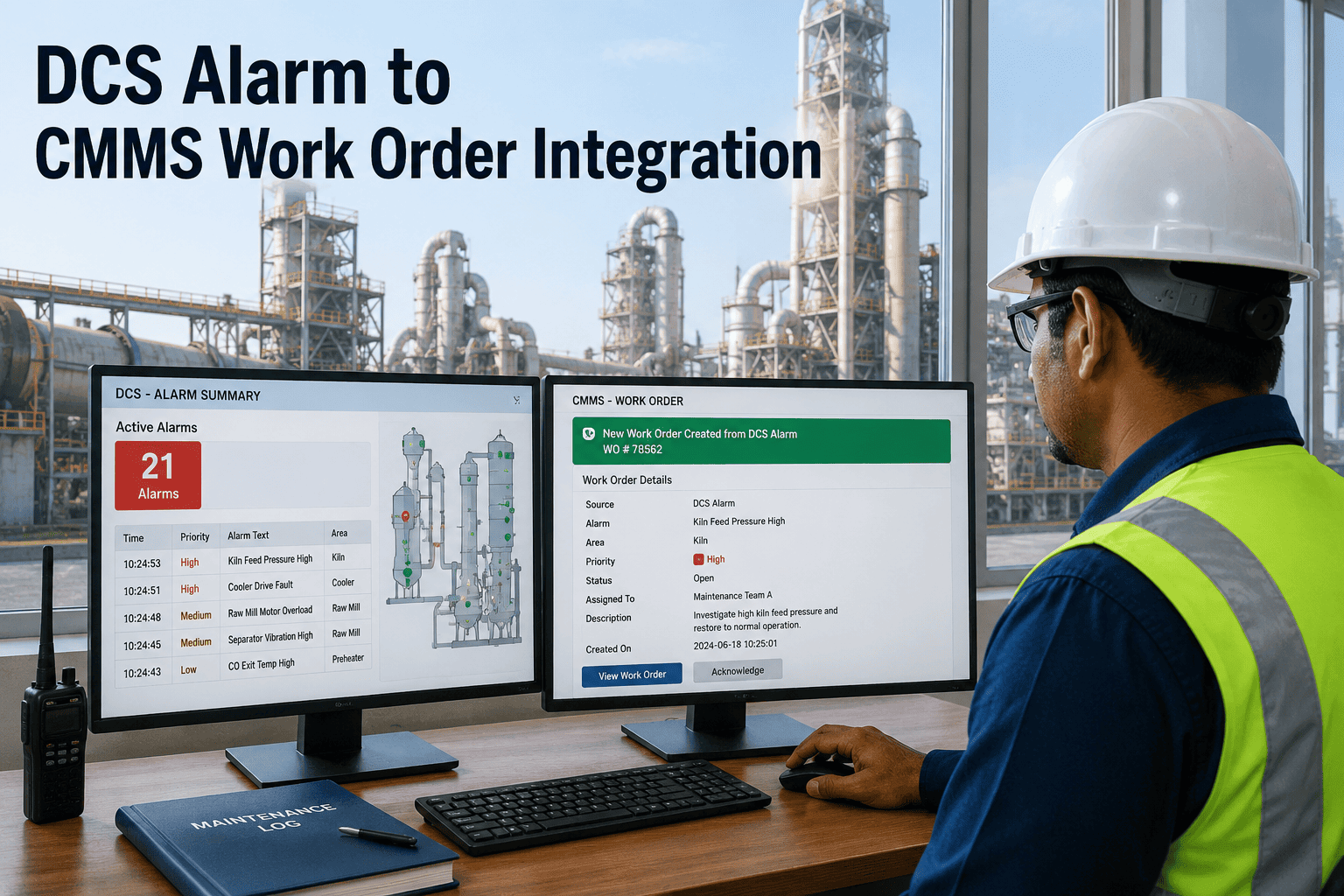
Threshold-based alerts triggering work orders automatically
Manual condition monitoring route support
Vibration, temperature, and oil analysis data capture
Integration & IT
SAP PM bi-directional work order and cost sync
REST API for custom integrations
MDM-compatible device provisioning for tablets
SSO / Active Directory authentication
Safety & Compliance
Permit to Work integration or built-in PTW workflow
LOTO procedure attachment on work orders
Audit-ready compliance report generation
Safety incident linkage to work order and asset
Analytics & Reporting
Real-time PM compliance dashboard by shift and area
Planned vs reactive ratio trend over time
Multi-plant group dashboard for cement group operations
Asset Management Deep Dive
Why Asset Hierarchy Depth Decides Rollout Speed
A cement plant's asset structure is not flat. The kiln train alone has seven layers of hierarchy: plant, line, kiln system, kiln drive, gearbox, input shaft bearing, and bearing race. A CMMS that cannot model this hierarchy forces every PM, work order, and spare part to float at the top equipment level, making asset history and failure analysis impossible.
Kiln Drive System
HRSG / Preheater
Clinker Cooler
Main Girth Gear Drive
Auxiliary Drive Motor
Input Shaft Bearing — SKF 23140
Output Shaft Bearing — FAG 23240
OxMaint's cement plant template pre-builds this hierarchy for all major asset classes. Platforms that require custom field workarounds to model sub-component levels force the reliability engineer to build the structure manually — typically adding three to four weeks to the rollout timeline for a 4,000-asset plant.
Sensor & Condition Monitoring
What to Ask Every Vendor About Sensor Integration
Predictive maintenance in cement plants is not future-state technology. Most plants above 2 MTPA already have vibration sensors on kiln drives, temperature probes on preheater fans, and process historians recording equipment data. The question is whether the CMMS can consume that data and trigger work orders from it.
| Integration Type |
Cement Plant Use Case |
Question to Ask Vendors |
| OPC-UA |
Direct sensor feed from kiln drive, VRM, fans |
Is OPC-UA a native integration or third-party connector? |
| OSIsoft PI / AVEVA |
Process historian with 10+ years of equipment data |
Can the CMMS read PI tags and trigger WOs from threshold breaches? |
| Emerson DeltaV |
DCS-integrated vibration and process monitoring |
What is the certified integration path? Who supports it? |
| SKF / Schaeffler Sensors |
Dedicated bearing condition monitoring systems |
Does the CMMS accept REST API from SKF @ptitude or Schaeffler OPTIME? |
| Manual Condition Routes |
Technician-recorded vibration pen readings on rounds |
Does manual condition data trigger the same WO workflow as sensor data? |
SAP integration is a hard requirement for most cement groups
OxMaint runs a certified SAP PM bi-directional sync — see it live on your plant's cost centers
If your corporate finance team closes work orders in SAP PM, a CMMS without certified SAP sync creates a double-entry problem that costs more in admin hours than the CMMS saves in maintenance efficiency. Book a demo to see OxMaint's SAP connector operating in a cement plant environment.
Safety & Compliance
Safety Requirements That Cannot Be Treated as Optional
Cement plants operate under process safety regulations, environmental compliance frameworks, and occupational health requirements that vary by geography but share a common theme: every maintenance task on a hazardous system must be documented, authorized, and traceable. A CMMS that cannot support this workflow adds risk rather than reducing it.
LOTO Documentation
Lockout-tagout procedures must be attached to every work order on energised equipment. The CMMS must enforce LOTO step completion before a work order can be marked complete. Verify this is a hard enforcement, not a soft reminder.
Permit to Work Workflow
Hot work, confined space entry, and working at height in cement plants all require PTW authorisation. The CMMS should either carry a built-in PTW module or integrate with your existing PTW system so permits are linked to the relevant work order before execution begins.
Audit Trail and Traceability
Environmental audits, ISO 50001 energy management reviews, and corporate safety audits require complete maintenance records on demand. The CMMS must generate audit-ready reports that show who performed what work on which asset on which date, with supporting condition data and parts used.
Analytics & Reporting
The Five Dashboards a Cement Plant Manager Actually Needs
Most CMMS platforms offer a reporting module. Very few offer the specific KPI views that cement plant managers and reliability engineers use in daily stand-ups and monthly leadership reviews. Before finalising a platform, verify these five views exist without custom configuration.
1
PM Compliance by Area and Shift
Kiln compliance, grinding compliance, and utility compliance broken down by shift team. This is the view the maintenance director uses in the morning stand-up to identify where the backlog is building before it becomes a reactive event.
2
Planned vs Reactive Work Order Ratio
The single KPI that most clearly separates a mature maintenance operation from a firefighting one. Cement plants should target above 70% planned work. A CMMS that cannot show this ratio in real time makes it invisible to leadership.
3
Asset Failure Frequency by Equipment Class
Which asset classes are generating the most reactive work orders per quarter? This view drives the decision to move an asset from time-based PM to condition monitoring. Without it, the PM strategy is static and never improves.
4
Work Order Backlog Age Distribution
Work orders sitting open beyond 7 days in a cement plant are a compliance and reliability risk. The backlog age dashboard identifies which work streams are accumulating open tasks and triggers supervisor escalation before the backlog becomes unmanageable.
5
Maintenance Cost per Ton of Clinker
The production-normalized cost metric that plant controllers and corporate reliability teams use to compare plants and track improvement. A CMMS that tracks maintenance cost in isolation, without linking to production volume, cannot produce this KPI without a manual calculation step.
Scoring Matrix
How to Score CMMS Vendors for Cement Plant Procurement
Use this weighted scoring matrix in your formal procurement process. Adjust weights to reflect your plant's specific priorities — a plant mid-SAP migration will weight the integration row higher; a plant just starting condition monitoring will weight predictive lower.
| Evaluation Category |
Suggested Weight |
Key Verification Test |
| Cement Asset Hierarchy Depth |
20% |
Load a 100-asset kiln train hierarchy in the demo environment. Measure setup time. |
| PM Scheduling Capability |
20% |
Configure a shutdown-linked PM schedule for kiln major overhaul. Verify trigger logic. |
| SAP / ERP Integration |
18% |
Request written confirmation of SAP PM certification. Ask for a reference cement plant customer running the integration live. |
| Mobile Execution and Offline Mode |
15% |
Execute a work order in full airplane mode. Verify sync behavior on reconnect. |
| Predictive / Condition Integration |
12% |
Connect a test OPC-UA feed and trigger a work order from a threshold breach in the demo. |
| Safety and Compliance Tools |
10% |
Configure a LOTO enforcement step on a sample work order. Verify that completion is blocked without LOTO sign-off. |
| Analytics and Reporting |
5% |
Generate a PM compliance by shift report from 30 days of sample data without custom development. |
Expert Review
What Procurement Veterans Say About Cement CMMS Selection
We gathered input from maintenance directors and procurement leads who have completed formal CMMS evaluations for cement plants. Their experience shapes what the scoring matrix above gets right — and what most vendors will try to avoid demonstrating in a demo.
The one test I run in every CMMS evaluation is to build a kiln PM schedule with a shutdown window during the demo. Not a simple monthly task — a full overhaul schedule with conditional steps, multiple trade assignments, and a 30-day lead time trigger. Every platform that was not built for heavy industrial failed that test within 20 minutes. The ones that passed earned the next conversation.
Maintenance Director
Three CMMS procurement processes across two cement groups, 2019 to 2024
Procurement teams often score CMMS on features they will never use and miss the one question that matters: how long until a frontline technician can complete a work order without asking anyone for help? For cement plants, that answer is usually 45 to 90 days. Platforms that achieve it faster do so because they have cement plant training materials, not because they have better UI.
Operations Technology Consultant
Former IT Director, 4 MTPA integrated cement group, Southeast Asia
Frequently Asked Questions
Questions from Cement Plant Buying Teams
How long should a formal CMMS procurement process take for a cement plant, from RFP to go-live?
A well-run procurement process for a cement plant CMMS takes 8 to 12 weeks from issuing the RFP to platform selection. Go-live follows 75 days after that with a structured deployment. The most common timeline killer is an extended procurement process that drags past 16 weeks due to a large steering committee without a single decision owner. Assign one plant-side decision owner with authority to approve the short-list and final selection. This single structural choice cuts procurement time by 30 to 40% in most cement plant evaluations.
Book a scoping call to see how OxMaint runs structured evaluations for cement plant buyers.
Should a cement plant buy a general CMMS with heavy industrial features or an industry-specific platform?
General CMMS platforms with heavy industrial features are frequently sold to cement plants and frequently underperform in them. The issue is not feature count — it is configuration depth. A general platform with a heavy industrial module requires the cement plant's reliability engineer to build the asset hierarchy, criticality classification, PM templates, and reporting structure from scratch. An industry-specific platform like OxMaint ships with cement plant templates that reduce that configuration work by 60 to 70%. The difference shows up in rollout time: general platforms average 4 to 6 months to live PM schedules in cement plants; OxMaint averages 75 days.
Start a free trial to access the cement plant template and evaluate the pre-built configuration depth directly.
What is the correct internal team structure to run a cement plant CMMS procurement and deployment?
A successful cement plant CMMS procurement and deployment requires five named owners: a maintenance director as program owner with final authority; a reliability engineer to own asset hierarchy and PM library decisions; a senior technician to co-design mobile workflows and validate field usability; an IT systems analyst to own device provisioning and ERP integration; and a plant manager or operations director to approve major milestones and remove organisational blockers. Procurement processes that involve larger committees without this named-owner structure consistently take longer and produce worse deployment outcomes because no single person is accountable for a decision. Size does not improve outcomes — accountability does.
How do we evaluate vendor claims about SAP integration during a CMMS procurement?
Request three things from any vendor claiming SAP PM integration: SAP certification documentation, a list of cement plant customers running the integration in live production, and a 30-minute technical demo that shows a work order created in the CMMS appearing in SAP PM and a cost posting flowing back. Vendors with real certified integrations can demonstrate all three. Vendors with API connectors that are called SAP integrations will be unable to show live bi-directional flow in a real SAP PM environment. The technical demo is the only reliable test — documentation and customer references without a live demo are not sufficient verification for a must-have integration requirement.
Book a demo and request the SAP PM live demonstration as part of your evaluation.
Ready to run your evaluation
Use the OxMaint cement plant trial to anchor your procurement scorecard
Load your real asset list, configure a kiln PM schedule, and test SAP sync in a live environment before your RFP closes. The OxMaint onboarding team provides procurement support including technical demo walkthroughs, reference customer introductions, and plant-specific ROI modelling for any formal evaluation process.