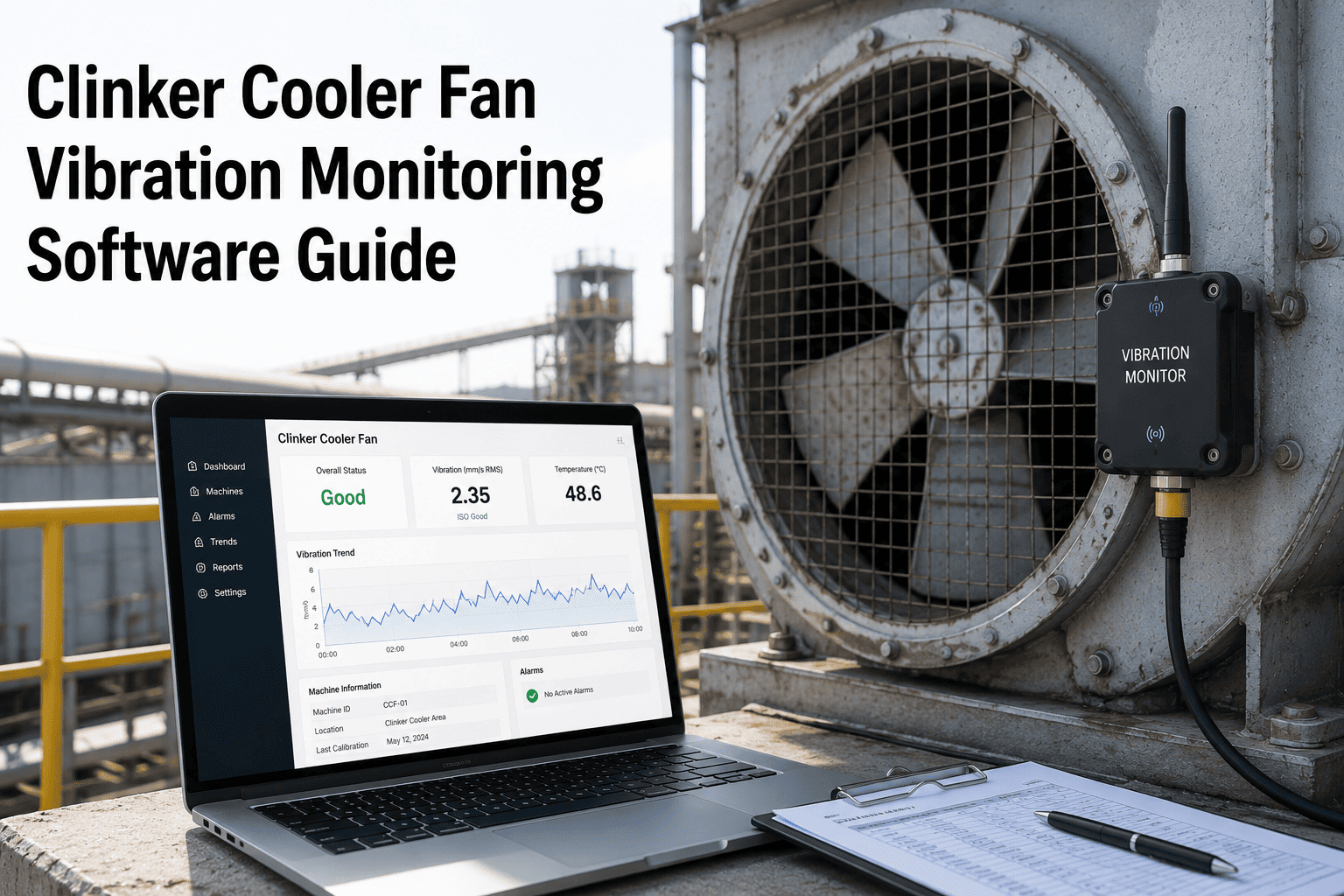
When the ID fan bearing on your cement kiln starts trending upward on the maintenance log, every reliability engineer faces the same question: is this normal running noise, or an early warning that needs an outage before the weekend. ISO 10816 exists to answer that question with a number instead of a guess, yet most cement plants still keep the standard as a PDF on a shared drive rather than inside the workflow where the reading is logged, the alarm is set, and the work order is raised. That gap between owning the standard and actually using it is where fan failures turn expensive — bearing seizures, shaft fatigue cracks, and unplanned ID fan stops that halt the entire kiln line. This guide breaks down how ISO 10816 zone classification applies to cement plant fans, what a defensible vibration record looks like to an insurer or auditor, and how zone-based alerting inside a CMMS turns fan vibration monitoring from a spreadsheet exercise into an automated reliability system.
Cement Fan Vibration ISO 10816 Software: Turn Zone Readings Into Defensible Maintenance Records
Classify ID fan, cooler fan, and coal mill fan vibration against ISO 10816 zones A through D automatically — with every reading, alarm, and work order stored in one CMMS that regulators, insurers, and OEMs can review without a spreadsheet hunt.
Why Fan Vibration Failures Hit Cement Plants Harder Than Other Industries
A cement plant does not have redundant induced draft fans sitting idle in the way a chemical plant might have redundant pumps. The ID fan, the cooler fan, and the coal mill fan are single points of failure that sit directly in the kiln's process path — when one trips on high vibration, the kiln line stops, refractory thermal cycling begins, and every hour of downtime carries a direct production cost measured in tonnes of clinker not made. Fan failures rarely happen without warning. They build slowly through imbalance, misalignment, bearing wear, or foundation looseness, and ISO 10816 exists specifically to catch that build-up while it is still a scheduled repair instead of an emergency shutdown.
Understanding ISO 10816 Zones A Through D for Cement Plant Fans
ISO 10816-3, now published as ISO 20816-3, covers broadband RMS vibration velocity measured on the bearing housings of rotating machines above 15 kW, including the centrifugal and axial fans found throughout a cement plant. Readings are taken directly on the bearing housing, in the horizontal, vertical, and axial directions, and compared against limits that depend on the fan's power rating and foundation type. The result of that comparison is one of four zones, and the zone — not the raw number alone — is what should drive the maintenance decision.
Stop Reading Vibration Reports After the Fan Has Already Failed
Oxmaint applies ISO 10816 zone logic to every fan reading the moment it is logged — turning a static standard into a live alarm, a scheduled work order, and a permanent compliance record.
How Oxmaint Applies ISO 10816 Logic Inside Your CMMS
Knowing the zone limits is not the same as using them every shift, on every fan, across every plant. Oxmaint builds the ISO 10816 evaluation directly into the asset record so the classification happens automatically, not as a manual lookup against a wall chart.
Manual Vibration Logging vs Oxmaint Zone-Based Monitoring
Most cement plants already collect fan vibration data. The difference between plants that catch a failing fan early and plants that do not comes down to what happens to that reading after it is written down.
| Step | Manual Spreadsheet Logging | Oxmaint ISO 10816 Software |
|---|---|---|
| Zone Classification | Technician manually checks the reading against a printed or PDF chart, prone to interpretation error | Reading is classified automatically against the fan's exact machine group and foundation type |
| Alarm Response Time | Zone C or D readings are noticed only when someone reviews the spreadsheet, often days later | Zone C or D readings trigger an instant notification to the assigned technician and supervisor |
| Work Order Creation | A separate manual step, frequently skipped during busy shifts or forgotten entirely | Generated automatically the moment a reading crosses the configured zone threshold |
| Historical Trending | Scattered across multiple spreadsheet tabs or files, difficult to trend by bearing point | Continuous per-bearing trend history available instantly on any device |
| Audit Preparation | Days of manual compilation before an insurance or regulatory review | Export-ready compliance report generated in minutes |
Scroll horizontally on smaller screens to view the full comparison
Rolling Out ISO 10816 Monitoring Across Your Fan Fleet
Deploying zone-based monitoring does not require replacing existing vibration sensors or hiring a dedicated analyst. It requires mapping the standard onto the assets you already maintain, in the right order.
Bring Every Fan in Your Plant Under One ISO 10816 Standard
From the ID fan to the cooler fans and the coal mill fan, Oxmaint keeps every reading, zone classification, and work order in a single searchable record built for reliability teams and auditors alike.
Frequently Asked Questions on Cement Fan ISO 10816 Monitoring
Give Every Fan in Your Plant a Defensible ISO 10816 Record
Stop relying on a printed zone chart and a technician's memory. Oxmaint logs, classifies, alarms, and reports on every fan reading automatically — so the next audit, insurance review, or OEM inspection is a five-minute export, not a week of spreadsheet reconstruction.