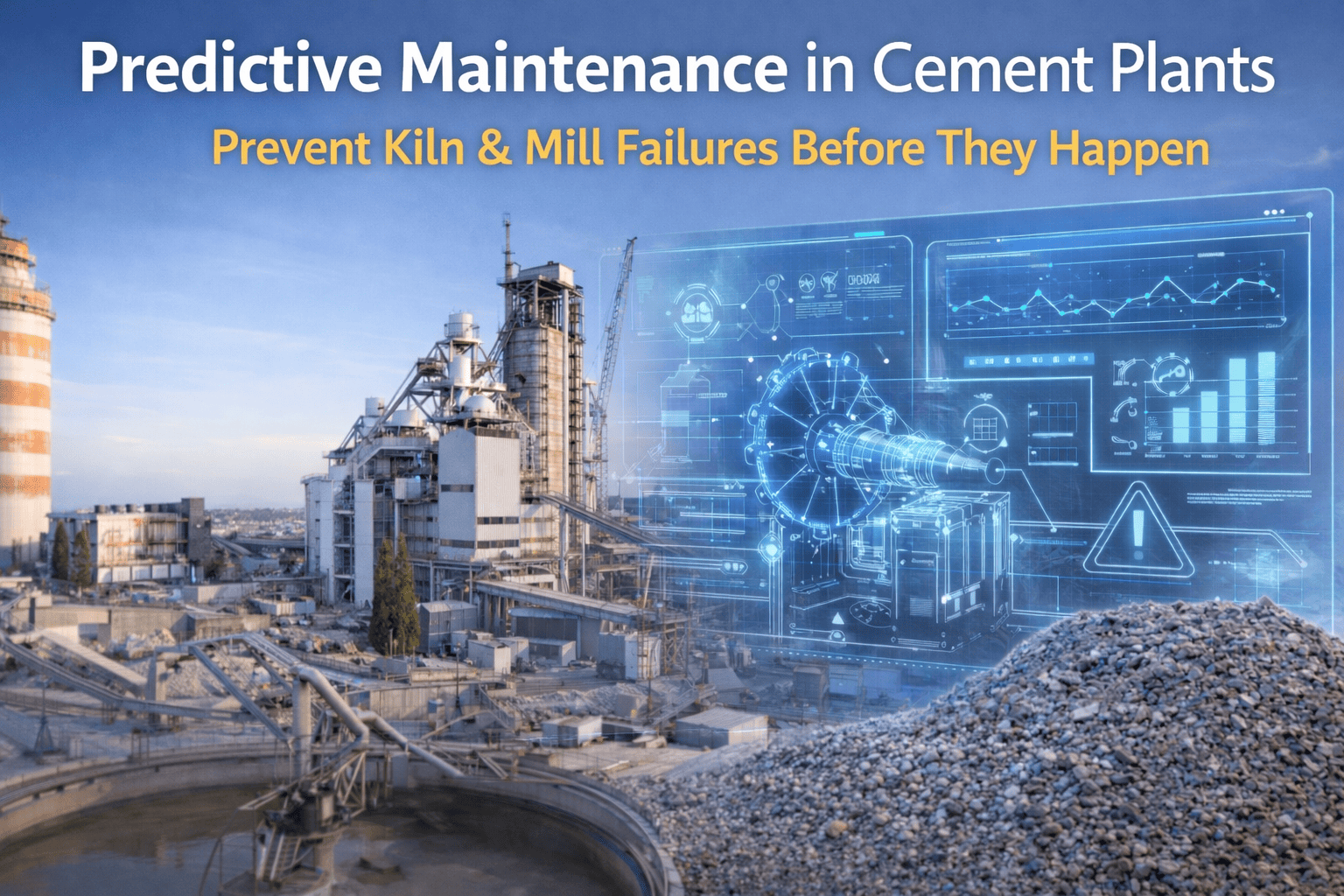
Most maintenance teams don't have a data problem — they have a translation problem. The sensor saw the failure coming weeks ago, but nobody connected that signal to a work order until the kiln actually stopped. Sign up for Oxmaint to put an AI copilot inside your CMMS that reads asset history, ranks risk, and drafts the work order before your team has to ask, or book a demo to see it run against your own kiln, mill, and crusher data.
Ask Your Maintenance Data a Question. Get a Work Order Back.
Oxmaint's AI copilot reads every sensor trend, work order, and inspection note across your plant, then answers in plain language — which asset needs attention, why, and exactly what to do about it.
Which assets need attention this week?
Vibration trending up 15% over 7 days — inspect alignment before next shift
Bearing temperature rising — schedule oil analysis this week
Running within normal range — no action needed
Four Things the Copilot Handles Before You Ask
This isn't a chatbot bolted onto a dashboard. It's reading the same work orders and sensor feeds your team already has — it just gets to the answer faster.
| Capability | What It Does | Example |
|---|---|---|
| Asset History Summary | Pulls every past work order, inspection, and failure note into one readable summary | "This bearing has failed twice in 14 months, both times after a vibration spike" |
| Risk Ranking | Scores every monitored asset by failure probability and urgency, updated continuously | Ranks 40+ kiln and mill assets by risk every morning |
| Auto-Drafted Work Orders | Converts a sensor alert or a technician's field note into a structured work order | A voice note about kiln tyre noise becomes a tagged, prioritized work order |
| Root Cause Suggestions | Matches a new fault pattern against your plant's own failure history, not generic templates | Flags a coupling misalignment based on a similar event 8 months ago |
From a Sensor Signal to a Finished Work Order
Four steps, no manual handoff in between.
Vibration, temperature, current, or a quick technician field note enters the system.
It checks the signal against your plant's own failure history, not an industry average.
Asset ID, failure mode, recommended action, and parts list populate automatically.
The right person gets a work order with everything needed to fix it the first time.
Prediction Accuracy Improves the Longer It Runs On Your Plant
The model re-weights its own logic against your plant's actual outcomes — not a generic industry template — so accuracy climbs the longer it runs.
Put the Copilot On Your Own Asset List
Bring your kiln, mill, and crusher history — we'll show you the first risk ranking live, in 30 minutes.
The plants getting real value from AI aren't the ones with the most sensors — they're the ones where the model's output lands directly in a work order a technician can act on the same shift. The moment AI just produces a chart nobody acts on, you've built a science project, not a maintenance program.
Sandra Okafor — Industrial AI and Reliability Advisor, 12 years deploying predictive maintenance programsAI Maintenance Copilot — Common Questions
No. It removes the manual digging, not the decision. Planners still set priorities and approve work — the copilot just hands them a ranked list and a drafted work order instead of a blank screen and a stack of sensor logs.
Oxmaint imports your existing work order, inspection, and failure history during onboarding, so the model has a baseline from day one instead of starting blank. Sign up to begin that import directly.
Yes. The copilot performs best with continuous sensor data, but it can also generate useful risk rankings from your existing work order history and inspection records alone, then improve further as sensors are added asset by asset.
Because it's trained against your plant's own failure history, not an industry template — a coupling misalignment gets flagged because it matches a pattern from your own kiln, not a textbook case. Book a demo to see it run on your actual fault history.
It's a copilot, not an autopilot — your planner reviews and can override any ranking before a work order is dispatched. Every outcome, right or wrong, feeds back into the model so its next prediction on that asset class is sharper.
Stop Searching for Answers Your Plant Already Has
Every sensor reading, work order, and inspection note in your plant already contains the next failure warning. The Oxmaint AI copilot just gets you to it before the kiln does.