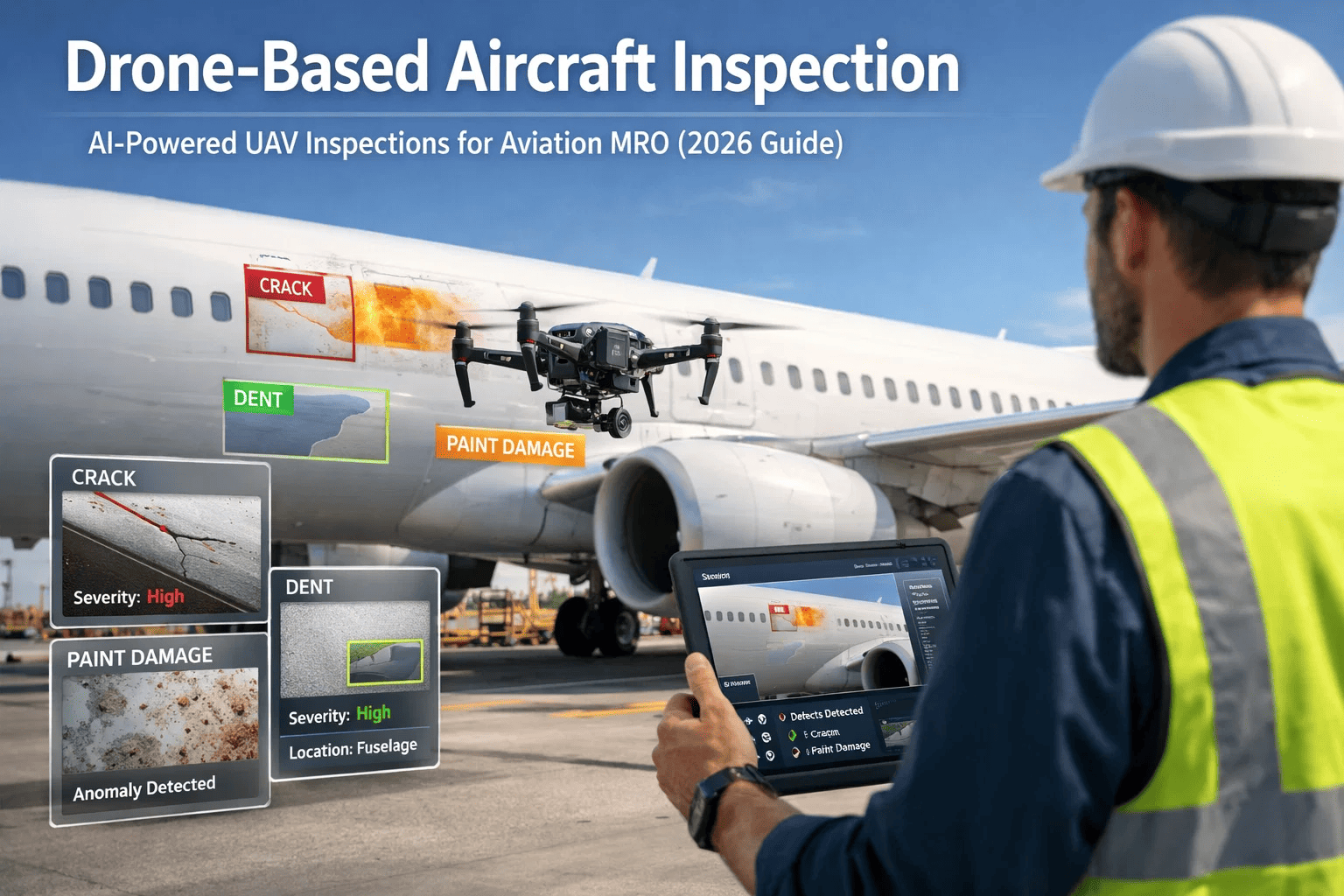
Manual aircraft and hangar inspections miss real defects — every recent study puts the gap in double digits — and they do it slowly, from ladders and scaffolds, under turnaround pressure. Drones changed the capture side: a narrow-body exterior that took an inspector most of a shift now scans in under 90 minutes, catching defects down to a millimeter with zero working-at-height risk. But a drone is only half a program. The other half is what happens to the finding — and that's where 2026's best platforms separate from the rest. This guide covers what drone-based aircraft and hangar inspection software actually has to do: capture evidence-grade findings, turn them into work orders automatically, and stand up to any FAA, EASA, or ICAO audit. Start free or book a demo.
Aviation · MRO & Airport Hangar · Drone Inspection Software · 2026 Buyer's Guide
Drone-Based Aircraft & Hangar Inspection Software: What the Best 2026 Platforms Do
Drones make the capture fast and safe. The software decides whether that capture becomes an evidence-grade, audit-ready, work-ordered record — or just a folder of images someone still has to transcribe. Here's the capability checklist to score every platform against, and the workflow that makes a drone program actually deliver.
The Numbers That Justify the Program
The case for drone inspection isn't subtle — it shows up in inspection time, defect detection, and the risk your people never take on. But those gains only stick if the data flows straight into maintenance instead of piling up as un-actioned images. Sign up free — no credit card and drone findings land directly in a work-order queue, not an inbox.
<90 min
narrow-body exterior scan by drone vs. up to 16 hours manual — a ~60% cut in external inspection time
1 mm
defect size AI-equipped drones resolve on fuselage, rivet lines, and composite surfaces
~90%
of working-at-height risk removed — no ladders or scaffold for routine visual inspection
$4.2B
annual FOD cost to aviation — drone AI vision spots runway debris down to half an inch
The Six Elements of an Audit-Grade Record
Here's the bar every drone finding — and every manual one — must clear to survive an audit. Miss any one, and it isn't an audit-grade record; it's a note that invites a finding. This is the first thing to score any 2026 platform against: does it enforce all six, automatically, on every observation? Schedule a 30-minute demo to see all six enforced on a live route.
1
GPS coordinate — proof the inspector or drone was on the surface, at the asset.
2
Verified timestamp — a server-reconciled ISO 8601 time for when the observation occurred.
3
Photo evidence — imagery with embedded metadata, captured on a mandatory in-app camera.
4
Authenticated identity — a known, signed-in user tied to the record, not an anonymous entry.
5
Structured classification — defect type from a controlled vocabulary, never free text.
6
Closure link — a tie to the work order the finding generated, with closing user and timestamp.
The Capability Checklist for 2026
Beyond the six elements, these are the operating priorities that decide whether a drone-inspection program delivers or stalls. Score every platform — and every vendor demo — against them, and don't accept a quiet-office demo for a feature that has to work on a noisy ramp or behind a hangar with no signal. Create your free account and put these to the test on your own routes.
Mobile Inspection Routes
Structured routes with mandatory fields, so no point on the aircraft or in the hangar gets skipped and no record ships incomplete.
Offline-First Capture
Records captured locally behind a hangar or in a dead zone and reconciled on reconnection — no inspector loses a finding to a signal gap.
Photo Evidence on Every Defect
A mandatory camera on high-risk points with EXIF timestamp and GPS baked in — fast to capture, slow to falsify.
Auto-Created Repair Work Orders
Every discrepancy generates a work order at the correct priority, assigned and notified — closing the gap between finding and fix with no manual handover.
Severity-Driven Workflow
Classification on the finding routes it automatically — a critical structural flag escalates differently than a cosmetic note.
Searchable Asset & Route History
Every finding and repair logged against the tail, the asset, and the route — a queryable record instead of a pile of PDFs.
The Drone Found the Crack in 40 Minutes. Then It Sat in a Folder for a Week.
That's the failure mode nobody demos: brilliant capture, broken follow-through. The image was georeferenced and razor-sharp — and it lived in a shared drive until someone manually opened a work order days later. OxMaint closes that gap. A drone or mobile finding becomes a tracked work order the moment it's raised — annotated image, severity score, correct priority, duty engineer notified — and the whole chain from finding to airworthiness sign-off lives in one searchable record.
The Pipeline: From Drone Flight to Signed-Off Repair
The best programs run one unbroken pipeline — capture never leaves the system, and no step needs re-keying. Here's the flow a 2026 platform should make automatic end to end. Schedule a live walkthrough to see the whole pipeline on your fleet or hangar.
01
Fly the Route
Drone runs a pre-programmed path around the airframe or across the hangar, capturing high-resolution imagery of every surface — including upper fuselage and wing tops no ladder reaches safely.
02
Detect & Classify
AI defect recognition flags anomalies and applies structured severity classification — consistent, repeatable thresholds instead of inspector-to-inspector variance.
03
Generate the Work Order
Each finding auto-creates a work order with the annotated image attached, priority set by severity, and the duty engineer notified — no transcription, no handoff.
04
Resolve & Archive
The repair is executed, signed off, and closed against the airframe history — building a searchable, audit-ready trail from inspection to airworthiness release.
Where the Regulators Draw the Lines
Drone inspection is operational, not experimental — but it lives inside a real regulatory frame, and your software has to produce documentation that meets the same bar as a manual inspection. Here's the landscape a 2026 platform has to satisfy. Sign up free in minutes and generate records built to these standards from day one.
FAA Part 107 & 145
Part 107 governs the commercial UAV operation (remote-pilot cert, line-of-sight — largely satisfied by default indoors). Part 145 accepts drones for General and Detailed Visual Inspection in the MRO environment.
EASA Part 145
Accepts drone-based GVI/DVI and mandates Safety Management Systems that digital inspection records must integrate with — timestamped, traceable, and defensible.
ICAO Annex 14
Sets global aerodrome standards for pavement condition and FOD management — increasingly expecting the quantitative, repeatable data drone LiDAR and AI vision produce.
FAA AC 150/5200-18C
Requires certificated airports to run daily runway inspections and periodic surveys — drone data must carry the same timestamped findings, classification, and corrective-action tracking as manual.
Score the platform on the six elements, the capability checklist, and the end-to-end pipeline — then let it produce the FAA, EASA, and ICAO-grade record automatically. That's the difference between a drone program that modernizes inspection and one that just adds a camera. Sign up free or schedule a demo to see it on your operation.
"
We bought the drones first and learned the hard lesson: fast capture with slow follow-through is just a nicer-looking backlog. Findings piled up as images while work orders got opened by hand, days late. Moving the whole flow into OxMaint fixed it — a drone finding now raises a work order the instant it's classified, with the annotated image and severity attached, and it closes against the tail's history. Our last EASA audit, I pulled a complete inspection-to-sign-off trail for any airframe in under a minute. The drones got the headlines; the workflow got us the clean audit.
Head of Base Maintenance · Part 145 MRO & Hangar Operation
Frequently Asked Questions
Is drone-based aircraft inspection approved by the FAA and EASA?
Yes. In 2026 it's an accepted method for General and Detailed Visual Inspection within FAA Part 145 and EASA Part 145 environments, provided the documentation meets the same timestamped, traceable standard as manual inspection.
How much faster is a drone inspection?
A narrow-body exterior scan drops from up to 16 hours manual to under 90 minutes — roughly a 60% cut in external inspection time — while removing most working-at-height risk.
What makes a finding "audit-grade"?
Six elements: GPS coordinate, verified timestamp, photo evidence with metadata, authenticated user identity, structured defect classification, and a closure link to the resulting work order. Anything short of all six invites a finding.
Do drone findings become work orders automatically?
With the right software, yes — each discrepancy generates a work order at the correct priority with the annotated image attached and the duty engineer notified, closing the gap between finding and fix without manual handover.
What if the hangar or airfield has signal dead zones?
A capable app captures records locally and reconciles them on reconnection, applying server-verified timestamps — so an inspector behind a hangar never loses a finding to a signal gap.
How should we evaluate 2026 inspection platforms?
Score each on the six audit-grade elements, the capability checklist, and end-to-end work-order automation — and test signal-dependent features on a real ramp, not in a quiet office.
Sign up free to start evaluating.
Make Every Drone Finding a Tracked, Documented, Audit-Ready Work Order.
OxMaint gives aviation inspection teams mobile routes with mandatory fields, GPS and timestamp capture, photo evidence on every defect, auto-created repair work orders, and a searchable history against every asset and route — so a drone program modernizes execution instead of stalling in a folder, and every record stands up to FAA, EASA, or ICAO audit. Start free — no credit card, unlimited users, forever. Or book a demo.