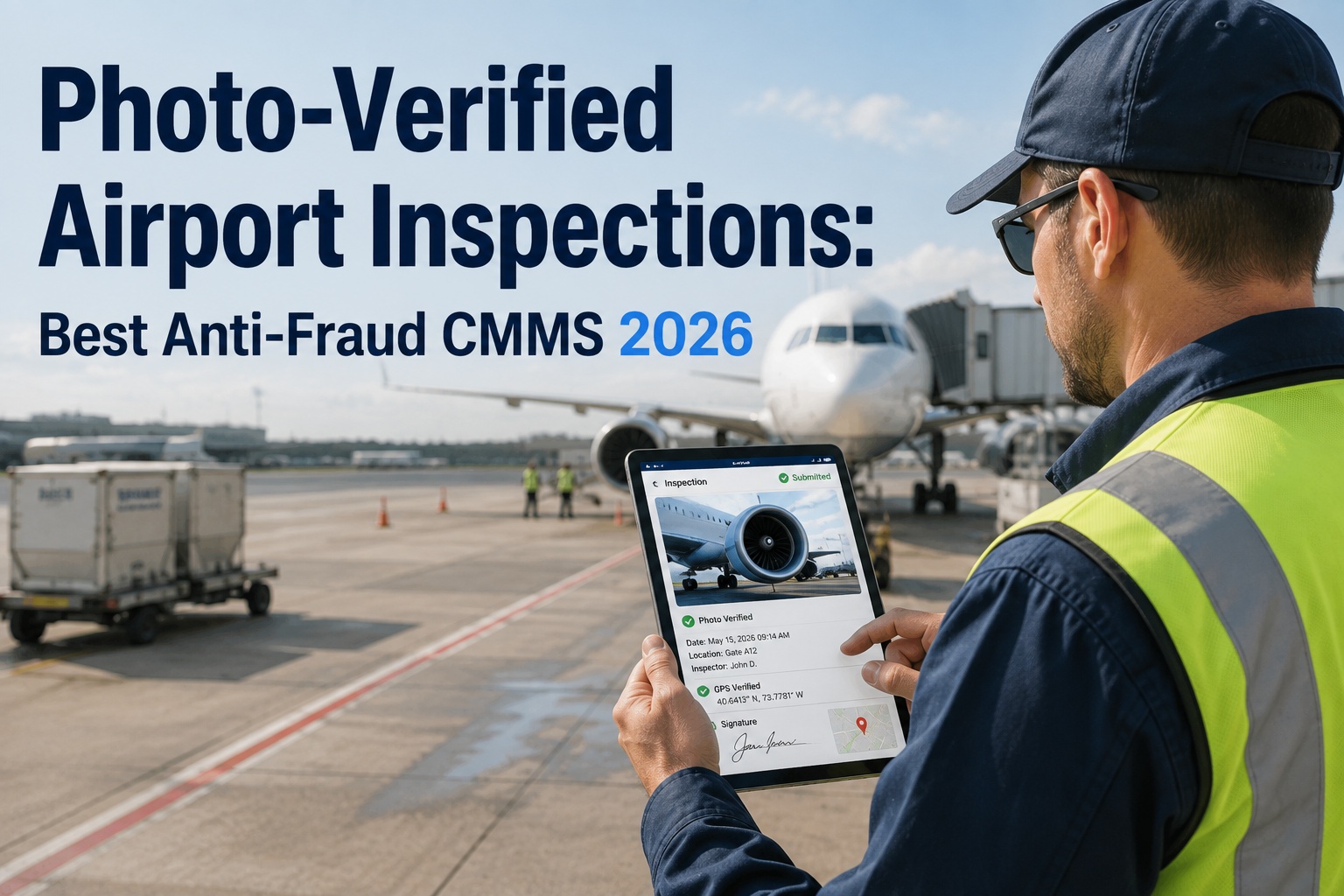
The typical airside inspector's hands are already occupied. One holds a torch or a radio. The other holds a FOD grabber, a signage tool, or the door handle of the ops vehicle. Gloves are on, PPE is on, jet noise is between 100 and 140 dB depending on distance from the taxiway, and the phone that is supposed to capture the inspection record is inside a case, under a hi-vis jacket, at the end of a lanyard the wearer cannot see. Which is exactly why so much airport inspection data ends up captured 20 minutes later — from the ops room, from memory, with detail loss and timestamp drift the FAA reads as reconstruction. Voice-to-text inspection changes the physics. The technician speaks the reading, the defect, the follow-up action while both hands stay on the job, and the CMMS captures structured data — timestamped, GPS-tagged, attached to the correct asset — before the walk is even complete. Oxmaint's mobile CMMS ships built-in voice-to-text capture that populates work order fields from spoken input, saving 30+ minutes per technician per day and lifting follow-up scheduling compliance from 41% to 82%. Start free and put hands-free inspection on every airside route this week, or book a demo to see voice-first inspection running against your Part 139 routes.
Aviation · Hands-Free · Voice-to-Text · 2026 Buyers Guide
Best Voice-to-Text Airport Inspection Software 2026
What "hands-free" actually has to deliver on the ramp — high-noise recognition, glove-friendly wake, offline capture, and structured population of Part 139 inspection fields. Built around the reality of gloves, PPE, jet noise, and inspectors whose hands are on tools, not touchscreens.
-
30+ min
saved per technician per day with voice-first inspection capture
-
41% to 82%
follow-up scheduling compliance jump when actions are voice-triggered at the point of repair
-
47% to 91%
asset condition record completeness with hands-free scoring at job completion
-
140 dB
peak jet blast noise — a real-world stress test for any voice-to-text platform
The Ramp Reality
Why the Inspector's Hands Are Almost Never Free
A voice-to-text platform earns its place in an airport buyers-guide only if it holds up to the environment the inspector actually works in — not a quiet office demo. This is the working baseline every 2026 evaluation should test against. Five simultaneous constraints, all present on a normal walk, all reasons a touchscreen loses the data before it reaches the CMMS.
Gloves & PPE
Nitrile, mechanic, or cold-weather gloves defeat capacitive touch. Removing them mid-walk is a safety and speed cost the CMMS has to eliminate.
Ambient Noise 100–140 dB
Jet blast, APU noise, ramp equipment. Consumer-grade voice recognition drops accuracy above 85 dB. Airside needs beamforming, noise-cancelling capture.
Tools in Both Hands
FOD grabber, torch, radio, signage tool, gate cycler. A one-handed CMMS interaction model is still a hands-busy one — full hands-free is the only real answer.
Moving Ops Vehicle
Ops crew driving between checkpoints. FMCSA-style handheld-device rules apply on movement areas at many airports — voice is compliance, not just convenience.
Wet, Cold, Wind, Dark
Rain-slick touchscreens, gloved hands, night-shift low-light. Voice performance stays constant where visual and touch performance drops off a cliff.
Voice Command Taxonomy
The Five Voice Command Types Every Airport CMMS Should Ship
Voice-to-text is not one feature; it is a family of five distinct command types, each with its own accuracy profile and its own operational impact. A CMMS that ships only free-text dictation is missing four of the five. This is the working taxonomy — the type, an example spoken command, and the structured data it populates in the record.
-
01
Reading Capture
Spoken: "Runway edge light bar 27L, station 12, all six functional"
Populates: per-asset pass reading + timestamp + inspector ID against light-bar record
-
02
Defect Description
Spoken: "FOD found taxiway B intersection, aluminum fastener, small, removed and bagged"
Populates: free-text finding + auto CAPA work order with location and category
-
03
Follow-Up Scheduling
Spoken: "Schedule bearing inspection in thirty days, reorder seal kit before next PM"
Populates: scheduled follow-up WO + parts requisition — the driver of the 41% to 82% compliance jump
-
04
Condition Scoring
Spoken: "Condition fair, noise present at high speed, suggest monitor"
Populates: asset condition score field — the driver of the 47% to 91% portfolio-wide completeness jump
-
05
Status Commands
Spoken: "Mark inspection complete" · "Start travel to gate 14" · "Accept next job"
Populates: work order state transitions with hands-free confirmation — enables in-vehicle compliance
Before & After
How the Same Inspection Actually Runs
The clearest way to see the impact is to walk the same route two ways. Below is a typical single FOD walk — the paper / touchscreen version, then the voice-first version — showing exactly where the time and the data quality leak away in the manual version.
Manual Route — Touchscreen or Paper
- Reach movement area, park ops vehicle
- Remove gloves to unlock phone, tap through app menus
- Find inspection route, load first checkpoint
- Put phone in pocket, put gloves back on, walk to point
- Observe condition, note it mentally
- Remove gloves, retrieve phone, type reading (or skip and remember)
- Repeat for 6–12 more checkpoints
- End of shift: reconstruct any missed points from memory
- Sign the record at the desk — 20+ minutes after the last observation
Result: partial detail, drifted timestamps, undocumented follow-ups, un-signed records at the top of the FAA finding list.
Voice-First Route — Oxmaint
- Reach movement area, ops vehicle plays route via Bluetooth audio
- Route auto-loads, hands stay on tools and PPE stays on
- Walk to first checkpoint, speak reading and condition
- App captures reading against the asset, timestamp server-set
- Spot a defect — speak the description, CAPA fires with location
- Speak a follow-up — WO scheduled with parts requisition
- Continue through all checkpoints without breaking stride
- Speak "mark inspection complete"; per-user sign-off applied
- Record on the server, signed, timestamped, evidenced — done at the point of walk
Result: 30+ minutes back per shift, follow-up compliance from 41% to 82%, condition data from 47% to 91% — captured at the source.
Hands-Free Is Also Photo-Verified
Voice Populates the Fields. The Photo Proves the Evidence.
Voice-to-text is not a replacement for photo evidence — it is a complement to it. Oxmaint's mobile app pairs voice-captured readings and findings with a mandatory in-app camera on high-risk inspection points, EXIF timestamp and GPS baked into every image. The result is an inspection record that is fast to capture and slow to falsify — exactly the combination the 14 CFR Part 3 Subpart D falsification rule was tightened to demand.
Buyers-Guide Evaluation
Eight Criteria to Score Any Voice CMMS On
If the vendor demo is done in a quiet office, it does not tell you what you need to know. This is the working checklist an airport authority procurement team should score every 2026 voice-to-text CMMS against — including a live noise test on the ramp before signing.
| # | Evaluation Criterion | What Good Looks Like | Why It Matters Airside |
|---|---|---|---|
| 1 | High-noise recognition | Accurate above 100 dB with beamforming mic | Ramp and taxiway operations |
| 2 | Structured field population | Voice fills numeric, dropdown, and pass/fail fields | Not just free-text — structured Part 139 records |
| 3 | Wake-word or lanyard button | Works with gloves, no unlock, no menu dive | Gloves and PPE never come off |
| 4 | Offline capture & sync | Records local, syncs on reconnect, preserves capture time | Terminal basements, hangar dead zones |
| 5 | Domain vocabulary | Recognises "PAPI," "MALSR," "holding position," etc. | Generic ASR mis-transcribes airport jargon |
| 6 | Per-user voice ID | Attributes voice submissions to authenticated inspector | Supports §139.327 sign-off requirement |
| 7 | Bluetooth headset support | Works via ear defenders and comm headsets | Hearing protection is mandatory near operations |
| 8 | Built-in, not integration | Part of the CMMS, not a third-party voice bolt-on | Single audit trail, no data hand-off gaps |
Built for Airports
How Oxmaint Ships Voice-First Airport Inspection
-
Built-In Voice
No Third-Party Voice Platform, No Separate Integration
The mobile app records, transcribes, and populates work order fields from spoken input natively. No hand-off to another platform, no separate audit trail, no data-gap between what was said and what was stored.
-
Structured Fields
Voice Fills Numeric, Dropdown, and Pass/Fail
Not just free-text dictation into a notes field. Voice input maps to the exact Part 139 structured fields the FAA expects — readings, condition scores, pass/fail, follow-up actions.
-
Follow-Up Auto-Schedule
Spoken Actions Become Scheduled Work Orders
"Schedule bearing inspection in 30 days" captured as a structured action and auto-scheduled — driving follow-up scheduling compliance from 41% to 82% versus free-text nobody reads.
-
Condition Score
Portfolio Condition Data Completeness Doubled
Post-repair condition scoring spoken at job completion updates the asset record in real time. Portfolio-wide condition data completeness jumps from 47% to 91% with voice input enabled.
-
In-Vehicle Voice
Movement-Area Compliance Without Handheld Use
Bluetooth-audio dispatch and voice-activated status updates while the ops vehicle is in motion. Compliance-by-design for movement-area handheld-device restrictions.
-
Photo + Voice Paired
Fast to Capture, Impossible to Falsify
Voice populates the fields; mandatory in-app camera provides EXIF-timestamped and GPS-tagged evidence. Server timestamps applied on receipt — the audit chain 14 CFR Part 3 Subpart D expects.
Measured Outcomes
What Airport Inspection Teams Actually Gain
-
30+ min
Per Technician Per Day Recovered
Time not spent removing gloves, unlocking phones, and typing under PPE. At a $45/hr fully-loaded rate, that is meaningful annual productivity per airside inspector.
-
82%
Follow-Up Scheduling Compliance
Up from 41% baseline. Follow-up actions spoken at the point of repair become scheduled work orders, not free text nobody reads.
-
91%
Asset Condition Record Completeness
Up from 47% baseline. Portfolio-wide condition scoring finally reflects reality because technicians can score at completion without stopping the job.
-
$0
Free Forever Plan to Start
Airport operations teams start on the free plan, enable voice on a first inspection route, and scale into the full platform as scope grows.
Frequently Asked
Voice-to-Text Airport Inspection Questions
Does voice-to-text work in high jet-noise environments?
The right platform does. Consumer-grade ASR drops accuracy above about 85 dB, but modern airport-ready voice CMMS use beamforming microphones and Bluetooth headsets rated for high-noise environments to maintain recognition on the ramp. Insist on a live noise test in your actual environment before signing. Book a demo and we will bring the noise test to your ramp.
Does voice replace photo evidence or work alongside it?
It works alongside. Voice fills the structured fields — readings, defect descriptions, follow-ups — at the point of walk. The mandatory in-app camera captures the visual evidence with EXIF timestamp and GPS baked in. Together they produce a record that is fast to capture and hard to falsify, which is exactly what the 14 CFR Part 3 Subpart D falsification rule expects.
Can it recognise airport-specific vocabulary — PAPI, MALSR, RVR?
Yes — but the domain vocabulary is a real evaluation criterion, and generic ASR often mis-transcribes airport jargon. Oxmaint's voice engine is tuned against airport and maintenance domain terms, and any recurring mis-recognitions are correctable at the tenant level so the model improves for your terminology.
How does voice interact with the §139.327 sign-off requirement?
Voice commands are attributed to the authenticated user for the duration of the inspection session. The final sign-off still uses per-user authentication — biometric or SSO — so the record ends with a legally-defensible signature. Voice speeds capture without weakening the signature chain.
Is there a free plan to prove out voice on one route first?
Yes. Oxmaint offers a free forever plan — enough to enable voice-first capture on a single Part 139 self-inspection route, prove the productivity and data-quality gains, and scale to the full airside programme when ready. Sign up for the free plan and put voice on one route today.
Speak · Structure · Sign · Survive Audit
The Best Airport CMMS Is the One That Runs at the Speed of the Walk
Gloves stay on. PPE stays on. Hands stay on tools. The inspector speaks the reading, the defect, the follow-up — and Oxmaint captures it as structured Part 139 data, timestamped on the server, signed at close, evidenced by mandatory photo. Deploy voice-first inspection and stop losing 30 minutes a technician a day to a touchscreen the ramp environment was never built for.