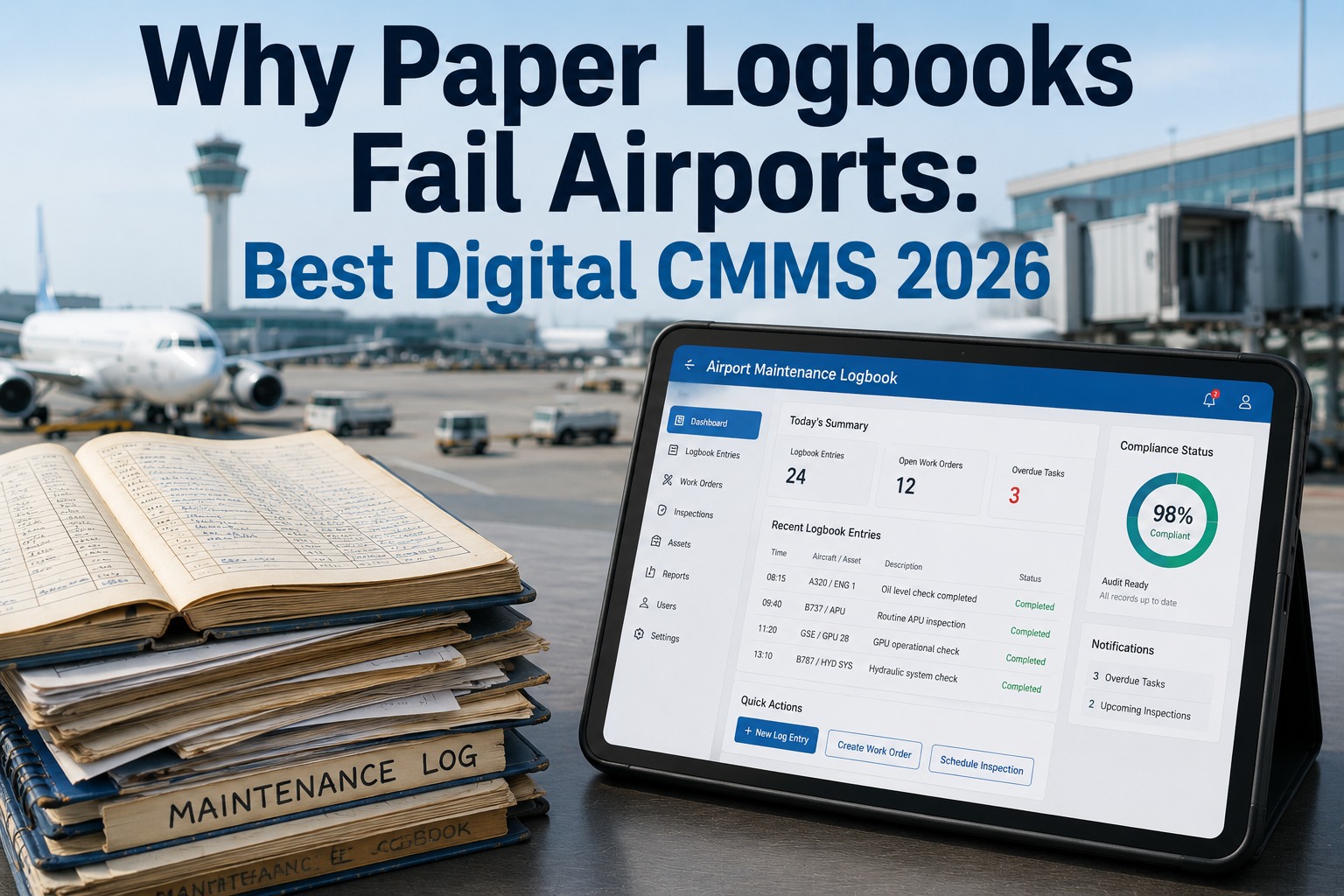
Best Digital Shift Handover Software for Airports: 2026 Playbook
By William Jerry on August 19, 2026
Every airport post-incident review eventually walks back through the handover log. A jet bridge that failed at 03:14, a runway light out at Runway 27L that a taxiing flight crew reported, a baggage sorter alarm that ran through three shifts before anyone captured it — the investigator opens the shift book, and either finds a defensible timeline or discovers that the previous shift's paper log is missing the two entries that would have explained everything. In 2026, the gap between paper and digital handover isn't a preference — it's the difference between a five-minute audit answer and a two-week reconstruction. This playbook covers what to look for in airport-grade digital shift handover software, how the leading platforms compare, and the operational capabilities that separate a defensible handoff from a fictional one. Book a free demo to see the handover flow across terminals.
The 2026 Airport Digital Handover Market · Why the Shift Is Happening Now
Industry data · Aviation Week 2025 MRO survey · airport CMMS market analyses
$3.87B
Global airport management software market · 2025
$6.61B
Projected market size by 2034 — 71% expansion window
$8.7B
Annual industry cost of maintenance delays traced to software limitations
10.4%
CAGR of the broader CMMS software market through 2033
Why Airport Handover Is Different From Every Other 24/7 Handover
Every 24/7 operation runs shifts. Airports run shifts that transfer responsibility for FAA Part 139 compliance, airside safety-of-life systems, ARFF equipment readiness, ground support fleet status, terminal HVAC and BHS alerts, contractor activity across the airfield, and open work orders on assets that live under continuous flight operations. A missed handover note on a runway edge light isn't a production KPI miss — it's a safety event. That singular fact is what separates airport-grade digital handover software from generic shift logbooks: the audit trail exists to protect lives, not just uptime.
01
Safety-of-Life Assets in the Handover
Runway lighting, ARFF, airfield markings — every open fault is a live safety item. The handover must carry not just "logged," but "closed or actively watched."
02
FAA Part 139 Documentation Weight
Daily airfield inspections, discrepancy logs, and corrective actions are inspectable records. Handover software must produce them on demand in Part 139 format.
03
Cross-Terminal Coordination
Handovers don't just span time — they span T1 to T4, airside to landside, base to remote stand. A single handover record must scope across zones.
04
Contractor & Tenant Airline Activity
Airline maintenance, ground handlers, cleaning crews all operate on the same assets. The handover captures who was on what, when, with what escort.
05
24/7 Operations, No Downtime Window
Unlike a factory that stops for changeover, the airport does not pause. Handover happens against live flight ops — every entry must sync in seconds.
06
Post-Incident Investigation Standard
The handover log is discovery material. NTSB, FAA, insurance, and litigation all trace back through it. Timestamp integrity is not a feature — it's a foundation.
The 8-Capability Scoring Framework · What "Best" Actually Means
"Best" is a shopping word — it means nothing until it's tied to capabilities. Below is the framework airport operations leaders actually use to score digital shift handover software, whether they call it that or not. Every platform earns a mark against each capability; the ones that score across all eight are the ones worth a shortlist slot.
Structured Handover Template
Not a free-text notebook — fields for asset status, open faults, contractor activity, safety issues, standing orders. Every shift produces a comparable record.
Mandatory Acknowledgment
Incoming supervisor cannot start shift without e-signing the outgoing handover. Every acknowledgment is timestamped and locked — no "I didn't see it."
Persistent Open-Issue Register
Unresolved faults carry forward across every shift boundary — not restarted. Every incoming supervisor sees the full context of every open item.
CMMS & Work-Order Integration
Handover log linked to live work orders — no data island. Open a fault from the handover; it's a real WO with owner, SLA, and asset history.
Mobile-First for Airfield Use
Handover created and read on phone or tablet at the asset — not typed up at a desk two hours later. Offline sync for airside dead zones.
Photo & E-Signature Evidence
Every entry can carry a photo — of the fault, the gauge, the tag-out, the closed work. E-signature on the acknowledgment. Server-side timestamps.
Multi-Zone / Multi-Terminal Scope
Handovers filterable by terminal, airside/landside, functional area — the T1 handover doesn't drown in T4 noise. Rollups for ops leadership.
Audit-Ready Export
Filter by date, terminal, asset, event type — export a defensible, timestamped, signed handover record for FAA, insurance, or internal audit in seconds.
Score Your Current Handover Program Against the 8 Capabilities
30-minute working session — walk your current paper or hybrid handover through the OxMaint framework, identify where each capability gap sits, and see what the digital flow looks like at your airport.
Most airports still run a hybrid: paper log at the shift desk, informal WhatsApp updates between supervisors, and CMMS work orders sitting in a separate system that neither shift consistently updates. The comparison below is not marketing — it's what an incident investigator finds when they open both systems side by side after a safety event.
Capability
Paper Logbook
Digital Handover Platform
Timestamp integrity
Handwritten, editable, disputable
Server-side, cryptographic, immutable
Open-issue continuity
Restarts each shift — issues get re-logged or lost
Persistent register — carries forward with full context
Photo evidence
Not possible in the log itself
Attached to every entry, geo-tagged, timestamped
Search & retrieval
Scan the binder page-by-page
Filter by asset, date, terminal, event type in seconds
CMMS work-order link
Manual double-entry into separate system
Handover entry = work order, single record, single owner
Acknowledgment enforcement
Signature at end of shift — no read-verification
Incoming shift cannot start without e-signed acknowledgment
Multi-terminal rollup
Not practical — logs live in physical binders per zone
Ops leadership sees single dashboard across every terminal
Post-incident audit pull
Days of manual reconstruction
Seconds — filtered export with photos and signatures
The Airport Handover Anatomy · What a Complete Shift Record Contains
Digital shift handover software is only as good as the template it enforces. Below is the anatomy of a complete airport shift handover — the six sections every record must carry, in the order incoming supervisors actually read them.
Every critical asset — jet bridges, BHS lines, HVAC units, GSE fleet, airfield lighting circuits, ARFF apparatus — with running / degraded / stopped / out-of-service state at shift end.
3
Open Fault & Work Order Register
Every unresolved fault carrying into the next shift — WO number, asset, first-logged time, current status, next expected action, priority, owner.
4
Safety Events & Near-Miss Log
Runway incursions, FOD events, contractor safety flags, injury reports — everything that will show up in monthly safety review, captured in the shift it occurred.
5
Contractor & Tenant Activity
Airline maintenance on the ramp, cleaning crews, HVAC contractors, IT vendors — who was on what asset, with what escort, from when to when.
6
Standing Orders & Watch Items
Anything the incoming shift needs to actively monitor — a marginal reading trending up, a temporary work-around in place, an inspection due mid-shift, a VIP arrival window.
Operational Priorities Airport Leaders Ask About
When ops leadership scopes a digital shift handover project, the same operational questions surface across every airport — regardless of size, hub type, or terminal count. The priorities below reflect what leadership actually filters against in the vendor conversation.
P01
Zero-Handover-Gap Guarantee
Every issue open at shift end is visible to the incoming supervisor. No orphaned faults. This is the single hardest requirement to meet with paper.
P02
FAA Part 139 Audit-Ready Export
Daily airfield inspection records, discrepancy logs, corrective-action closure — all pullable in the exact format Part 139 inspectors expect.
P03
Mobile Capture in Airside Dead Zones
Not every corner of the airfield has connectivity. Offline capture with automatic sync when back in range is a non-negotiable for line-side ops.
P04
Single Record, Not Two Systems
The handover entry and the CMMS work order are the same object. No double-keying, no version drift between shift log and work-order system.
P05
Multi-Terminal Ops Dashboard
The Duty Manager sees rolling handover status across every terminal, filterable by function and by criticality — not eight separate binders.
P06
Contractor & Tenant Visibility
Third-party activity on airport assets is captured in the same handover record — no separate tenant paperwork buried in a different filing cabinet.
Expert Perspective · What Actually Moves Airport Handover From Paper
The airports that have successfully moved off paper handover share one habit: they stopped treating the shift log as an operations artifact and started treating it as evidence. The moment the log became something a post-incident investigator would open, everything changed — the entries got structured, the timestamps got trusted, the acknowledgments became enforced, and the CMMS integration became mandatory instead of optional. What most airports discover after the transition is that the handover software isn't the win — the win is that every shift now inherits real context from the last one, so the same fault stops getting re-discovered, re-logged, and re-worked across three shifts. Duty managers get their nights back. Post-incident reviews shrink from two weeks to two hours. And the FAA Part 139 audit stops being a scramble. The playbook is not complicated: pick a platform that scores on all eight capabilities, integrate it with the CMMS on day one, and enforce e-signed acknowledgment from shift one. Everything else follows.
Treat It As Evidence
The moment the log becomes discovery material, structure and timestamp integrity stop being optional. Design the program that way from day one.
CMMS Integration Is Table Stakes
A handover system that doesn't create real work orders is just a nicer notebook. The entry has to become an actionable object in the maintenance system.
Enforce Acknowledgment From Day One
Voluntary acknowledgment fails at week three. Mandatory e-sign at shift start is the discipline that makes every other feature actually work.
How OxMaint Delivers Airport-Grade Digital Handover
OxMaint is a CMMS-native handover system — the shift log is not a bolt-on module or a separate database. Every open fault, every asset, every work order, every inspection record already lives in OxMaint, and the handover surface pulls from the same source of truth. That's what "no data island" actually means in production.
01
Structured Shift Template
Airport-specific handover form with asset status board, open-fault register, safety events, contractor log, and standing orders sections
02
Mandatory E-Sign Acknowledgment
Incoming supervisor cannot start shift without acknowledging the outgoing handover — locked timestamp, full audit trail
03
Live Open-Issue Register
Every unresolved WO auto-appears on the next shift's handover — full history, owner, next action, no re-logging
04
Mobile-First With Offline Sync
Capture on any phone or tablet at the asset — airside dead-zone tolerant, auto-syncs when back in range
05
Multi-Terminal Rollup
Duty Manager dashboard aggregates across T1-T4, airside/landside — filter by criticality, terminal, or function
06
Part 139 Audit Export
Filter by date range, asset, or event type — export a defensible, signed, timestamped handover record for any audit in seconds
Stop Re-Discovering the Same Fault Every Shift
See what a real airport-grade digital handover looks like in production — one platform for shift logs, work orders, inspections, and audit exports. Free forever plan available to trial the full workflow across your terminals.
What is digital shift handover software for airports?
Digital shift handover software for airports is a purpose-built platform that replaces paper shift logs with a structured, mobile, mandatorily-acknowledged handover record covering asset status, open faults, safety events, contractor activity, and standing orders across every terminal and airside zone. The strongest platforms are CMMS-native — the handover entry and the work order are the same object, not two records in two systems. Sign up free to try the airport handover template.
Why do airports need dedicated handover software when generic shift log tools exist?
Airport handovers carry safety-of-life obligations that generic shift logs don't address: FAA Part 139 documentation requirements, multi-terminal / airside-landside scoping, contractor and tenant airline activity tracking, and post-incident investigation-grade audit trails. Generic shift log tools built for manufacturing plants miss the aviation-specific data model — asset classes like ARFF apparatus and runway lighting circuits, Part 139 inspection format requirements, and the 24/7 no-downtime operational reality that airports live in.
What features separate the best airport shift handover CMMS from average platforms?
Eight capabilities matter most: structured handover template (not free text), mandatory e-sign acknowledgment, persistent open-issue register carrying across shifts, direct CMMS and work-order integration, mobile-first with offline sync for airside use, photo and e-signature evidence, multi-zone / multi-terminal scope with rollup, and audit-ready export in Part 139 format. Platforms that score on all eight are the shortlist; anything missing three or more is a compromise. Book a free demo to score your current setup.
Can digital shift handover software really eliminate incidents from missed handovers?
The evidence from operational deployments is consistent: airports moving from paper to structured digital handovers report substantial reductions in safety incidents traced back to handover gaps. One published case cited elimination of 4-5 quarterly safety incidents attributed to handover gaps after digital shift logbook rollout across 3 terminals. The mechanism is simple: the persistent open-issue register and mandatory acknowledgment together prevent the "I didn't know about that" failure mode that most paper-era incidents trace back to.
How long does it take to roll out digital shift handover software at an airport?
Rollout scope drives timeline. A single-terminal pilot with 20-40 users typically goes live in 2-4 weeks on a cloud-native CMMS-integrated platform. Full multi-terminal deployment covering airside operations, GSE fleet, and terminal facilities typically completes in 6-12 weeks depending on integration complexity with existing SCADA/BMS and airline tenant systems. Legacy enterprise handover platforms with heavy customization can take 6-12 months — the cloud-native tier is dramatically faster because there is no separate handover database to build.
Does OxMaint replace an airport's existing airline or ATC systems?
No — OxMaint sits in the airport operations layer, covering maintenance, facilities, GSE, airside infrastructure, and shift handover across those functions. It doesn't replace airline MRO systems, ATC operational systems, or airport authority financial platforms. It integrates alongside them, taking the shift handover, work order, inspection, and asset management surface off paper and legacy tools into one cloud-native CMMS with a free forever plan available to trial. Sign up free to explore the platform.