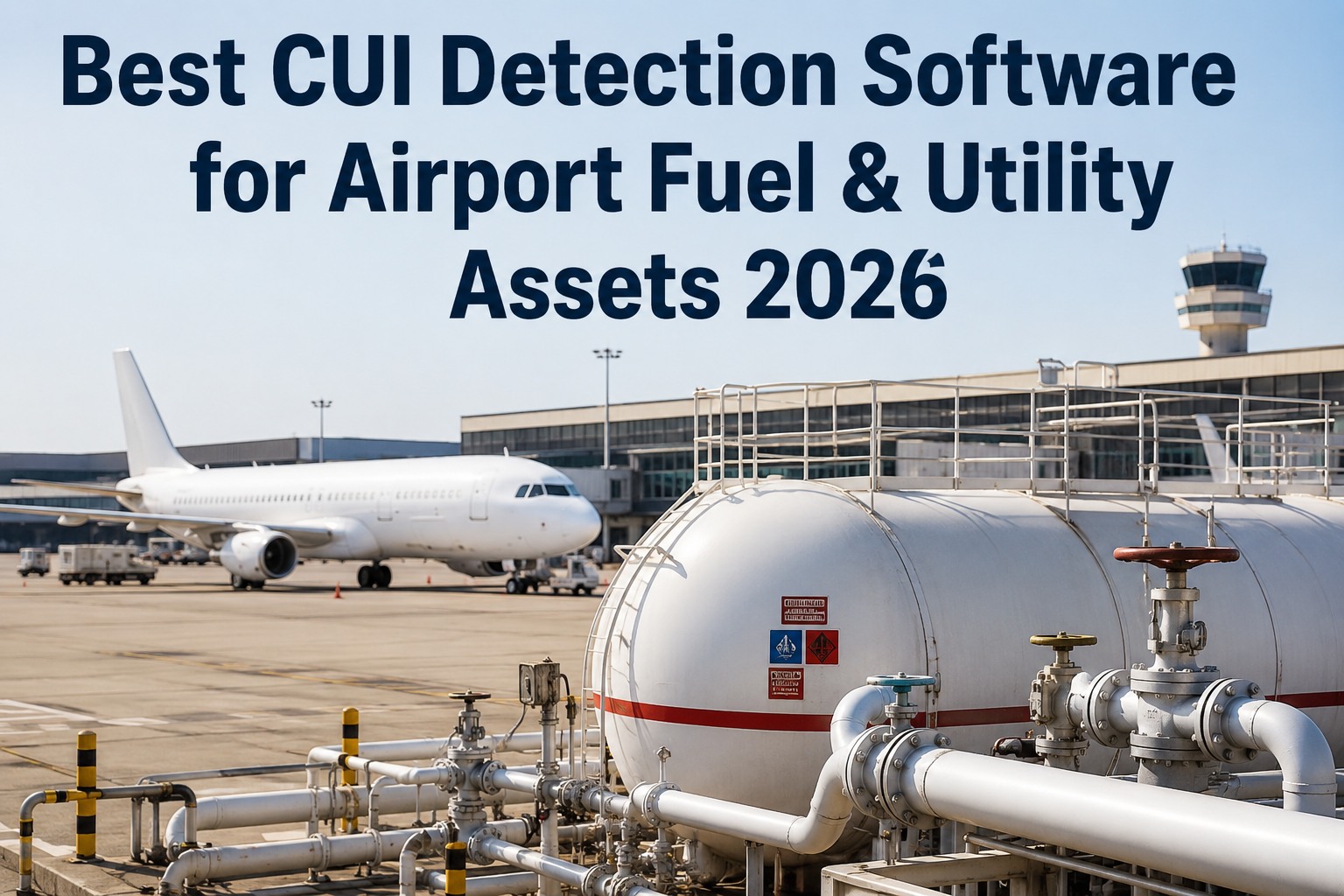
Corrosion Under Insulation is the single most under-detected damage mechanism in industrial asset integrity. The insulation that keeps a pipe efficient is exactly what makes it impossible to inspect visually — moisture penetrates the jacketing, gets trapped against the metal wall, and corrosion propagates silently for years before external evidence appears. The 2008 US Chemical Safety Board report put it plainly: the highest incidence of leaks in refining and chemical operations comes from CUI, not from internal process corrosion. Global process-industry losses to CUI now run an estimated $276 billion annually. For airports, the exposure is real and specific — insulated jet fuel transfer piping, insulated hydrant loops, utility steam lines through terminal mechanical rooms, chilled water headers, and fuel farm tank nozzles all sit in the CUI risk window. API RP 583 identifies peak susceptibility for carbon steel between 77°C and 110°C (with broader risk -4°C to 175°C) and for austenitic stainless steel between 60°C and 177°C where chloride stress corrosion cracking becomes the concern. Below is the working guide — the temperature risk bands, the four practical NDE detection methods, and the mobile-first digital inspection workflow that turns every CUI walkdown into GPS-tagged, photo-verified evidence in the CMMS. Start free and stand up API 583 CUI inspection on one airport fuel or utility circuit this week, or book a demo to see the risk-based CUI workflow mapped to your airport asset register.
Aviation · Airport Fuel & Utility · API RP 583 · 2026
Best CUI Detection Software for Airport Fuel & Utility Assets 2026
The temperature risk bands, the four practical NDE detection methods (PEC, guided wave UT, profile radiography, spot UT), and the mobile-first digital inspection workflow that produces API 583-aligned CUI records for airport fuel systems, hydrant loops, and terminal utilities.
-
$276B
annual global process-industry cost of undetected CUI
-
API 583
governing standard — 19 documented NDE methods
-
77–110°C
peak carbon-steel CUI susceptibility (broader -4°C to 175°C)
-
CSB 2008
CUI is the #1 cause of refining and chemical leaks — not internal corrosion
The Risk Window
Where Airport Assets Actually Sit on the CUI Temperature Curve
API 583 defines CUI risk as a temperature-dependent phenomenon. Below is the working temperature band map — the zones where CUI activity is peak, active, and low, with the specific airport asset classes that sit inside each zone.
Jet Fuel Transfer / Hydrant Piping
Ambient to lightly heated — insulated for freeze protection and fire suppression. Cyclic wet/dry conditions ideal for CUI initiation on carbon steel.
Terminal Steam / Hot Water Utility Lines
Building heat, sterilisation, HVAC reheat loops. Operating 80–150°C — directly in peak CUI window on carbon steel piping. Highest risk for accelerated wall loss.
Chilled Water Headers & Condensate
4–15°C operating with insulation for thermal loss control. Persistent moisture from condensation is the failure mechanism — especially at supports and penetrations.
The Four Detection Methods
Which NDE Method Actually Fits Each Airport Circuit
API RP 583 lists nineteen NDE methods for CUI detection. Four of them cover the majority of real-world airport applications — each with a specific fit, coverage rate, and cost profile. Below is the working selection reference.
Pulsed Eddy Current (PEC)
Best for: Screening large areas without insulation removal
Works at -100°C to 500°C, no shutdown required. ~10% accuracy on corrosion detection, 0.2% on trending. Ideal for airport hydrant loops and utility risers.
Guided Wave UT (GWUT)
Best for: Long straight runs — 50-100 m per collar
Single collar location screens both directions along the pipe. Detects cross-sectional area loss from both internal and external corrosion. Best on long jet fuel transfer runs.
Profile Radiography (RT)
Best for: Small-diameter piping, welds, penetrations
X-ray through insulation produces a wall-profile image without removal. Coverage ~30 sec/ft for real-time radiography. Best at supports, elbows, and insulation penetrations.
Spot UT Thickness
Best for: Confirmation and trending at known locations
Requires small insulation window at each measurement point. Highest precision on remaining wall thickness. Used to confirm PEC/GWUT screening findings and trend over cycles.
The Digital Inspection Loop
Every CUI Walkdown, Every Reading, Every Photo — In One Searchable Record
Paper CUI inspection reports depend on which inspector walked the route, whose handwriting can be read, and which binder someone can find. Digital inspection turns every reading into GPS-tagged, timestamped, photo-verified evidence linked to the specific circuit and inspection cycle — auditor-retrievable in seconds. Oxmaint runs the entire loop: risk-based route generation, mobile capture with mandatory fields, auto-created repair work orders on findings, and full API 583 alignment on every asset.
Built for Airport CUI Programmes
How Oxmaint Runs Airport CUI Detection End to End
-
Risk-Based Routes
API 583 RBI Prioritisation per Circuit
Inspection routes generated by API 583 risk-based inspection logic — temperature band, insulation age, coating condition, and consequence-of-failure weighted per circuit. High-risk assets inspected first; low-risk retired to failure-finding cadence.
-
Mobile Capture
GPS + Timestamp + Photo Per Reading
Every measurement point captured through the mobile app with GPS location, timestamp, and photo evidence. Mandatory fields prevent incomplete records. The "which inspector walked this route" ambiguity disappears.
-
Auto Repair Work Orders
Finding Above Threshold = Dispatched WO
Wall thickness readings below configured threshold auto-create repair work orders with location, photo evidence, and recommended action. The finding becomes actionable inside the same shift.
-
Cycle Trending
Wall Thickness Trend per Measurement Point
Every measurement location retains its full history — first-cycle baseline, every subsequent reading, corrosion rate calculation. Remaining-life projection per circuit becomes a data-driven number, not gut feel.
-
Audit-Ready Retrieval
Filter by Circuit, Method, Date in 30 Seconds
Full CUI programme history retrievable in seconds — filtered by circuit, NDE method, date range, or inspector. The regulatory or insurer audit becomes a filter query, not a binder search.
-
Free Forever Plan
Pilot on One Fuel Circuit or Utility Loop
Cloud-based, mobile-first. Load your API 583 circuit list, run the first inspection cycle on one fuel transfer or utility loop, and prove the digital evidence chain before scaling airport-wide.
Frequently Asked
CUI Detection Questions
Which NDE method is best for insulated jet fuel piping?
For long straight runs, Guided Wave UT is the most efficient screening method — a single collar location screens 50 to 100 meters in both directions without insulation removal. For confirmation of GWUT findings and for supports, elbows, and insulation penetrations, profile radiography or spot UT is used. Pulsed Eddy Current is the alternative for high-temperature or difficult-access runs. Method selection is per-circuit, not one-size-fits-all. Start free and configure per-circuit method selection today.
Do we need to remove insulation for every inspection?
No. PEC, GWUT, and profile radiography all detect CUI through the insulation without removal — screening methods designed exactly for this problem. Insulation removal is reserved for confirmation at high-risk locations flagged by screening, or for spot UT thickness measurement where highest precision is needed. Insulation removal is the most expensive method and is triggered by findings, not applied blanket-fashion.
How often should airport fuel piping be inspected for CUI?
API 583 uses risk-based intervals — high-consequence circuits at 3-5 year cycles, medium risk at 5-7 years, low risk on longer intervals with failure-finding tasks in between. Insulation condition, coating age, ambient environment (coastal airports carry higher exposure from salt-laden air), and operating temperature all drive the interval. Fixed calendar cycles are the wrong operating model for CUI. Book a demo to see risk-based interval calculation on your circuits.
Is there a free plan to run digital CUI inspection on one circuit?
Yes. Oxmaint offers a free forever plan — enough to load API 583 circuit definitions, run the first mobile inspection cycle on one fuel or utility loop, capture GPS-tagged photo evidence per measurement point, and prove the digital record chain. Cloud-based, mobile-first — no server procurement to start. Sign up for the free plan and pilot on one circuit today.
API 583 · Risk-Based · Mobile-Captured · Audit-Ready
CUI Only Stays Undetected When the Programme Depends on Paper and Luck.
Airport fuel transfer piping, utility steam lines, chilled water headers, and hydrant loops all sit in the CUI risk window. API 583 is the framework; risk-based routes, mobile capture with mandatory fields, and auto-generated repair work orders are the operating model. Oxmaint runs it end to end — from circuit prioritisation through GPS-tagged measurement to audit-ready record retrieval.