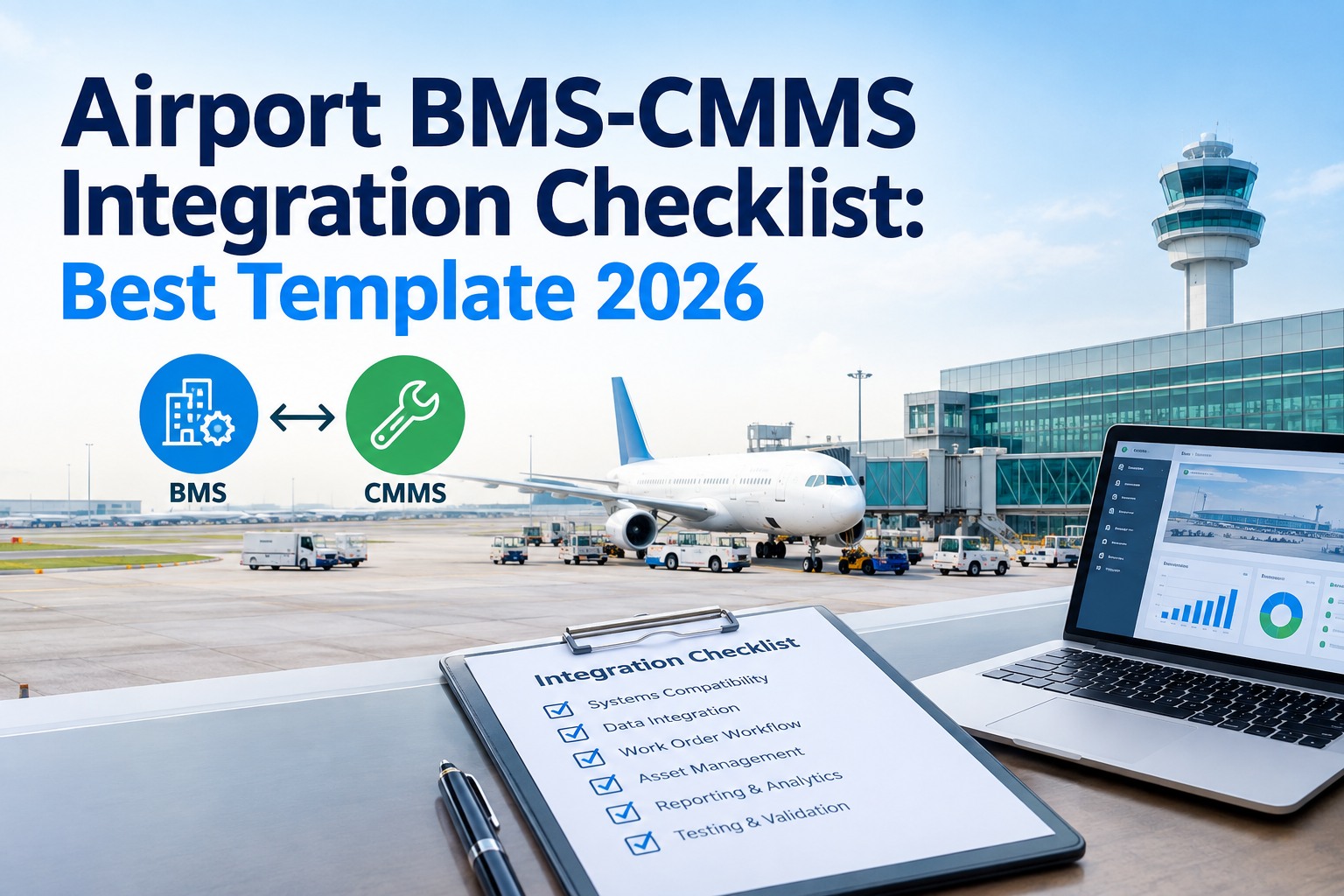
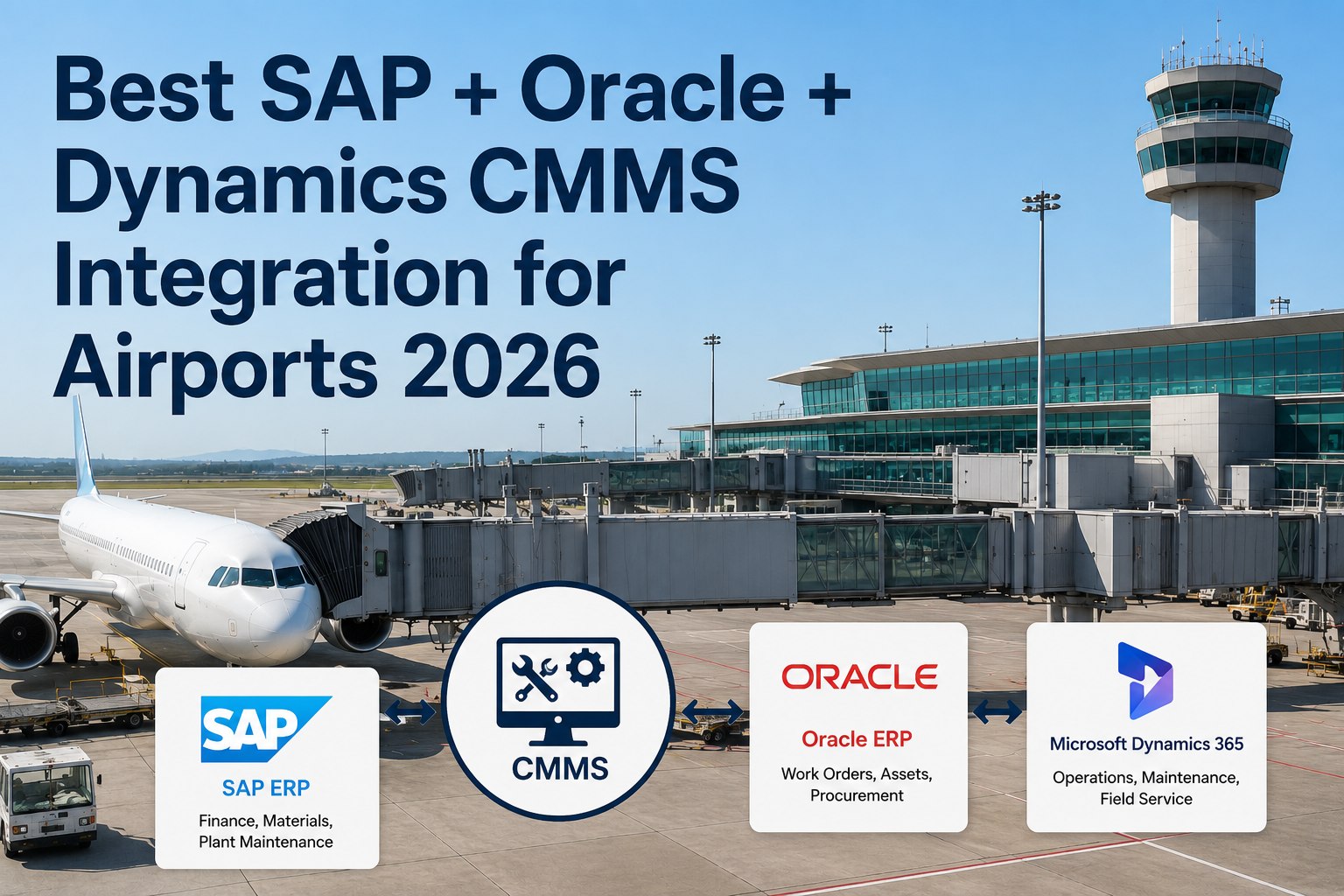
An airport is not one system running maintenance — it's dozens of systems running in parallel, and the ones that talk to each other cleanly are the ones that pay back. On any given morning a hub airport has HVAC consuming 40–50% of total energy load through a BMS, thousands of vibration and temperature sensors on baggage handling conveyors and sortation systems, SCADA telemetry streaming from airfield lighting and electrical distribution, an ERP holding purchase orders and asset depreciation schedules, and a maintenance team trying to run all of it from a CMMS that historically had no way to see any of it in real time. The airports handling this well in 2026 have collapsed the silos through a purpose-built CMMS-ERP-IoT integration architecture — REST and MQTT gateways, pre-built connectors to SAP S/4HANA and Oracle EBS, BACnet and Modbus adapters into the BMS, and bidirectional flows that turn every sensor signal into a structured work order and every closed work order into an ERP cost posting. The result is measurable: 81% average reduction in unplanned BHS downtime in AI-CMMS-enabled airports, 92-98% predictive alert accuracy at 30-90 days lead time, and 92% elimination of manual procurement data entry. Airports still running disconnected stacks report 47% of maintenance team time spent moving data between systems rather than actually managing maintenance. This guide is the 2026 architecture reference for airport CMMS-ERP-IoT integration — the layers, the protocols, the airport-specific systems that need connecting, and the evaluation criteria for choosing the platform. Book a free integration architecture review against your current stack.
81%
Average reduction in unplanned BHS downtime in AI-CMMS-enabled airports with IoT sensor integration
92–98%
Predictive alert accuracy achievable with 30–90 day failure prediction lead time
47%
Of maintenance team time spent moving data between disconnected systems rather than doing maintenance
4.7 tools
Average number of software systems a maintenance operation touches · CMMS, ERP, BI, IoT, BMS, accounting
The Integration Triangle · Three Domains That Must Talk
Airport maintenance operates at the intersection of three technology domains, each with its own data model, its own vendor ecosystem, and its own change cycle. The CMMS runs day-to-day work orders and preventive maintenance. The ERP holds financial, procurement, HR, and asset accounting data. The IoT/OT layer generates the real-time signals that drive condition-based work. When any one of the three disconnects, the whole reliability program stalls.
CMMS
Maintenance Operations
Work orders · PMs · assets · technicians · mobile execution · closure evidence
OxMaint · Maximo · UpKeep · Fiix · Limble
ERP
Financial & Procurement
Purchase orders · vendor payments · asset depreciation · GL postings · HR labor · MRO parts
SAP S/4HANA · Oracle EBS · Microsoft Dynamics · Ramco Aviation · AMOS · Trax
IoT · OT
Real-Time Sensor Signals
Vibration · temperature · current · pressure · runtime · BMS telemetry · SCADA fault codes
BHS PLCs · BMS · airfield SCADA · thermal cameras · vibration sensors · smart meters
The Airport-Specific Systems Map · What Actually Needs Connecting
Airport integration architecture is not the same as manufacturing or facilities integration. The systems inventory is airport-specific, the protocols are a mix of aviation-standard and building-standard, and the operational stakes are higher because a failed BHS conveyor doesn't just delay production — it delays flights. Below is the working map of what a hub airport actually needs to connect.
Landside & Terminal Systems
Building Management System (BMS)
BACnet · Modbus · KNX
HVAC, lighting, elevators, escalators · 40–50% of airport total energy load · needs bidirectional CMMS flow
Baggage Handling System (BHS)
OPC-UA · MQTT · REST
Conveyors, sortation, carousels · vibration + current sensors · directly delays flights on failure
Passenger Boarding Bridges
Modbus · REST
Hydraulic system telemetry · position sensors · usage-based maintenance triggers
Airside Systems
Airfield Lighting SCADA
SCADA · IEC 61850 · REST
Runway, taxiway, approach lighting · fault signals must auto-trigger corrective WOs within response window
ARFF Vehicle Telematics
MQTT · REST · Cellular
Engine hours · pump activation · location · maintenance triggered by runtime and event data
Fuel Farm SCADA
Modbus · OPC-UA
Tank levels · pump status · filtration DP · quarterly inspection linkage per §139.321
Enterprise Systems
ERP · SAP S/4HANA · Oracle EBS
REST · SOAP · BAPI · IDoc
PO generation on parts request · GL cost postings on WO close · asset depreciation on capex WOs · HR labor
MRO Systems · AMOS · Trax · Ramco
REST · MQTT · SFTP
Aviation-specific MRO for airport-owned GSE · component tracking · airworthiness data linkage
BI · Power BI · Tableau · Snowflake
GraphQL · REST · ODBC
MTBF, MTTR, PM compliance, cost per asset pushed into enterprise dashboards without a separate silo
The 5-Layer Architecture · How Airport Integration Actually Assembles
Every scalable airport integration architecture organizes into the same five layers, mapped from the IJCET Tier-1 airport reference model. Understanding the layer separation is what makes the architecture maintainable — you can replace a sensor without changing the ERP integration, add a new ERP without re-wiring the field devices.
L5
Application Layer
CMMS work orders · ERP financial postings · BI dashboards · SMS documentation · audit-ready record export
OxMaint · SAP S/4HANA · Oracle EBS · Power BI
↑
L4
Analytics & AI Layer
Signal fusion · ML models for failure prediction · anomaly detection · remaining useful life · threshold tuning
Vibration ML · thermal analytics · digital twin engines
↑
L3
Integration Gateway Layer
API gateway · protocol translation · authentication · rate limiting · data normalization · event routing
REST · MQTT broker · OPC-UA gateway · webhooks
↑
L2
Control Layer
PLCs · DCS · automation controllers · SCADA head-ends · edge computing for latency-sensitive control
Rockwell · Siemens · Schneider · edge nodes
↑
L1
Field Layer
Vibration sensors · thermal cameras · current transformers · pressure transducers · smart meters · BACnet devices
BACnet · Modbus · KNX · 4-20mA · wired & wireless
The Protocol Stack · What Speaks to What
Airport integration requires a mixed protocol stack because the systems being connected were built across four decades of technology cycles. Modern REST and MQTT dominate greenfield sensor deployments; BACnet and Modbus dominate BMS and legacy building systems; SAP and Oracle have their own aviation-specific interfaces. A capable integration layer speaks all of them fluently.
Protocol
Domain
Typical Use in Airport
Direction
REST API
Universal
Modern SaaS-to-SaaS · webhook triggers · BI queries · mobile app data
↔
MQTT
IoT
High-volume sensor streams · low-bandwidth field devices · pub-sub broker architecture
↓
OPC-UA
OT
Industrial control · PLC-to-CMMS · BHS conveyor telemetry · modern SCADA
↓
BACnet
BMS
HVAC, lighting, elevators · established building automation standard · read + command
↔
Modbus TCP/RTU
Legacy OT
Older BMS · fuel farm SCADA · legacy building systems · reliable serial fallback
↓
SAP BAPI · IDoc · OData
ERP
SAP PM notification creation · MM parts postings · FI cost center pushes
↔
GraphQL
BI & Analytics
Selective KPI queries for Power BI, Tableau · avoids over-fetching for dashboard aggregation
↑
Webhooks
Event-Driven
WO close fires downstream · sensor threshold triggers external notification · Zapier-style automation
↑
↔ Bidirectional flow
↓ Inbound to CMMS
↑ Outbound from CMMS
Audit Your Airport Integration Stack in 30 Minutes
Working session with our aviation integration team — we'll map your current CMMS, ERP, BMS, and IoT stack, flag broken data flows and re-keying hotspots, and show how OxMaint's REST + MQTT gateway closes the gaps without a custom integration project.
Six Integration Flows Every Airport Needs Automated
Airport integration ROI comes from six specific data flows that eliminate the daily re-keying, delay, and gap-generating manual handoffs that plague disconnected stacks. Each flow below is a distinct workflow the integration layer should handle without human intervention.
F1
Sensor Signal → Predictive Work Order
IoT Sensor → Analytics Layer → CMMS WO
Vibration or thermal threshold crossing auto-generates a predictive work order · asset tag, symptom, priority, parts pre-populated · technician sees on phone within seconds of the alarm
F2
Parts Request → ERP Purchase Order
CMMS Request → Stock Check → ERP PO
Technician requests parts on the WO · CMMS checks inventory · if below reorder point, ERP purchase requisition creates automatically · eliminates 92% of manual procurement data entry
F3
Work Order Close → ERP Cost Posting
Technician Close → Cost Aggregate → SAP Cost Center
Labor hours, parts consumed, contractor invoice on WO close · aggregate cost pushes to ERP cost center or SAP PM equipment history · no re-entry, no lag, no reconciliation
F4
BMS Fault → Corrective Work Order
BMS Alarm → BACnet Gateway → CMMS Corrective WO
HVAC unit trip, chiller fault, elevator alarm from the BMS auto-triggers a corrective WO with location, fault code, priority · technician dispatched without a phone call
F5
Runtime Counter → PM Schedule Adjustment
Equipment Hours → CMMS PM Engine → Auto-Reschedule
Real runtime hours from sensor or SCADA replace calendar-based PMs · high-utilization assets get more frequent service · low-utilization avoid over-maintenance
F6
CMMS KPIs → Enterprise BI
GraphQL Query → Data Warehouse → Power BI / Tableau
MTBF, MTTR, PM compliance, cost per asset queryable from BI stack · maintenance KPIs join operational reporting used by leadership, no separate maintenance silo
Software Evaluation Framework · What "Best" Actually Means for Airport Integration
Generic CMMS vendors claim "open API" and stop there. Airport-purpose-built integration platforms treat the API layer as the product. The evaluation criteria below are what separates platforms that will actually run at hub scale from those that will need a custom integration engagement every time a new system connects.
Capability
Generic CMMS
Airport Integration Platform
API architecture
REST endpoints, limited docs
REST + MQTT + GraphQL + webhooks · versioned · developer portal
Pre-built ERP connectors
SAP only, one-way
SAP S/4HANA · Oracle EBS · Dynamics · Ramco · AMOS · Trax · bidirectional
BMS protocol support
Third-party middleware required
BACnet · Modbus · KNX · native adapters, no middleware
IoT sensor ingest volume
Batched, minutes-scale latency
MQTT streaming · sub-second latency · thousands of tags per airport
Bidirectional data flow
Read-only from ERP
Full bidirectional · WO close pushes cost, PO approval updates WO
Threshold-driven auto WO
Manual rule config per sensor
Templated per asset class · ML-tuned thresholds · closed loop
Multi-site / multi-terminal
Single-tenant, per-site licenses
Hierarchy-native · terminal / concourse / gate roll-ups · single dashboard
Aviation-specific compliance
Not covered
Part 139 records retention · SMS documentation · audit-package export
Real-World ROI Signals · What Airports Actually Measure
Integration ROI at airport scale is documented across a consistent set of benchmark metrics. The numbers below are what OxMaint and other AI-CMMS platforms report from live deployments at hub and regional airports — the airports that ran disconnected stacks before adoption and can measure the delta.
81%
BHS Unplanned Downtime Reduction
Baggage Handling System conveyor + sortation predictive intervention · vibration and current sensor integration · directly reduces flight delays and passenger disruption
92–98%
Predictive Alert Accuracy
AI models achieve near-industrial-benchmark accuracy on 30–90 day failure prediction · continuously learning from closure evidence · improves with usage
92%
Procurement Data Re-Entry Eliminated
CMMS-to-ERP parts request → PO flow removes the manual keying that dominated pre-integration MRO ops · 11% of productive labor hours recovered
15–25%
Asset Availability Lift
Predictive maintenance replaces preventive calendar-based service · fewer premature interventions, fewer surprise failures · benchmark for AI-CMMS deployments
40–50%
HVAC Energy Load Managed
Airport HVAC accounts for 40–50% of total facility energy · BMS integration surfaces optimization opportunities the disconnected stack couldn't see
8–12 wks
Typical Integration Timeline
Sensor deployment, system integration, staff training, AI model calibration · phased rollout starting with critical assets and expanding incrementally
Expert Perspective · Why Middleware Is Not the Answer
The default response to airport integration complexity for the last twenty years has been to add another product to the stack — a middleware ESB, an integration platform-as-a-service, an ETL vendor sitting between the CMMS and everything else. In principle this decouples the systems and lets them evolve independently. In practice at airport scale it adds a third license, a third support contract, a third team of engineers to hire, and a third layer where data can get stuck, corrupted, or lost. The airports handling integration well in 2026 have gone the opposite direction — they've selected a CMMS whose integration layer is native and treats REST, MQTT, OPC-UA, BACnet, and SAP BAPI as first-class citizens rather than plugins. Sensor signals flow through MQTT directly into work order generation. BMS faults route through BACnet into corrective WOs. ERP cost postings push out through SAP BAPI on WO close. There is no middleware in the middle because the CMMS is architected as the integration platform. That's the difference between a maintenance operation where the technician's phone shows every relevant alert and the technician's phone rings because someone in the control room saw the alert on a separate system nobody connected. The former is the airport that runs at hub scale with predictive maintenance actually paying back. The latter is the airport that has 47% of its maintenance team's time going into data movement instead of maintenance.
Integration as Architecture
The CMMS is the integration platform · REST, MQTT, OPC-UA, BACnet, and SAP BAPI as first-class citizens · no middleware in the middle to add lag and failure surface.
Bidirectional or Nothing
Read-only integrations are demoware · every flow must be bidirectional so WO close pushes cost and PO approval updates WO status.
Signal → Action in Seconds
Sensor threshold to technician phone should be seconds, not minutes · MQTT streaming with sub-second latency is table stakes at hub scale.
How OxMaint Delivers the Airport CMMS-ERP-IoT Integration Architecture
OxMaint is architected as an integration platform first, a maintenance workflow second. Every airport-specific system — BMS, BHS, airfield SCADA, ERP, MRO systems — connects through the native gateway layer with the protocols the system actually speaks, without middleware in between.
Gateway
REST + MQTT + GraphQL Native
Modern API stack with versioned endpoints · MQTT streaming for sensor ingest · GraphQL for BI queries · webhooks for event-driven flows · documented developer portal
ERP
Bidirectional Financial Sync
SAP S/4HANA · Oracle EBS · Microsoft Dynamics · Ramco Aviation · AMOS · Trax · WO close pushes cost, PO approval updates WO, no re-keying
BMS
BACnet / Modbus / KNX Adapters
Direct connection to airport BMS platforms · HVAC fault → corrective WO · elevator alarm → dispatched technician · zero middleware
IoT
MQTT Sensor Streaming
Vibration, thermal, current, pressure sensors ingest via MQTT with sub-second latency · thresholds fire predictive WOs · asset tag, symptom, priority pre-populated
SCADA
OPC-UA + Airfield Integration
Airfield lighting SCADA, BHS PLCs, fuel farm SCADA via OPC-UA · fault codes auto-trigger WOs · separation of control plane from CMMS visibility
BI
Enterprise Dashboard Push
MTBF, MTTR, PM compliance, cost per asset queryable via GraphQL · pushes to Power BI, Tableau, Snowflake · maintenance KPIs join enterprise reporting stack
Turn Sensor Signals Into Maintenance Action
Stop losing 47% of maintenance team time to data movement. See how OxMaint's native integration layer connects your CMMS, ERP, BMS, SCADA, and IoT sensors with no middleware — assembling a unified airport data thread with bidirectional flows and sub-second latency. Free forever plan available.
Frequently Asked Questions
What is airport CMMS-ERP-IoT integration and why does it matter?
Airport CMMS-ERP-IoT integration is the connection of three technology domains that historically ran as silos: the CMMS handling day-to-day maintenance work orders and preventive maintenance, the ERP holding financial, procurement, HR, and asset accounting data, and the IoT/OT layer generating real-time signals from sensors, BMS, SCADA, and airfield systems. When these three connect bidirectionally, sensor signals auto-generate predictive work orders, work order closure pushes cost data to the ERP without re-entry, and BMS faults route directly to corrective WOs. Airports running disconnected stacks report 47% of maintenance team time spent moving data between systems rather than actually managing maintenance — integration reclaims that time and enables measurable outcomes like 81% BHS downtime reduction.
Which airport systems need to connect to the CMMS?
The typical hub airport integration inventory covers three domains. Landside/terminal: BMS (HVAC, lighting, elevators via BACnet/Modbus/KNX), BHS (baggage conveyors via OPC-UA/MQTT), passenger boarding bridges. Airside: airfield lighting SCADA, ARFF vehicle telematics, fuel farm SCADA per §139.321. Enterprise: ERP (SAP S/4HANA, Oracle EBS, Ramco Aviation, AMOS, Trax) via BAPI/OData/REST, MRO systems for airport-owned GSE, and BI platforms (Power BI, Tableau, Snowflake) via GraphQL. A capable integration platform speaks all of these protocols natively without middleware.
Book a free integration audit against your stack.
What protocols does an airport integration platform need to support?
The core protocol stack is: REST API (universal SaaS-to-SaaS, bidirectional), MQTT (high-volume sensor streaming inbound), OPC-UA (industrial control and PLC-to-CMMS inbound), BACnet (BMS bidirectional for HVAC, lighting, elevators), Modbus TCP/RTU (legacy OT and older BMS), SAP BAPI/IDoc/OData (ERP bidirectional for notifications, MM parts, FI cost postings), GraphQL (BI selective queries outbound), and webhooks (event-driven outbound triggers). Airport integration architecture requires a mixed stack because the systems being connected span four decades of technology cycles — modern greenfield sensors use REST and MQTT while established BMS runs BACnet and Modbus, and none of it is going away.
What ROI can airports expect from CMMS-ERP-IoT integration?
Documented benchmark results from AI-CMMS platforms at hub airports: 81% average reduction in unplanned BHS downtime (baggage handling conveyor + sortation predictive intervention), 92–98% predictive alert accuracy at 30–90 day failure prediction lead time, 92% elimination of manual procurement data re-entry (the CMMS parts request → ERP PO flow), 15–25% asset availability lift versus preventive calendar-based maintenance, 11% recovery of productive labor hours previously lost to re-keying between CMMS and ERP, and BMS integration surfacing energy optimization opportunities on the 40–50% of airport energy load HVAC represents. Typical integration timeline is 8–12 weeks for sensor deployment, system integration, staff training, and AI model calibration.
Sign up free to trial the integration workflow.
Do we need integration middleware between our CMMS and ERP?
No, and adding middleware is usually the wrong answer at airport scale. Traditional integration middleware (ESBs, integration platforms-as-a-service, ETL vendors) adds a third license, a third support contract, a third team of engineers to hire, and a third layer where data can get stuck or corrupted. The airports handling integration well in 2026 have selected a CMMS whose integration layer is native — REST, MQTT, OPC-UA, BACnet, and SAP BAPI treated as first-class citizens rather than plugins. Sensor signals flow through MQTT directly into work order generation. BMS faults route through BACnet into corrective WOs. ERP cost postings push out through SAP BAPI on WO close. No middleware in the middle because the CMMS is the integration platform.
Does OxMaint integrate with SAP and Oracle for aviation MRO?
Yes. OxMaint provides native bidirectional integration with SAP S/4HANA (BAPI, IDoc, OData), Oracle EBS, Microsoft Dynamics, and aviation-specific MRO systems including Ramco Aviation, AMOS, and Trax. Work orders created in OxMaint synchronize to SAP PM as maintenance notifications, cost settlements push back into SAP controlling modules, parts requests trigger ERP purchase requisitions on stock-below-reorder-point, and PO approvals update the CMMS work order with expected delivery. For airport-owned GSE and aviation-specific asset classes, the MRO-side integration maintains component tracking and airworthiness data linkage. Free forever plan available to trial the full integration workflow.
Book a free demo to see live integration.