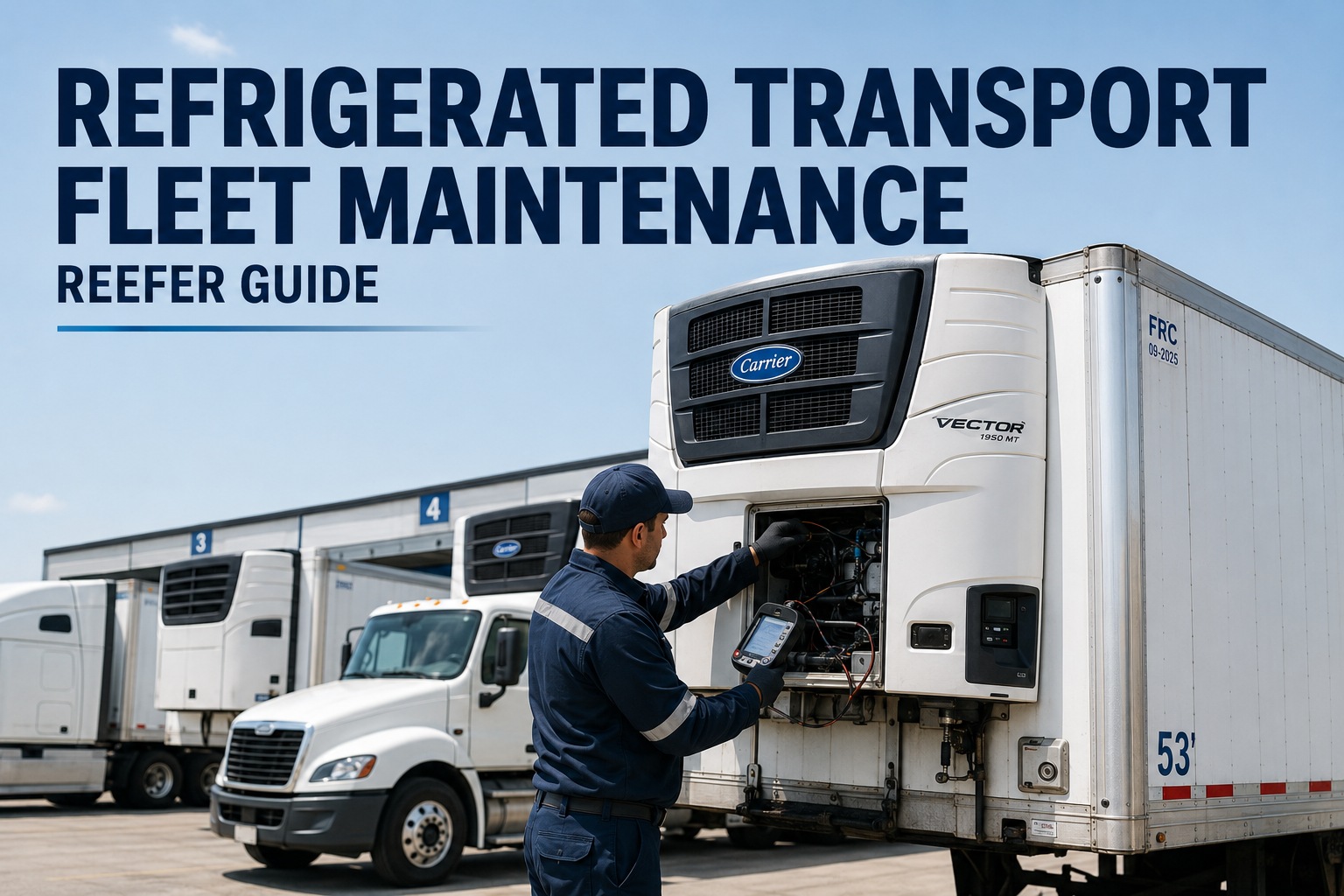
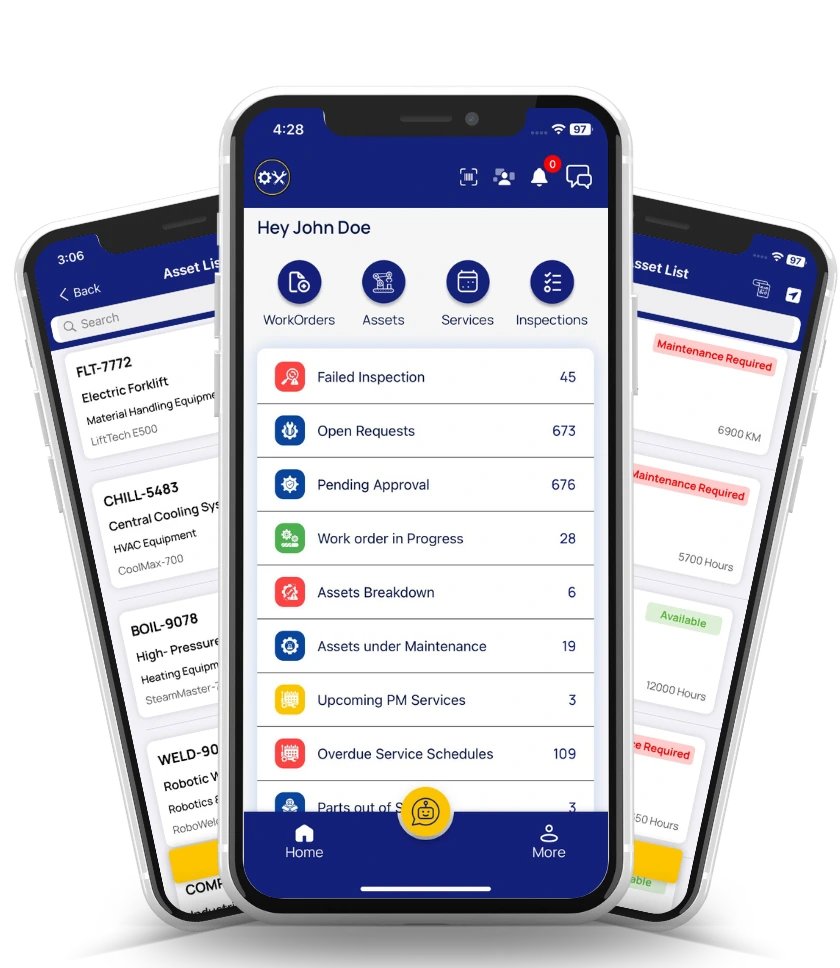
A single-temperature reefer unit typically logs 1,800 operating hours per year — the wear-equivalent of driving a car 100,000 miles annually in continuous engine service. And it does that work while running on its own independent diesel engine, drawing from its own fuel tank, maintained by its own battery, kept alive by its own trickle-charging solar panel — a complete second powertrain that most fleet PM programs treat as an afterthought until the day it fails on a Saturday night with 44,000 pounds of boxed beef in the box. This guide is written for fleet managers building reefer programs that actually match the operational stakes: pre-trip inspections that catch failures before the wheels turn, sensor calibration discipline that satisfies FSMA audits, PM cadences tied to reefer runtime hours rather than tractor mileage, and documentation that protects the carrier when a receiver rejects a load as "temperature-abused." OxMaint stores every reefer unit as a distinct asset with its own maintenance history, hour meter, and compliance record — so the reefer side of the fleet finally gets managed with the same rigor as the tractor side. Book a free demo to see reefer fleet management inside OxMaint.
01
Diesel Engine & Power
Independent diesel engine · dedicated fuel tank · battery + solar trickle charge · alternator
Failure mode: engine won't restart after Cycle-Sentry cycle
02
Refrigeration Cycle
Compressor · condenser coil · expansion valve · evaporator · refrigerant charge · sight glass
Failure mode: refrigerant leak · slipping belt · fouled coil
03
Airflow & Trailer
T-floor · air chute · rear door seals · insulation panels · drain lines
Failure mode: torn seal · blocked chute · water intrusion
04
Sensors & Controls
Return air probe · discharge air probe · Thermo King / Carrier controller · data logger
Failure mode: probe drift · false readings · cleared fault codes
OxMaint models each subsystem as a child asset under the reefer unit — PM and diagnostic history stay attached at the level where failures actually happen
1,800 hr
annual runtime for a typical single-temperature reefer — equivalent engine wear to 100,000 automotive miles
18-22%
fuel consumption increase from a single 1/4" gap in a rear door seal on a chilled load
12 mo
minimum FSMA record retention for temperature control · records retrievable within 24 hours of FDA request
The Pre-Trip Inspection Sequence That Protects Every Load
Every reefer load begins with a Pre-Trip Inspection (PTI) — a structured verification of both the visible trailer condition and the operational health of the refrigeration system. Skip the PTI and problems that would have taken 20 minutes to catch in the yard become $50,000 rejected loads in Miami. The five-stage sequence below reflects the discipline that professional carriers actually follow, and each stage generates a documented record in OxMaint that satisfies both FSMA audit requirements and defends against later temperature-abuse claims.
The Five-Stage PTI Sequence
Stage 1
Structural Walk-Around
Exterior panels · door hardware · roof cuts · sub-floor liner · signage · CSC plate legibility
5-8 min
Stage 2
Interior & Sanitation
Floor cleanliness · drain line clear · air chute intact · odor check · door seal condition · T-floor free
6-10 min
Stage 3
Reefer Unit & Fluids
Engine oil level · coolant level · fuel level · battery voltage · V-belt condition · sight glass reading
8-12 min
Stage 4
Automated Pre-Trip Test
Push PTI button on controller · auto-test cycles through cool / defrost / heat / probe diagnostics
15-20 min automated
Stage 5
Pre-Cool & Setpoint Verify
Pull down to setpoint · confirm return/discharge probes agree · document temperature ready-to-load
30-90 min pre-cool
Sensor Calibration — The 3°F That Ends the Carrier's Case
The most consequential piece of hardware on a reefer trailer is not the compressor — it is the temperature probe. A probe reading three degrees below the actual air temperature means a load being "maintained at 38°F" is actually sitting at 41°F, above the FDA safe transport threshold for fresh produce and many pharmaceutical products. When the receiver measures the load at delivery and the carrier's records show 38°F while the actual product core reads 41°F, the carrier owns the claim. Return air probes and discharge air probes must be calibrated separately against a reference thermometer at every PM cycle, with results documented against the asset record — that documentation is the single most important artifact in a temperature-abuse dispute.
Probe Drift · Small Reading, Catastrophic Consequence
Calibrated Probe
38°F
Reading matches actual air temperature
Load stays inside FDA safe range · claim defense intact
Drifted Probe (-3°F)
38°Fdisplayed
41°F actual
Reading 3°F below reality — displayed value looks fine
Load above FDA threshold · receiver rejects · carrier owns the claim
Calibration Discipline Required
Test each probe separately against a calibrated reference thermometer
Record both probe readings and the reference reading in the maintenance log
Store calibration date and result against the asset record for FSMA audit
Verify high-temperature alarm activates at setpoint + 3°F with remote notification
Cargo Setpoint Reference — Right Product, Right Temperature
Reefer maintenance discipline includes knowing what setpoints are actually correct for each cargo category. Setting a produce load at frozen-goods temperature causes freezer burn; setting a frozen protein load at chilled temperature causes partial thaw and irreversible quality damage. Setpoints are locked into the load-tender contract, but reefer techs, dispatchers, and drivers all touch the controller — and the maintenance program must include verification that the setpoint on the controller matches the setpoint in the load documentation before departure.
Ice cream & deep frozen
-10 to -20°F
Continuous Run
Zero tolerance for excursion — Cycle-Sentry never appropriate
Frozen protein · seafood
0 to -10°F
Continuous Run
Partial thaw causes irreversible quality loss
Fresh meat & poultry
28 to 34°F
Continuous Run
FDA safe transport threshold · high-liability cargo
Dairy & eggs
33 to 38°F
Continuous or Cycle-Sentry
FSMA STR applies — full documentation required
Fresh produce (chilled)
36 to 40°F
Continuous or Cycle-Sentry
Ethylene sensitivity varies · check load-specific specs
Pharmaceuticals · vaccines
36 to 46°F (cold chain)
Continuous Run
GDP compliance · redundant monitoring required
Bananas & tropical produce
55 to 58°F
Cycle-Sentry acceptable
Chill injury below 54°F · ripening controlled
Track Setpoints, Sensors, and PTIs Per Trailer
OxMaint captures every PTI, every sensor calibration, and every setpoint change against the specific reefer trailer as a searchable audit record. See it live against your reefer fleet in a 30-minute walkthrough.
Continuous Run vs Cycle-Sentry — The Operating Mode Decision
Every Thermo King and Carrier Transicold unit offers two operating modes, and choosing correctly per load is one of the most impactful decisions in reefer operations. Continuous Run keeps the diesel engine on 24/7 to hold tight temperature tolerances — required for frozen and pharmaceutical loads. Cycle-Sentry starts and stops the engine automatically to save fuel on less-sensitive loads. Cycle-Sentry depends heavily on battery strength for restart cycles: a weak battery can cause the unit to stall overnight and fail to restart, silently letting the box drift out of temperature. The mode decision matters, and the maintenance implications differ significantly.
Continuous Run
Engine on 24/7
Best forFrozen · pharma · high-value chilled
Temperature controlTightest — ±1°F typical
Fuel consumptionHigher — full-time diesel
Engine wearAccelerated — 250 hr PM
Battery stressLow — always cranking
Fail modeEngine issue = immediate temperature drift
Cycle-Sentry
Auto start/stop
Best forChilled produce · dairy · non-sensitive
Temperature controlWider — ±3°F typical
Fuel consumption15-40% lower on average
Engine wearReduced — 500 hr PM
Battery stressHigh — frequent restarts
Fail modeWeak battery = failed restart = silent drift
FSMA Compliance — The Documentation That Actually Wins Audits
The FDA Food Safety Modernization Act (FSMA) Sanitary Transportation Rule sets the compliance floor for every carrier hauling food-grade loads. What has shifted materially in the past 24 months is the standard of proof regulators and receivers now accept. A driver's handwritten temperature reading on a clipboard is increasingly treated as insufficient evidence during an audit or claim. Continuous electronic records with timestamps, no gaps, and no manual gap-filling are what a modern FSMA audit expects to see. The requirements below are the minimum records OxMaint captures against every reefer trailer, every load, every trip.
FSMA Sanitary Transportation Rule · Records Required
Pre-Cool Verification
Documented evidence the trailer reached target setpoint before loading — time, temperature, driver ID
12 mo min
Washout / Sanitation Ticket
Trailer clean and sanitized between loads · often required by shippers before loading
12 mo min
Continuous Temperature Log
Minute-by-minute temperature record from pre-cool through delivery · no gaps allowed
12 mo min
Sensor Calibration Records
Return and discharge probe calibration against reference · date, result, technician
12 mo after use
Corrective Action on Excursion
Written record of action taken when any temperature deviation occurred — mandatory
12 mo min
FSMA 204 Traceability (some loads)
Enhanced traceability requirements for FTL (Food Traceability List) items — 2 year retention
24 mo min
Expert Perspective · The Reefer Program That Never Loses a Load
Reefer failures are almost never mysterious — they are consequences of maintenance decisions someone made three months earlier. The slipping V-belt someone noticed but did not replace. The probe someone meant to calibrate but pushed to the next PM. The door seal with the visible gap that "still worked well enough." Every one of those decisions turns into a temperature-abuse claim eventually. The fleets that never lose loads are not lucky and they are not spending more on maintenance — they are running a program where every PTI, every probe calibration, every seal inspection is a tracked event tied to a specific trailer. When the receiver challenges the load temperature, the carrier who can produce the calibration record from three days before the trip, the PTI record from that morning, and the continuous temperature log from the trip itself owns the conversation. The one who cannot pays the claim. That is the entire game.
Reefer Hours ≠ Tractor Miles
OxMaint schedules reefer PM against reefer engine hours — the real wear metric — not the tractor's odometer.
Probe Calibration Is the Claim
Every PM includes a documented probe calibration event · the single highest-value FSMA audit artifact.
PTI as a Tracked Event
Every PTI stored against the trailer becomes the defense evidence when a temperature dispute reaches litigation.
Give Your Reefer Fleet the Discipline It Deserves
If your reefer PM is still living inside your tractor PM schedule, and your temperature logs are still paper clipboards, you are one temperature-abuse claim away from losing a customer contract. See what OxMaint — a maintenance management platform built for refrigerated fleet operations — looks like against your reefer trailers and reefer units.
Frequently Asked Questions
How often should reefer units receive preventive maintenance?
Reefer PM should be scheduled against reefer engine hours, not tractor mileage. High-utilization units running 18+ hours per day typically need PM every 250 engine hours; units averaging 8-12 hours daily can run to 500 hours between PMs. Thermo King and Carrier Transicold units both have hour meters that feed directly into telematics, so OxMaint schedules PM automatically as hour thresholds approach. Basing PM on tractor mileage systematically under-services high-runtime reefers.
What is a Pre-Trip Inspection (PTI) and why does it matter?
A Pre-Trip Inspection is the standardized 5-stage verification performed on a reefer trailer before every load: structural walk-around, interior and sanitation check, reefer unit and fluids inspection, automated pre-trip test cycle, and pre-cool and setpoint verification. A properly executed PTI catches slipping belts, torn door seals, blocked airflow, low refrigerant, and probe faults before the wheels turn. Each stage should be documented against the trailer in OxMaint — the record protects the carrier when temperature-abuse claims arise.
How do you calibrate reefer temperature sensors?
Return air and discharge air probes must be tested separately against a calibrated reference thermometer at every PM. Both probe readings and the reference reading are recorded in the maintenance log, along with the calibration date, technician, and pass/fail result. A probe drifting even 3°F below actual air temperature means loads appear correct on the display while sitting above FDA safe transport thresholds — precisely the failure mode that ends up in claim disputes. OxMaint stores calibration records against the trailer as the primary FSMA audit artifact.
When should Cycle-Sentry mode be used versus Continuous Run?
Continuous Run is required for frozen loads, pharmaceuticals, and high-value chilled loads where temperature tolerance is tight. Cycle-Sentry is acceptable for chilled produce, dairy, and non-temperature-sensitive commodities where 15-40% fuel savings justify the wider ±3°F control band. Critically, Cycle-Sentry depends on battery strength for restart cycles — a weak battery can cause the unit to fail to restart overnight and silently drift the load out of range. Battery health monitoring is non-negotiable on Cycle-Sentry units.
What FSMA records are required for refrigerated transport?
FSMA's Sanitary Transportation Rule requires documented pre-cool verification, washout/sanitation tickets, continuous temperature logs from pre-cool through delivery, sensor calibration records, and written corrective actions on any temperature excursion. Records must be retained a minimum of 12 months and be retrievable within 24 hours of an FDA inspection request. FSMA 204 traceability requirements add 24-month retention for Food Traceability List items. OxMaint captures every record automatically as work orders and inspections complete.
Why does a small door seal gap matter so much on a reefer?
A 1/4-inch gap in a rear door seal on a chilled load forces the reefer unit to run continuously to compensate for air infiltration, increasing fuel consumption 18-22% and causing condensation damage to packaging. The seal replacement costs under $100 and takes 30 minutes; the fuel and packaging damage across even a single week can exceed the replacement cost tenfold. OxMaint tracks door seal inspection at every PTI and PM so gaps are caught during scheduled service rather than discovered during a mid-route excursion.