Power plant water treatment maintenance is the discipline that keeps cycle water quality inside spec — protecting boiler tubes, condensers, cooling towers and RO membranes from corrosion, scaling and fouling that can take a unit offline for weeks. A single chemistry excursion can cost a 500 MW plant over $1M in tube replacement and lost generation, which is why O&M and reliability teams treat cooling water maintenance, RO membrane maintenance, condensate polisher maintenance and deaerator maintenance as non-negotiable preventive work. This guide maps the full plant water treatment schedule — cooling tower chemical dosing, boiler water treatment, condensate treatment and water quality compliance — and shows how a water treatment CMMS like OxMaint enforces every PM, dosing log and discharge-permit record. Ready to replace spreadsheets with structured maintenance? Start Free Trial and see your water treatment PMs in one dashboard today.
POWER PLANT WATER CHEMISTRY GUIDE
Is your water treatment maintenance program leaking revenue through corrosion, fouling and permit violations?
Cycle water chemistry decides whether your boiler, condenser and cooling assets run 8,000 hours a year — or fail at 4,200. Without a structured CMMS, missed RO cleans, skipped deaerator inspections and overdue polisher resin changes quietly destroy asset life and trigger EPA discharge violations. OxMaint digitizes every PM, dosing log and compliance record so nothing slips.
PREVENTIVE MAINTENANCE SCHEDULE
Power plant water treatment PM checklist by equipment type
A disciplined plant water treatment schedule spans daily chemistry checks, weekly dosing calibration, monthly membrane cleans and quarterly resin analysis. The checklist below covers the four highest-risk subsystems — cooling water, RO membranes, condensate polishers and deaerators — with frequencies and failure indicators your team should be tracking in a CMMS.
Cooling Tower & Cooling Water
- ✓ Daily — log cycles of concentration, conductivity & pH (target 8.2–9.0)
- ✓ Weekly — verify cooling tower chemical dosing pump calibration (±5%)
- ✓ Weekly — inspect drift eliminators & fill for scale / biofilm
- ✓ Monthly — Legionella sampling & biocide residual review
- ✓ Quarterly — basin desludge & sump pump functional test
- ✓ Semi-annual — fan gearbox oil sample & vibration trend
RO Membrane System
- ✓ Daily — record permeate flow, pressure drop & rejection rate
- ✓ Daily — check SDI on feed water (target <3)
- ✓ Weekly — inspect cartridge filter ΔP (change at 15 psi)
- ✓ Monthly — normalized permeate flow trend (flag −10% drop)
- ✓ Quarterly — CIP clean-in-place (alkaline + acid sequence)
- ✓ Annual — element probing & membrane autopsy if rejection <97%
Condensate Polisher
- ✓ Shift — sodium breakthrough monitor (<2 ppb at outlet)
- ✓ Daily — differential pressure across resin bed
- ✓ Weekly — conductivity grab sample at polisher outlet
- ✓ Per run — resin regeneration throughput logging
- ✓ Monthly — resin capacity test & bead integrity exam
- ✓ Annual — full resin replacement if capacity loss >25%
Deaerator & Boiler Water
- ✓ Daily — dissolved O₂ at deaerator outlet (<7 ppb)
- ✓ Daily — boiler blowdown conductivity (3,000–4,000 µS/cm)
- ✓ Weekly — oxygen scavenger residual (sulfite 20–40 ppm)
- ✓ Monthly — safety valve lift test & pressure-relief log
- ✓ Semi-annual — internal inspection of storage section
- ✓ Annual — NDE / UT thickness survey on shell & heads
| Equipment | Critical KPI | Target / Limit | PM Frequency | Failure Mode if Missed |
|---|---|---|---|---|
| Cooling Tower | Cycles of Concentration | 4–6 cycles | Daily log / weekly review | Scale deposition, Legionella risk |
| RO Membrane | Normalized Permeate Flow | −10% action / −15% CIP | Monthly trend / quarterly CIP | Fouling, irreversible flux loss |
| Condensate Polisher | Na+ at Outlet | <2 ppb | Shift / per regeneration | Turbine deposition, blade corrosion |
| Deaerator | Dissolved Oxygen | <7 ppb | Daily / semi-annual internal | Boiler tube oxygen pitting |
| Boiler | Total Dissolved Solids | <2,500 ppm (blowdown) | Daily / continuous blowdown | Carryover, superheater fouling |
COST OF INACTION
What poor water chemistry maintenance really costs your plant
When power plant water chemistry maintenance drifts, the financial impact compounds fast. The formula below estimates the annual cost of chemistry-related fouling and corrosion when PMs are tracked on spreadsheets instead of a CMMS — and the savings OxMaint delivers by enforcing every task on schedule.
Annual Chemistry-Related Loss (Reactive)
Tube failures + Membrane replacement + Derate hours + Permit fines
A 500 MW coal plant missing 12% of water-treatment PMs typically loses $850K–$1.4M annually in forced outages, premature RO membrane replacement and derated generation.
Annual Savings with OxMaint CMMS
(Missed PMs eliminated) × (Failure cost per event) + (Extended asset life)
Plants using a structured water treatment CMMS cut chemistry-related forced outages 30–50% and extend RO membrane life by 18–24 months.
WORKED EXAMPLE
A 180-asset gas-fired combined-cycle plant was spending $42K/yr on RO membrane replacement and losing 120 derate hours annually to condenser fouling. After implementing OxMaint for water treatment PM scheduling — automated CIP triggers, dosing pump calibration alerts and resin capacity trending — the plant cut membrane spend by $28K in year one, eliminated 90 derate hours and passed its EPA discharge audit with zero findings. Total documented ROI: $190K in 12 months on a $14K CMMS subscription.
HOW OXMAINT HELPS
How OxMaint CMMS keeps water treatment maintenance on spec
OxMaint is built for maintenance & reliability teams who can't afford a missed chemistry PM. The platform maps each capability below to a concrete, measurable outcome — so your water treatment program runs like a laboratory, not a spreadsheet.
Automated PM & Dosing Scheduling
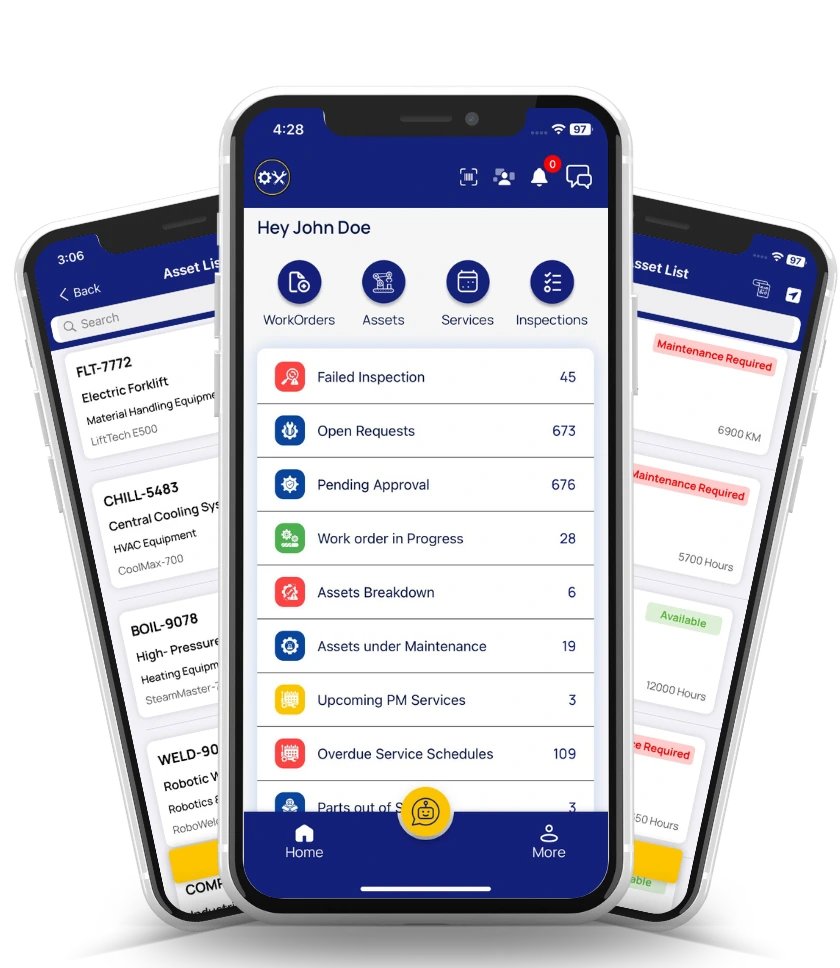
Auto-generate work orders for CIP cycles, resin regenerations, dosing pump calibrations and deaerator inspections on exact time or meter-based triggers. Technicians get mobile alerts — nothing falls through the cracks.
Outcome: 95%+ PM compliance rate, 30–50% fewer chemistry-related forced outages.
Water Chemistry Trending & Predictive Alerts
Log pH, conductivity, SDI, dissolved O₂ and sodium breakthrough directly into work orders. OxMaint's AI engine flags normalized permeate flow decline and resin capacity loss before failure — turning lab data into predictive action.
Outcome: Catch membrane fouling 4–6 weeks earlier, extend RO life 18–24 months.
EPA Discharge Compliance & Audit Trail
Every dosing log, blowdown record, biocide residual and lab result is time-stamped, geo-tagged and stored in a tamper-proof audit trail. Generate permit compliance reports for EPA NPDES and state agencies in one click.
Outcome: Zero-discharge-finding audits, $50K+ per-violation penalty avoidance.
Spare Parts & Chemical Inventory
Track RO membrane serial numbers, resin batches, biocide drums and scavenger chemical stock with min-max reorder triggers. Link spares to parent assets for one-click installation history and warranty tracking.
Outcome: 40% lower chemical inventory carrying cost, zero stock-out downtime.
MAINTENANCE TIMELINE
Annual water treatment maintenance timeline for power plants
Use this month-by-month timeline to structure your plant water treatment schedule. Each milestone maps to a recurring OxMaint PM template — so a chemistry tech, supervisor and plant manager all see the same upcoming work.
Quarterly RO CIP (alkaline + acid), cartridge filter replacement, normalized flow trend review.
Cooling tower basin desludge, drift eliminator inspection, biocide dosing program winter review.
Deaerator internal inspection (outage window), safety valve lift test, UT thickness survey.
Condensate polisher resin capacity test, bead integrity exam, regeneration system functional check.
EPA NPDES semi-annual discharge monitoring report, cooling water compliance review, Legionella sampling.
Q2 RO CIP cycle, membrane element probing, SDI feed review for summer high-temperature loading.
Peak-load cooling tower audit — fan gearbox oil sample, vibration trend, scale inhibitor rate adjustment.
Boiler water treatment review — blowdown optimization, scavenger residual audit, carryover test.
Resin replacement decision point (if capacity loss >25%), full regeneration throughput audit.
Q3 RO CIP, membrane autopsy if rejection <97%, pre-winter feed water temperature adjustment.
Deaerator storage section internal inspection, oxygen scavenger dosing pump calibration, NDE survey.
Year-end water treatment compliance report, PM template review, OxMaint analytics downtime-cost summary.
REAL-WORLD RESULTS
Maintenance teams trust OxMaint for water treatment reliability
"We went from tracking CIP cycles on a whiteboard to OxMaint's automated PM triggers. Our RO membrane life jumped from 3 years to nearly 5, and we haven't had a chemistry-related forced outage in 14 months."
"The EPA audit trail alone paid for the platform. Every dosing log, every blowdown record — time-stamped and exportable in one click. Our last NPDES review took two hours instead of two weeks."
"The cost of one missed deaerator inspection — a single oxygen-pitting tube leak — is more than ten years of OxMaint. The ROI isn't a question; it's arithmetic."
— Reliability Director, Independent Power Producer
See OxMaint on your water treatment assets — book a 30-minute demo
We'll load your equipment list, PM frequencies and chemistry KPIs into a live workspace so you can see exactly how OxMaint prevents the next missed CIP, resin change or discharge violation.
FAQ
Power plant water treatment maintenance — frequently asked questions
How often should RO membranes be cleaned in a power plant water treatment system?
RO membranes in power plant service should be cleaned (CIP) every 3–4 months under normal loading, or sooner when normalized permeate flow drops 10–15% or differential pressure rises 15%. A quarterly alkaline-plus-acid CIP cycle is the industry standard for maintaining rejection rates above 97% and extending element life to 5–7 years. OxMaint auto-triggers CIP work orders based on your flow and pressure trends, so the clean always happens on spec. Start Free Trial to automate your CIP schedule.
What does a cooling tower chemical dosing maintenance program include?
A compliant cooling tower chemical dosing program includes daily logging of conductivity and pH, weekly dosing pump calibration to ±5%, biocide residual monitoring, monthly Legionella sampling and quarterly basin desludging. Scale inhibitor, biocide and dispersant feed rates must be adjusted to cycles of concentration. All of this should be tracked as recurring PMs in a CMMS to ensure cooling water compliance and prevent scale, biofilm and drift eliminator fouling.
Why is condensate polisher maintenance critical for turbine protection?
Condensate polishers remove dissolved sodium and silica that would otherwise deposit on turbine blades, causing efficiency loss and stress-corrosion cracking. Sodium breakthrough above 2 ppb at the polisher outlet is an immediate action-level excursion. Regular resin capacity testing, regeneration throughput logging and bead-integrity exams — all tracked as CMMS PMs — prevent the polisher from becoming a contamination source rather than a filter.
How does a CMMS improve EPA discharge permit compliance for power plants?
A water treatment CMMS creates a tamper-proof, time-stamped audit trail of every dosing log, blowdown event, lab result and biocide application required under an NPDES permit. Instead of assembling paper records over weeks for an inspection, plants generate compliance reports in one click. OxMaint also sends alerts when a required monitoring task is overdue, preventing the missed-sample violations that trigger $50K+ per-day penalties.
What are the signs that a deaerator needs maintenance?
Key indicators include dissolved oxygen at the deaerator outlet exceeding 7 ppb, fluctuating vent condensate flow, corrosion pitting in the storage section and oxygen scavenger consumption increasing beyond baseline. These symptoms point to worn spray valves, tray damage or spray-nozzle fouling. A semi-annual internal inspection and annual NDE/UT thickness survey — both standard OxMaint PM templates — catch these issues before they cause boiler tube oxygen pitting.
Stop managing water treatment on spreadsheets. Start protecting every asset.
Join the power plants using OxMaint to enforce water chemistry PMs, predict membrane and resin failure, and pass every compliance audit — all from one AI-powered CMMS platform.
Free 14-day trial · No credit card