Pharmaceutical packaging line maintenance is the single largest lever for lifting Overall Equipment Effectiveness (OEE) in a cGMP-regulated environment where a minute of unplanned downtime can cost $10,000 or more in lost production. When blister machines, cartoners, labelers, and vision inspection systems are maintained reactively, packaging line uptime drops below 55% and compliance risks multiply. This guide breaks down pharmaceutical packaging maintenance strategies—including blister packaging machine PM, labeling calibration, and vision system upkeep—along with OEE benchmarks and CMMS templates that help pharma reliability teams move from fire-fighting to predictive, audit-ready operations. Ready to modernize your maintenance program? Start Free Trial with OxMaint or keep reading for the full framework.
Is your packaging line OEE stuck below 60% while cGMP audit findings pile up?
Most pharmaceutical packaging lines lose 25–40% of available production time to unplanned downtime, unoptimized changeovers, and reactive maintenance on blister machines and labeling equipment. OxMaint's AI-powered CMMS helps pharma maintenance teams lift packaging OEE to 75–85% while keeping every work order cGMP-audit-ready.
What drives OEE on a pharmaceutical packaging line?
OEE on pharma packaging lines is the product of availability, performance, and quality—and maintenance decisions directly impact all three. A blister machine running at 92% speed but stopping twice per shift for jam clearance drags performance down. A labeler that produces 3% reject rate due to mis-calibration kills quality. Here is how the math works and where maintenance teams have the most leverage.
Blister packaging machine maintenance: PM checklist for pharma lines
Blister machines are the throughput bottleneck on most pharma packaging lines. A typical rotary blister machine has 200+ lubrication points, 4–6 heating stations, and pneumatic forming seals that degrade with every 8-hour shift. Without a structured blister pack machine maintenance schedule, teams see repeated web-breakage, cavity deformation, and seal-integrity failures that trigger batch rejection. Below is a PM checklist mapped to cGMP and TPM standards.
Operator-Level Autonomous Maintenance
- Inspect forming station heater temps (140–160°C range)
- Verify pneumatic seal pressure (4–6 bar) and log readings
- Clean guide rollers and web-path of PVC/Alu film residue
- Check indexing cam for wear play and abnormal noise
Technician Preventive Maintenance
- Lubricate all 200+ grease points per OEM chart (NLGI #2)
- Inspect sealing bar Teflon coating for wear and replace if scored
- Test safety interlocks and e-stop circuit response time
- Calibrate foil feed sensor and punch-registration photoeye
Deep PM & Condition Assessment
- Vibration analysis on main drive motor and gearbox bearings
- Replace heated platen seals and inspect for thermal fatigue
- Thermographic scan of electrical cabinet for hotspots
- Full calibration verification of forming station temperature PID loops
A mid-size contract packaging operation running 3 blister lines at 55% OEE was losing 22 production hours per week to unplanned jam-clearing and seal failures. After implementing OxMaint CMMS with structured PM triggers on heater bands, sealing pressure, and cam lubrication, unplanned downtime dropped 34% in 90 days—recovering $1.2M in annualized throughput. The payback period for the CMMS investment was under 5 weeks.
Pharmaceutical labeling maintenance and vision inspection upkeep
Labeling and vision inspection systems are the last line of defense against product recall. A mis-calibrated labeler applies cartons with shifted barcodes; a dirty vision camera lens rejects good product or—worse—passes defective units. Both scenarios destroy packaging OEE quality scores and trigger 21 CFR Part 11 compliance flags. The maintenance standards below are what audit-ready pharma lines follow.
| Equipment | PM Frequency | Critical Task | GMP / Compliance Link | OEE Impact |
|---|---|---|---|---|
| Roll-through labeler | Each shift change | Calibrate label-spool tension and registration sensor | 21 CFR 211.130 — Tamper-evident packaging | Quality +3–5% |
| Vision inspection camera | Daily + post-CIP | Clean lens, verify illumination, run golden-sample test | 21 CFR 211.68 — Automatic equipment calibration | Quality +4–7% |
| Cartoner infeed worm | Weekly | Inspect for scoring, verify timing belt tension | cGMP changeover documentation | Performance +5–8% |
| Leaflet inserter | Weekly | Validate OCR/OMR code reader accuracy with test batch | EU FMD serialization compliance | Quality +2–4% |
| Case packer elevator | Monthly | Lubricate chain drive, inspect sprocket alignment | TPM autonomous maintenance standard | Availability +3–6% |
| Thermal transfer printer | Per ribbon change | Calibrate print head pressure, clean platen roller | GS1 data matrix verification grade B+ | Quality +2–3% |
Where packaging line downtime comes from — and what top quartile plants do differently
Industry data from ISPE and TPM benchmarking studies shows that pharmaceutical packaging lines lose available time across six dominant categories. Top-quartile operations (OEE 75%+) attack each category with a different maintenance strategy—operator autonomous maintenance for micro-stops, predictive analytics for unplanned failures, and SMED methodology for changeovers. OxMaint CMMS supports all three workflows in one platform.
Unplanned Equipment Failures — 35% of lost time
Blister seal-bar failure, labeler servo drive faults, cartoner cam breakage. Top quartile solution: Predictive maintenance with vibration and thermal sensors feeding into OxMaint's AI anomaly detection — catches bearing degradation 2–6 weeks before failure.
Changeovers and Format Changes — 25% of lost time
Average pharma line changeover takes 90–180 minutes. Top quartile solution: SMED-driven digital SOP checklists in OxMaint mobile app, with pre-kitted change parts and auto-triggered PM tasks reduce changeover to 30–45 minutes.
Micro-stops and Jam Clearing — 18% of lost time
Repeated 2–5 minute stops for web breaks, carton jams, leaflet mis-feeds. Top quartile solution: Operator autonomous maintenance (AM) checklists completed on the OxMaint mobile app before each shift, catching root causes early.
Planned PM Execution — 12% of lost time
PMs take too long because parts are missing or instructions are on paper. Top quartile solution: OxMaint auto-populates PM work orders with OEM specs, attached manuals, and pre-staged spare parts — cutting PM execution time 30–50%.
Quality Rejects and Rework — 6% of lost time
Blister seal integrity failures, mislabeled cartons, vision system false rejects. Top quartile solution: Calibration management in OxMaint ensures labeler registration and vision system golden-sample tests never lapse — quality loss held under 1%.
Material and Supply Shortages — 4% of lost time
Line waits for foil stock, labels, or cartons. Top quartile solution: OxMaint spare-parts inventory module auto-reorders critical consumables at min-stock thresholds, integrated with PM schedules.
How OxMaint CMMS lifts pharma packaging OEE while keeping you audit-ready
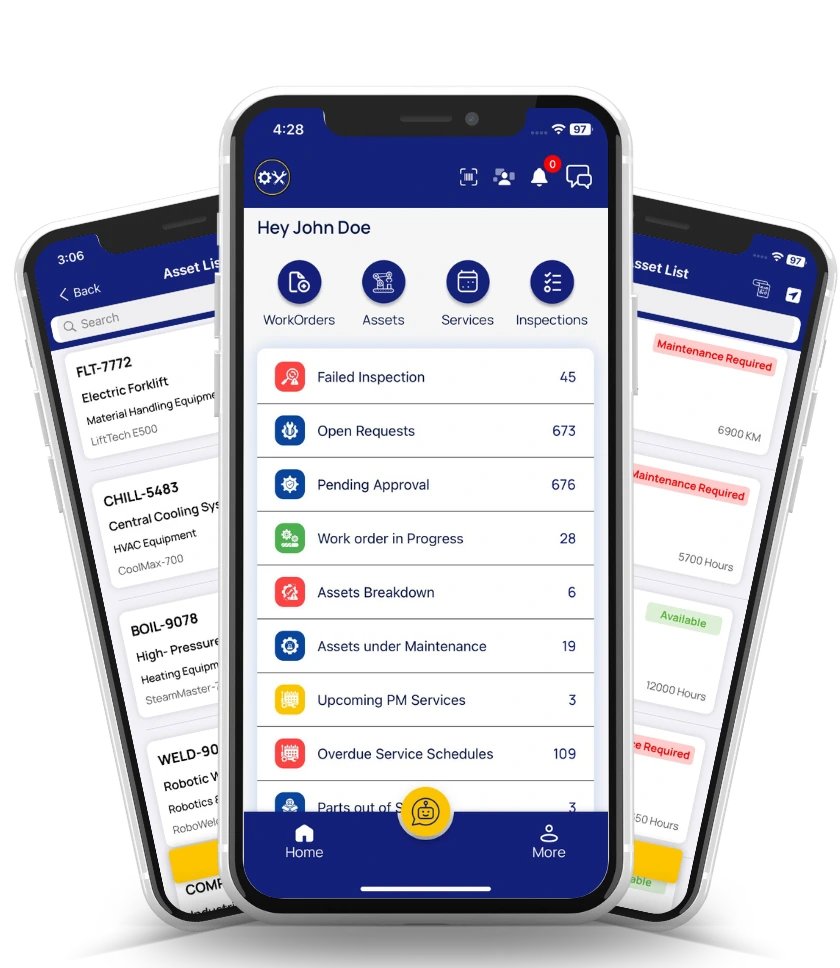
OxMaint is an AI-powered CMMS and EAM platform built for maintenance and reliability teams who need to simultaneously improve packaging line uptime, reduce costs, and pass cGMP audits without scrambling for documentation. Here is how OxMaint maps directly to the pharmaceutical packaging maintenance challenges above.
Automated PM Scheduling for Blister & Labeling Lines
OxMaint auto-generates preventive maintenance work orders based on machine runtime cycles, calendar intervals, or batch counts — so no blister heater inspection or labeler calibration is ever missed again. Every PM is pre-loaded with OEM specs, digital checklists, and safety instructions.
AI-Powered Predictive Maintenance Analytics
Connect vibration, temperature, and pressure sensors from your blister machines and cartoners to OxMaint. The AI engine detects anomaly patterns 2–6 weeks before failure and automatically generates work orders — shifting your team from reactive to predictive.
cGMP-Audit-Ready Work Order Documentation
Every work order in OxMaint captures technician identity, timestamp, parts used, calibration readings, and digital signature — fully 21 CFR Part 11 compliant. Generate a complete maintenance history for any asset in seconds when an auditor asks, not days.
Spare-Parts Inventory with Auto-Reorder
OxMaint tracks every spare part — from sealing bars to servo motors — across multiple stockrooms with min/max thresholds. When a PM consumes a part, inventory auto-updates and triggers reorders so you never delay a blister machine PM because a $40 seal kit is out of stock.
"We moved from Excel spreadsheets to OxMaint and cut unplanned blister line downtime 38% in the first quarter. The audit trail alone saved us 200+ hours of documentation prep during our last FDA inspection."
See OxMaint on your packaging assets — book a 30-min demo
Watch how OxMaint structures your blister machine PM, auto-triggers labeling calibration, and generates cGMP-audit-ready reports in real time. Bring your asset list and we will build a live walkthrough.
Pharmaceutical packaging maintenance & OEE — your questions answered
What is a good OEE target for a pharmaceutical packaging line?
A good OEE target for a pharmaceutical packaging line is 75–85%, with world-class operations reaching 85%+. Most pharma packaging lines run between 55–60% OEE, meaning there is significant room for improvement through structured preventive maintenance, optimized changeovers, and reduced quality rejects. OxMaint CMMS helps teams close this gap by automating PM schedules and tracking real-time OEE drivers.
How often should blister packaging machines undergo preventive maintenance?
Blister packaging machines require daily autonomous maintenance (10–15 min by operators), weekly technician PM (45–60 min for lubrication and sensor calibration), and quarterly deep PM (4–8 hours for vibration analysis and platen seal replacement). OxMaint auto-triggers each tier based on runtime hours or calendar intervals so no PM task is missed. You can Start Free Trial to import your existing PM schedule today.
How does a CMMS improve cGMP compliance in pharmaceutical packaging?
A CMMS improves cGMP compliance by creating a complete, timestamped electronic record of every maintenance action — including who performed it, what parts were used, what calibration readings were taken, and when it was completed. OxMaint is 21 CFR Part 11 compliant with digital signatures and full audit trails, so maintenance documentation is always inspection-ready without manual compilation.
What are the biggest causes of downtime on pharma packaging lines?
The biggest causes of downtime on pharma packaging lines are unplanned equipment failures (35% of lost time), changeovers and format changes (25%), micro-stops and jam clearing (18%), planned PM execution (12%), quality rejects (6%), and material shortages (4%). Addressing the top two categories — failures and changeovers — typically delivers the fastest OEE improvement. Book a demo to see how OxMaint targets each.
Can OxMaint integrate with sensors on blister machines for predictive maintenance?
Yes. OxMaint integrates with vibration, temperature, and pressure sensors via standard industrial protocols (OPC-UA, MQTT, REST API). The AI analytics engine processes sensor data streams in real time, detects anomaly patterns that precede equipment failure, and automatically generates predictive work orders — typically giving maintenance teams 2–6 weeks of advance warning before a critical blister machine or cartoner component fails.
Stop losing 40% of your packaging line capacity to reactive maintenance
Join the pharma packaging operations using OxMaint to lift OEE above 75%, pass cGMP audits with confidence, and cut unplanned downtime by up to 50%. Set up your asset registry and PM schedules in days, not months.
Free 14-day trial · No credit card