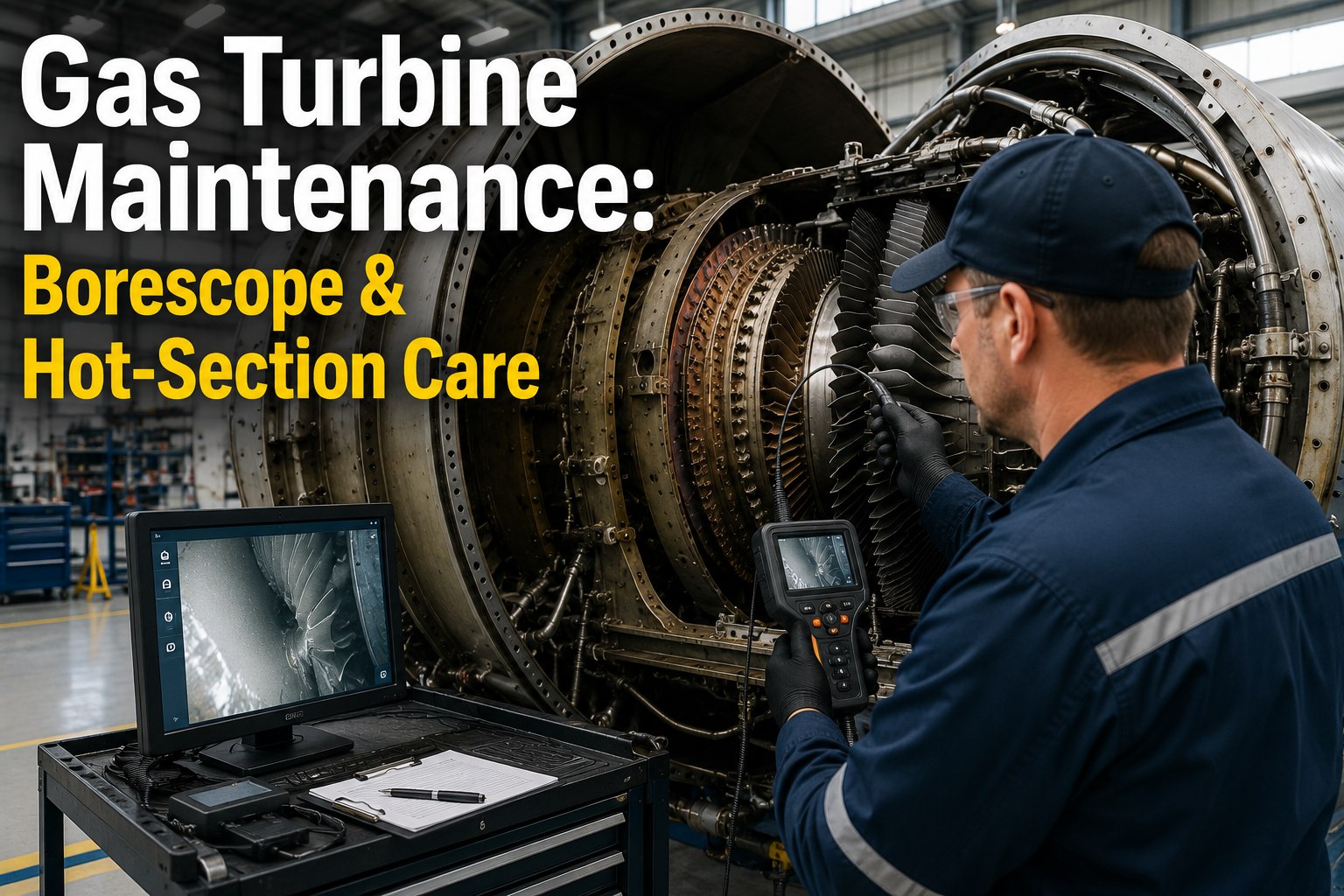
A gas turbine that loses 1% of compressor efficiency doesn't announce itself — it just quietly burns more fuel for the same megawatts until someone notices the heat rate drift months later. Most of that drift starts at the inlet: a filter house loading up faster than the calendar PM assumed, an evaporative cooler running with half its nozzles plugged, or an anti-icing valve that hasn't been stroke-tested since commissioning. This guide covers how to maintain gas turbine inlet air filtration and cooling systems on condition and season rather than habit — and how OxMaint's free trial or a 30-minute demo can put those triggers on autopilot.
Gas Turbine Inlet Air Filter & Cooling System Maintenance
Inlet condition is a performance variable, not a housekeeping task. Every inch of water column of excess filter differential pressure and every degree of inlet cooling you lose shows up in output, heat rate, and compressor fouling rate. Here's how to run inlet maintenance on data.
When should you actually replace inlet filters — and what should trigger it?
Replace on differential pressure trend, not on the calendar. A fixed 12-month changeout either wastes filter life in a clean year or lets a loaded filter strangle the machine in a dirty one. The trigger is the DP across the final filter stage, trended against your OEM's alarm limit and your own fuel-cost math.
Most multi-stage inlet houses (weather hood or inertial pre-filter → medium-efficiency pleats → final EPA/HEPA-grade barrier stage) follow the same pattern: pre-filters catch the coarse load and are cheap to change; the final stage is where DP climbs and where the money decision lives. A practical decision rule:
- Trend weekly, alarm on slope. A filter at 1.8 in. w.g. that's risen 0.1 in. per week for a month is fine. The same reading after a 0.6 in. jump in two weeks means a loading event — dust storm, construction upwind, cottonwood season — and you should plan the changeout now, not at the alarm.
- Know your replacement trigger before the season starts. Many plants set the final-stage trigger between 2 and 4 in. w.g. depending on OEM limits and filter media. Cross-check it against economics: if excess DP is costing you more in heat rate than a filter set costs, change early.
- Never let DP spike and collapse. A sudden DP drop after a high reading is worse than a high reading — it usually means media failure or a seal blowout, and unfiltered air is now sandblasting your compressor. Log it as an urgent work order, not a note.
- Record DP at a consistent load. DP scales with airflow. A reading at 40% load tells you nothing next to one at base load. Standardize readings at full load or correct for flow, or your trend is noise.
The objection we hear: "We've always changed filters at the outage — the crew knows the rhythm." Fair enough if your environment is stable. But one bad pollen season or a nearby construction project can double your loading rate, and the calendar won't notice. Keep the outage changeout as the backstop, and let the DP trend pull the date forward when conditions demand it. That one change usually pays for a year of filter monitoring in a single avoided stretch of degraded heat rate.
What does evaporative cooler and inlet chilling PM actually involve?
Evaporative cooling recovers capacity on hot days — every degree of inlet air temperature reduction is worth real megawatts, since gas turbine output falls roughly 0.5–0.9% per °C (about 0.3–0.5% per °F) of rising inlet temperature on many frames. But an evap cooler only delivers that if the media wets evenly and the nozzles flow. A cooler with 20% of its nozzles plugged is a humidifier for your filter house, not a cooler.
In-season (cooling months)
- Weekly: verify approach-to-wet-bulb against design. If you're getting 4°F of approach where design says 8°F, find the dry streaks.
- Weekly: inspect spray pattern; plugged or worn nozzles show as dry lanes on the media face.
- Monthly: check water chemistry — conductivity/TDS, pH, biocide residual. Scale and biofilm are the two media killers.
- Monthly: verify blowdown valve operation and sump level control.
Shoulder season & layup
- Spring startup: flush distribution headers, replace scaled nozzles, inspect media for sagging, delamination, or biological growth before first call for cooling.
- Fall layup: drain and dry the system fully — stagnant water over winter guarantees a Legionella risk and a media replacement in spring.
- Annually: measure media DP across the cooler section itself; rising resistance with clean filters points at scaled or collapsed media.
- Annually: exercise isolation and drain valves so they move when you need them.
If you run inlet fogging or a chiller coil instead of media evap, the same logic applies with different hardware: fogging wants nozzle flow checks and demin water quality verification (carryover erodes compressor blades); chillers want coil fin inspection, refrigerant charge verification, and condensate drain checks. In every case, the performance test — actual inlet temperature depression versus ambient wet-bulb — is the PM that tells you whether all the others worked.
How do you keep inlet icing from taking the machine down in winter?
Icing risk starts well above freezing — typically around 40°F (4°C) ambient with relative humidity above roughly 70%, because the pressure drop at the compressor inlet bellmouth supercools the air further. Ice ingestion doesn't just trip the machine; liberated chunks damage first-stage blades. The maintenance answer is to prove the anti-icing system works before the first cold, humid night, not during it.
- 1Pre-season (early fall): stroke the anti-icing valve. Whether your system bleeds compressor discharge air into the inlet or recirculates exhaust heat, verify the valve travels full stroke, seats tightly, and responds to the control signal. A valve stuck 15% open all summer is a hidden heat-rate tax; stuck closed in January is a trip.
- 2Verify the instrumentation that calls for anti-ice. Calibrate or function-check the inlet temperature and humidity transmitters and confirm the control logic setpoints match the OEM icing envelope. Drifted sensors either arm the system late or run it needlessly.
- 3Inspect bleed-air ducting and screens. Look for cracked manifolds, missing insulation, and blocked distribution screens. Uneven anti-ice flow creates cold spots that ice up while the average inlet temperature looks safe.
- 4In-season: watch the DP signature. Ice forming on filter elements shows as a DP rise with no dust loading explanation — often overnight, often with fog. Trend DP alongside ambient temperature and humidity so the control room can distinguish "filter icing" from "filter loading" and respond with heat, not a filter change.
- 5Post-event: inspect after any suspected icing. Borescope the first compressor stage if the machine ingested ice or ran with a collapsed, iced filter. Document findings against the event record.
What should a filter house structural and seal inspection catch?
Every leak path downstream of the final filter stage is unfiltered air going straight into the compressor — and bypass air does more fouling damage per cubic foot than people expect, because it carries the coarse fraction the filters exist to stop. A seal inspection is cheap; the compressor wash frequency and efficiency loss it prevents is not.
| Inspection point | What failure looks like | Cadence |
|---|---|---|
| Filter element gaskets & seating frames | Dust streaking on the clean-air side ("witness marks"), distorted frames, compressed or missing gasket | Every filter change + annually |
| Access door seals & latches | Cracked bulb seals, doors that close without compression, missing latches | Quarterly |
| Filter house wall & floor joints | Rust trails, daylight visible at seams, corrosion holes in coastal or high-humidity sites | Annually |
| Penetrations (instrument lines, anti-ice ducting) | Deteriorated boots and gland seals | Annually |
| Weather hoods, louvers & bird screens | Missing screens, louver damage, debris buildup restricting flow | Quarterly + after storms |
| Drainage & moisture separators | Standing water in the house, failed coalescer pads, blocked drains | Quarterly + before wet season |
The field test that catches what eyeballs miss: with the unit running, hold a smoke pencil or tissue near suspect joints on the clean side — inward leakage shows immediately. Some crews do a dust-trail inspection with a flashlight after a filter change; fine dust deposited downstream of a seat tells you exactly which gasket failed.
How does inlet condition connect to compressor fouling — and how do you use that link?
Inlet degradation and compressor fouling are the same story told twice. Sub-micron particles that pass the final filter stage deposit on compressor blades; sticky aerosols (hydrocarbon vapor from nearby equipment, salt in coastal air, agricultural residue) make deposits adhere. The result is a gradual loss of compressor efficiency that online water washing only partially recovers.
The practical move is to trend three curves together: filter DP, corrected compressor efficiency (or a proxy like compressor discharge pressure at corrected speed), and water-wash recovery. Then read the pattern:
- DP normal + efficiency decaying fast → suspect bypass leakage or media failure, not loading. Go do the seal inspection.
- DP high + efficiency stable → filters are doing their job; the cost is pressure drop, so economics decide the changeout date.
- Wash recovery shrinking over successive washes → deposits are baking on; review offline wash intervals and check what's upstream (a new lube-oil vent routing or a nearby VOC source can change fouling character overnight).
- Efficiency decay accelerating after a loading event (dust storm, smoke) → the event overwhelmed a stage; consider upgrading pre-filtration for that season rather than accepting the fouling rate.
This is where most inlet programs die: the DP readings live in the control room historian, the filter changes live in a paper log, and the wash records live in the OEM portal — so nobody ever sees the three curves on one page. The plants that catch fouling early are the ones where all three data streams land on the same asset record.
How OxMaint operationalizes inlet filter & cooling PM
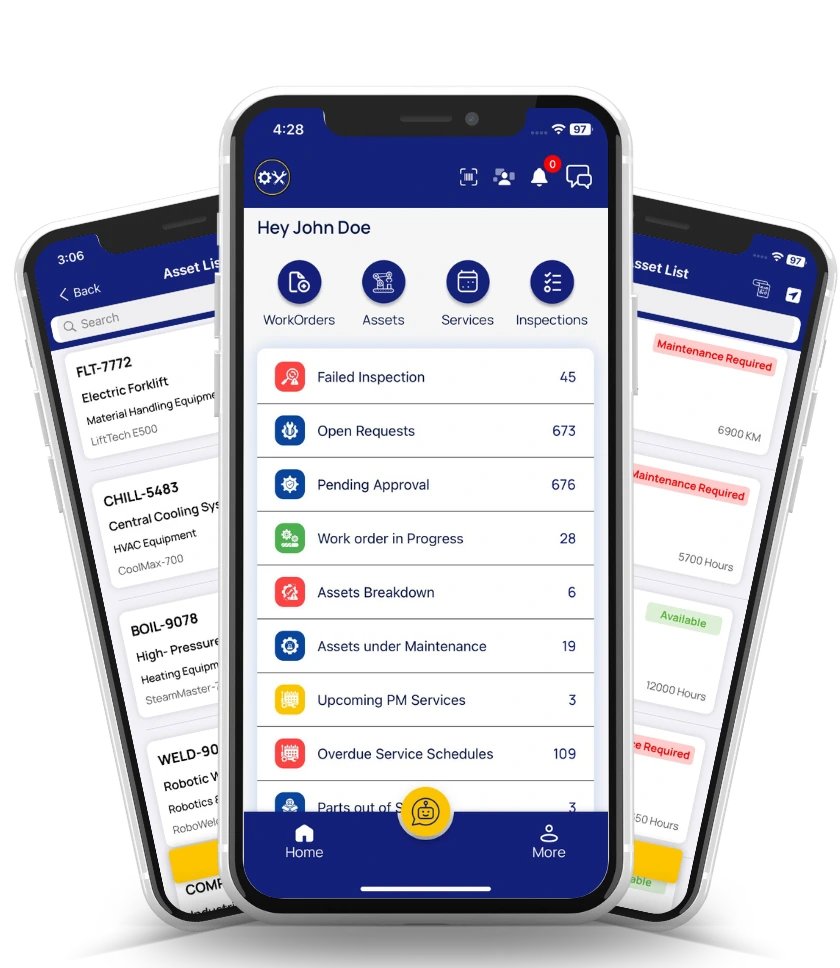
Everything above is a set of triggers, not dates — and triggers are exactly what a CMMS should fire on. In OxMaint, the inlet system becomes one asset record where condition data, seasonal PMs, and history actually meet:
DP-triggered work orders
Log or integrate filter DP readings; when a reading crosses your threshold — or the week-over-week slope does — OxMaint generates the changeout work order with the right filter part numbers attached. The calendar PM stays as a backstop, not the driver.
Seasonal PM schedules
Evap cooler spring startup and fall layup, anti-ice valve stroke tests, pre-winter instrumentation checks — scheduled by season with checklists per task, so shoulder-season prep stops depending on one person's memory.
One history for the whole inlet train
Filter changes, seal findings, wash dates, nozzle replacements, and DP trends sit on the same asset timeline. When heat rate drifts, you can answer "what changed at the inlet?" in minutes instead of archaeology.
What can you do this week?
You don't need new sensors or a budget cycle to start running inlet maintenance on condition. Three concrete moves:
- 1Pull your last 12 months of filter DP readings and changeout dates. Plot them. If changeouts happened on dates rather than DP values, calculate what the excess pressure drop cost in heat rate during the loaded months — that number justifies the trigger-based approach to finance better than any brochure.
- 2Walk the filter house with a flashlight and a smoke source this week. Check the clean-air side for dust witness marks, door seal compression, and seam daylight. Photograph everything and log it as findings — that's your baseline.
- 3Check your anti-ice valve's last stroke-test date. If it's not within the last 12 months and winter is anywhere on the horizon, schedule the test now — it's an hour of work that prevents a cold-night trip.
Frequently asked questions
Should we upgrade to HEPA-grade final filters, or is a mid-efficiency stage enough?
It depends on your fouling cost. High-efficiency barrier filters (EPA/HEPA class) sharply reduce compressor fouling and extend wash intervals, but cost more per set and run higher initial DP. If you're in a clean rural environment with cheap water washing, mid-efficiency may pencil out. Coastal, industrial, or high-dust sites usually recover the upgrade cost in recovered efficiency alone.
Can we run the evaporative cooler and anti-icing system in the same season?
Rarely — they serve opposite conditions. Evap cooling pays off on hot, dry days; anti-icing matters on cold, humid ones. The overlap risk is shoulder-season mornings that start near the icing envelope and warm into cooling range. Keep both systems operational through the shoulder months and let ambient conditions, not the calendar, decide which is armed.
How often should we do an offline compressor wash if inlet filtration is good?
Let the performance trend decide rather than a fixed interval. A common practice is scheduling an offline (crank) wash when corrected compressor efficiency has degraded a few percent and online washes no longer recover it — for many plants that lands somewhere between one and four times per year. Good inlet filtration stretches that interval; degraded seals shorten it.
What's the right way to log filter DP if we don't have a transmitter?
A simple magnehelic or inclined manometer read weekly at a consistent load is perfectly workable — thousands of plants run exactly that. The discipline that matters is consistency: same load condition, same gauge, same person recording into the same log (ideally your CMMS). A manual trend you actually keep beats a transmitter feeding a historian nobody trends.
Does inlet cooling affect filter life?
Yes, in both directions. Evap cooling raises inlet humidity, which can accelerate loading of hygroscopic dust and shorten filter life if water carryover wets the media — one reason nozzle and drift-eliminator PM matters. Properly maintained, the capacity gain on hot days outweighs modestly faster filter loading, but trend DP more frequently during cooling season to confirm that trade on your site.
Schedule inlet PM by DP readings and seasonal triggers — not calendar habit
OxMaint lets your inlet filters, evap cooler, and anti-icing system fire work orders from the conditions that actually matter — differential pressure, season, and inspection findings — with the full history on one asset record.