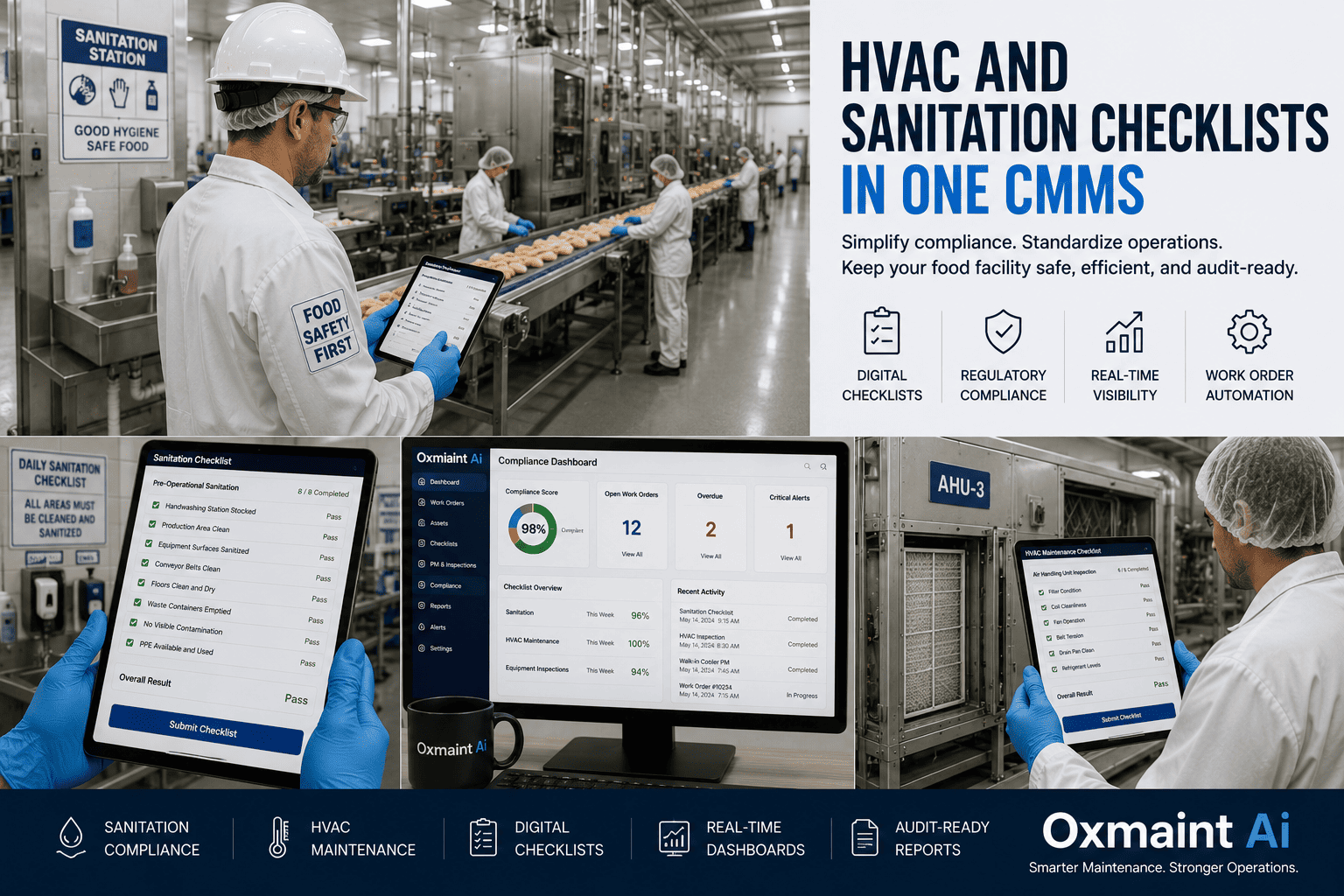
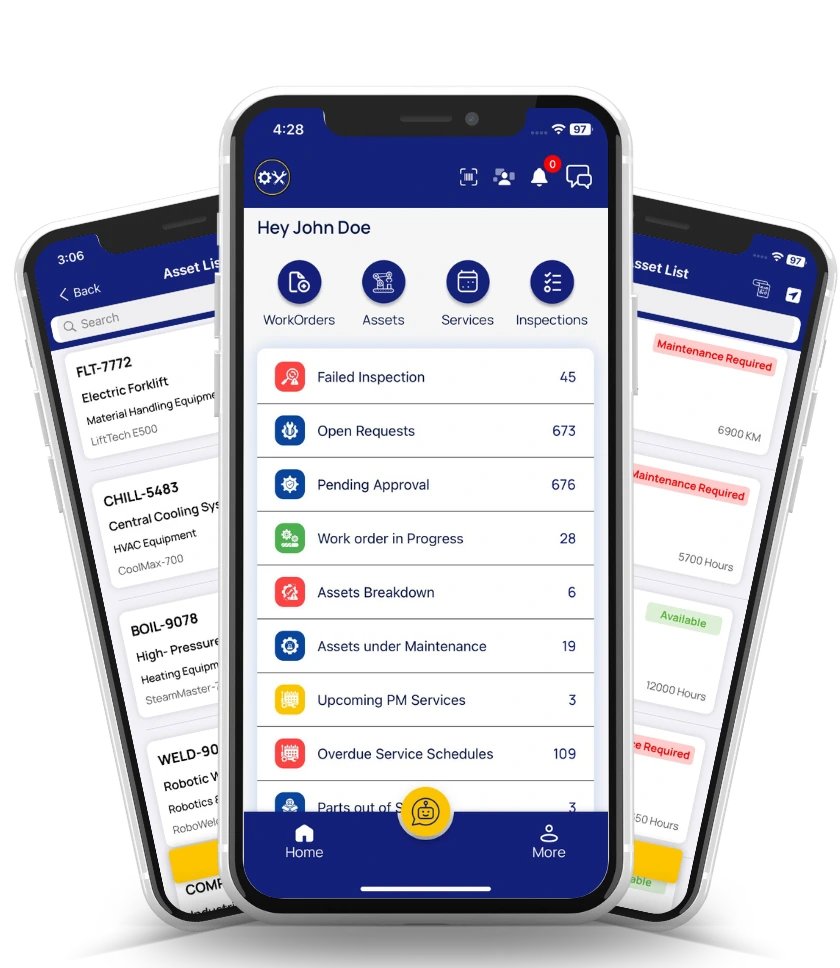
Food manufacturing sanitation and maintenance integration is the practice of running sanitation and preventive maintenance as one coordinated program inside a CMMS — so pre-operational equipment checks, post-maintenance sanitation and the Master Sanitation Schedule (MSS) all live on the same calendar, on the same assets, with the same audit trail. In most food plants these two programs run in parallel silos: maintenance closes a work order on a filler at 2 a.m., sanitation never hears about it, and the line starts up with lubricant residue near a product zone — a classic path to an FDA 483 observation or a costly recall. The fix is structural: link SSOP tasks to maintenance work orders, flag sanitation-critical assets, and let one master schedule drive both teams. This guide shows exactly how food plants build that integration — and how OxMaint makes it automatic. You can Start Free Trial and have your first integrated sanitation-maintenance schedule running this week.
What if every maintenance work order automatically triggered the sanitation step that must follow it?
That single dependency — maintenance hands back equipment only after sanitation verifies it — is the difference between plants that pass unannounced FDA and SQF audits calmly and plants that scramble. Here is the CMMS structure that makes it the default, not the exception.
Why sanitation and maintenance drift apart in food plants — and what it costs
In a typical 150–300 asset food plant, sanitation and maintenance each keep their own schedules, their own logs and their own idea of what "ready for production" means. The result is a set of predictable, expensive failure modes.
Post-maintenance contamination risk
A technician rebuilds a pump seal or re-tensions a conveyor — then the line restarts without a documented post-maintenance sanitation verification. One missed allergen clean after a gasket change can trigger a recall averaging $10M in direct costs, before brand damage.
Schedule collisions
Sanitation books a deep clean on Line 3 the same night maintenance planned a bearing replacement. One team loses its window; the task slips a week. Plants report 15–25% of sanitation tasks are delayed or skipped when the two schedules aren't unified.
Audit-evidence gaps
SQF, BRC and FSMA auditors ask one question: "Show me the equipment was sanitary before production resumed." Paper logs and disconnected spreadsheets make that proof take days. Integrated CMMS records answer it in under 5 minutes.
How to build a Master Sanitation Schedule in your CMMS
A Master Sanitation Schedule (MSS) lists every cleaning task beyond daily SSOPs — overhead structures, HVAC, drains, ice machines, inside-equipment teardowns — with a defined frequency and owner. In a CMMS, the MSS stops being a wall chart and becomes a living, auto-generating work order stream. Build it in four layers.
Inventory every cleanable asset and zone
Register not just production equipment but the environment: ceilings, walls, floor drains, compressed-air points, cooling units. Tag each with its hygienic zone (Zone 1 = direct food contact through Zone 4 = remote areas). OxMaint's asset hierarchy lets you model zones as parents so tasks roll up by area and line.
Assign risk-based frequencies
Zone 1 teardown cleans may run weekly; overhead structures quarterly; drains daily. High-risk ready-to-eat (RTE) areas typically need 2–3x the frequency of low-risk zones. In the CMMS each frequency becomes a recurring PM that auto-generates — nothing depends on someone remembering.
Attach SSOP procedures and verification steps
Every MSS task carries its SSOP: chemicals, concentrations, contact times, disassembly photos, and a required verification (visual, ATP swab, or micro result) before sign-off. Digital checklists with pass/fail fields create the documented proof FSMA's Preventive Controls rule expects.
Link sanitation to maintenance dependencies
This is the integration layer most plants miss: configure rules so specific maintenance work orders (product-zone repairs, lubrication, welding) automatically spawn a post-maintenance sanitation task that must close before the asset returns to service.
SSOP-linked PMs: the workflows that keep both teams aligned
Integration lives or dies on a handful of concrete workflows. These four cover roughly 90% of sanitation-maintenance conflict points in a food plant.
| Workflow trigger | What the CMMS does automatically | Compliance outcome |
|---|---|---|
| Maintenance WO opened on a Zone 1 / food-contact asset | Flags the asset "sanitation hold"; line cannot be released until post-maintenance sanitation task closes | Documented sanitary condition before production resumes (FSMA 21 CFR 117) |
| Pre-operational inspection scheduled | Auto-generates a pre-op checklist each shift; a failed check blocks startup and notifies QA + maintenance | USDA/FDA pre-operational verification evidence, timestamped |
| Lubrication PM on equipment near product zones | Checklist enforces food-grade (H1) lubricant selection and a wipe-down verification step | Chemical-contamination preventive control with proof |
| MSS deep-clean task falls due | Reserves the asset window, checks for conflicting maintenance WOs, and sequences both teams' tasks | No skipped cleans; MSS completion rate visible per line |
Worked example: a 12-line bakery with 220 tracked assets moved its MSS and PMs into one CMMS calendar. In the first quarter, sanitation task completion rose from 78% to 99.2%, post-maintenance sanitation verification hit 100% on food-contact assets, and the plant cleared its SQF recertification with zero sanitation-related non-conformances — versus three minor findings the prior year.
Food plant CMMS capabilities that make integration stick
OxMaint is an AI-powered CMMS + EAM platform built for exactly this: one system where sanitation, maintenance and QA share the same asset data, schedules and audit trail.
Master Sanitation Schedule automation
Recurring MSS tasks auto-generate by frequency and hygienic zone, with SSOP checklists attached. Plants typically lift MSS completion from ~80% on paper to 99%+ — with zero manual scheduling effort.
Sanitation-critical asset flagging
Flag food-contact and Zone 1 assets once; OxMaint then enforces post-maintenance sanitation holds automatically, so 100% of product-zone repairs get a documented sanitation verification before release.
One unified calendar for both teams
Sanitation and maintenance see the same schedule, eliminating window collisions. Plants report reclaiming 4–8 production hours per month previously lost to scheduling conflicts and re-cleans.
Audit-ready digital records
Every pre-op check, ATP verification and corrective action is timestamped and searchable. SQF, BRC and FSMA audit evidence that took days to compile now exports in minutes — a measurable cut in audit prep labor.
KPIs that prove sanitation-maintenance integration is working
What gets measured gets funded. Track these five metrics in your CMMS dashboard; integrated plants typically see movement within 60–90 days.
See your Master Sanitation Schedule running inside OxMaint
Book a 30-minute demo and we will walk you through MSS automation, sanitation-critical asset flagging and post-maintenance sanitation workflows — mapped to your plant's lines and zones.
Food plant sanitation & maintenance integration — answered
What is a Master Sanitation Schedule (MSS) in food manufacturing?
A Master Sanitation Schedule is the documented list of all cleaning tasks beyond daily SSOPs — overheads, drains, HVAC, equipment teardowns — with defined frequencies, responsible owners and verification methods. It is a core expectation of SQF, BRC and FSMA Preventive Controls, and it works best when managed as recurring work orders inside a CMMS rather than on paper.
How do you integrate sanitation and maintenance schedules?
Put both programs on one CMMS calendar and create dependency rules: maintenance work orders on food-contact assets automatically generate a post-maintenance sanitation task that must close before the asset returns to service. You can Start Free Trial of OxMaint and configure these rules with templates in under an hour.
What is a post-maintenance sanitation verification?
It is a documented check — visual inspection, ATP swab or micro sampling — confirming equipment is sanitary after maintenance work and before production resumes. It closes the contamination gap created when tools, lubricants or debris enter product zones during repairs, and it is one of the first records FDA and GFSI auditors request.
Can a CMMS handle both SSOPs and preventive maintenance?
Yes. A food plant CMMS like OxMaint manages SSOP checklists, pre-operational inspections and MSS tasks alongside maintenance PMs on the same asset records — so a filler carries its lubrication schedule, its teardown clean and its full history in one place. Book a Demo to see a combined asset record live.
How does integration improve FSMA and SQF audit readiness?
Integration creates an unbroken, timestamped evidence chain: every sanitation task, pre-op check and post-maintenance verification is logged against the asset and instantly retrievable. Plants using integrated CMMS records typically cut audit preparation from days to minutes and eliminate the documentation gaps behind most sanitation-related non-conformances.
Run sanitation and maintenance as one program — starting this week
OxMaint gives your food plant one master schedule, SSOP-linked work orders, sanitation-critical asset controls and audit-ready records — without replacing your team's existing routines.
Free 14-day trial · No credit card · Set up your first integrated schedule in under an hour