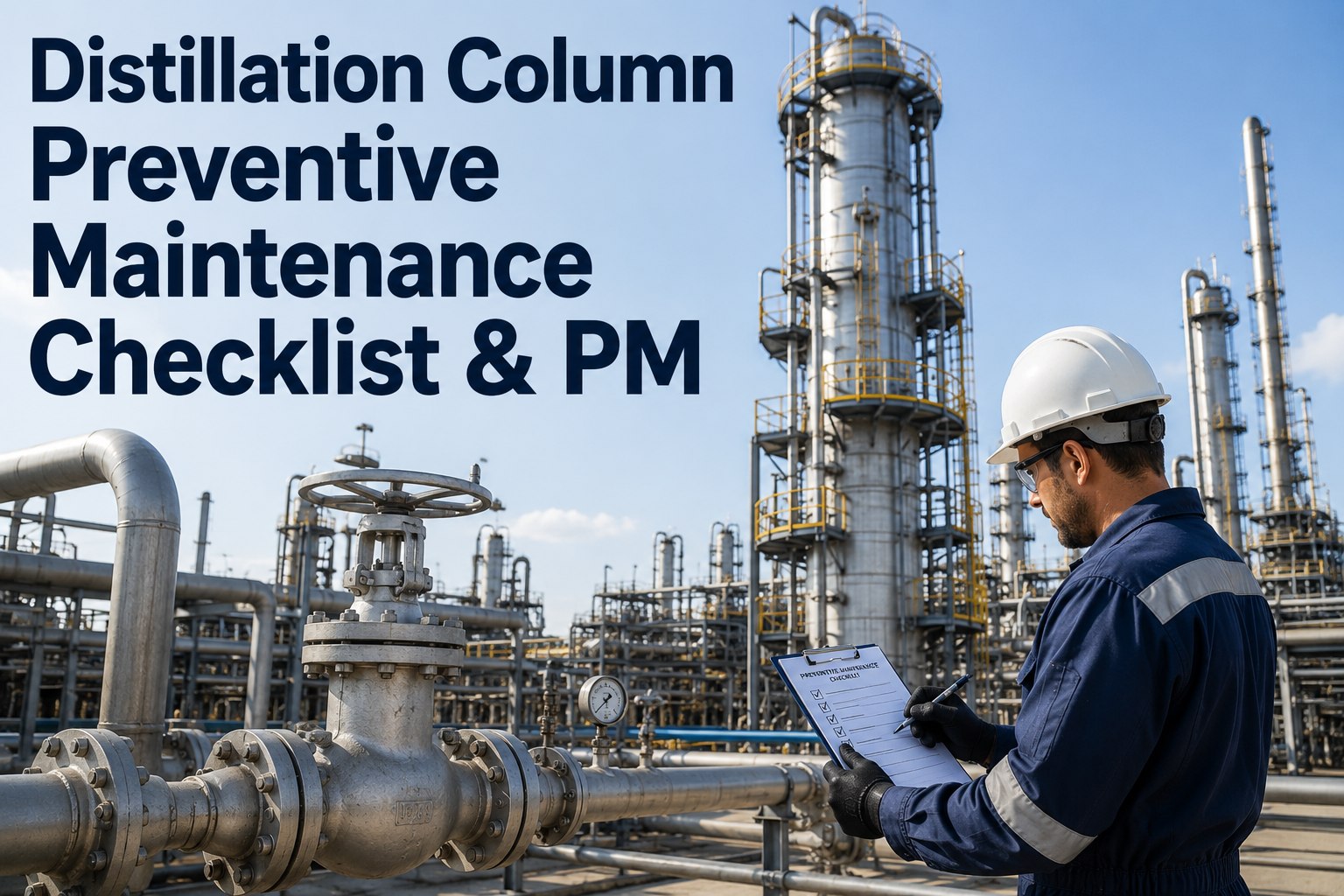
A distillation column preventive maintenance checklist covers tray inspection, reboiler and condenser servicing, pressure relief valve testing, instrumentation calibration, and structural integrity checks — typically on monthly, quarterly, and annual cycles aligned to API 510/570 and OSHA PSM mechanical integrity requirements. Because a single fouled tray or stuck relief valve can shut down an entire separation train, distillation tower maintenance is one of the highest-consequence PM programs in any chemical plant or refinery. This guide gives you a complete, defensible distillation column PM checklist with realistic intervals, inspection criteria, and the CMMS structure that keeps every task scheduled, documented, and audit-ready. Plants that digitize their column PM program in OxMaint typically cut missed inspections to near zero within the first quarter — Start Free Trial and load your first column in under an hour.
Is Your Distillation Tower Maintenance Program Audit-Proof — or Just a Binder?
One missed tray inspection can mean $100K+ in unplanned turnaround scope. Here is the complete preventive maintenance checklist high-performing chemical plants run — and how a CMMS makes it defensible under PSM.
Distillation Column Preventive Maintenance Checklist by Component
A defensible column PM program covers six systems. Industry data shows roughly 60% of unplanned distillation outages trace back to fouling, corrosion, or relief-device failures — all detectable through routine PM. Use these grids as your master task library.
Column Trays & Internals
- Inspect trays for fouling, corrosion, and mechanical damage during every turnaround
- Measure tray thickness on corrosion-prone passes; log readings per tray number
- Check valve caps, sieve holes, and downcomer clearances for plugging
- Verify tray levelness — sag over 6 mm can cut separation efficiency 10–20%
- Photograph every finding and attach to the asset record
Reboiler Maintenance
- Trend approach temperature and steam consumption monthly for fouling signals
- Hydrojet or chemically clean tube bundles when duty drops 10–15%
- Eddy-current or IRIS test tubes every 3–5 years per API 510 intervals
- Inspect gaskets, channel heads, and tube sheets at each bundle pull
- Track spare bundle availability in your parts inventory
Overhead Condenser
- Monitor cooling-water ΔT and outlet temperature weekly
- Schedule condenser cleaning when heat-transfer coefficient falls 15%
- Check for air in-leakage and vent non-condensables on vacuum columns
- Inspect fins/fan blades on air coolers quarterly; clean debris buildup
- Test cooling-water treatment residuals monthly to control scaling
Pressure Relief Valves
- Pop-test every PSV on a risk-based interval — typically 3–5 years, per API 576
- Verify set pressure within ±3% of nameplate; document as-found vs as-left
- Inspect inlet/outlet piping for blockage, corrosion, and car-seal status
- Track test history per PSV tag for PSM mechanical integrity audits
- Flag overdue valves automatically — never let a due date slip silently
Instrumentation & Controls
- Calibrate pressure, temperature, and level transmitters annually
- Proof-test column pressure and level safety trips per SIS proof-test interval
- Verify reflux and reboiler control valves stroke fully; check for stiction
- Compare DP across trays against design — rising DP signals flooding or fouling
- Reconcile lab assays with analyzer readings quarterly
Shell, Piping & Structure
- External visual inspection of shell, skirts, and anchor bolts annually
- CUI inspection under insulation at susceptible locations every 3–5 years
- Ultrasonic thickness monitoring at designated TMLs per API 570 circuit plans
- Check foundation for settlement, cracking, and bolt corrosion
- Inspect platform steelwork, ladders, and grounding connections
Distillation Maintenance Schedule: What Runs Weekly, Monthly, and at Turnaround
The most common failure in chemical column PM programs is not missing tasks — it is missing intervals. This schedule reflects typical refinery and petrochemical practice; adjust frequencies with risk-based inspection (API 580/581) data for your service.
| Interval | Distillation Column PM Tasks | Standard / Basis |
|---|---|---|
| Weekly | Operator rounds: DP across trays, reflux flow, reboiler steam rate, condenser outlet temp, unusual vibration or noise | Site operating procedures |
| Monthly | Fouling-factor calculation on reboiler/condenser, cooling-water residuals, PSV visual check, lubrication of associated pumps/fans | OEM + site PM plan |
| Quarterly | Air-cooler fin cleaning, control-valve stroke checks, analyzer reconciliation, CUI spot checks | Reliability program |
| Annually | Instrument calibration, external shell inspection, foundation and structure survey, relief-system documentation review | API 510 / OSHA PSM |
| 3–5 Years | PSV pop-testing, reboiler tube NDT, TML ultrasonic thickness readings, SIS proof tests | API 570/576, RBI |
| Turnaround | Full internal tray inspection, tray thickness mapping, bundle pulls, internal corrosion survey, repairs and replacements | API 510 internal inspection |
What Skipped Column Maintenance Actually Costs
Unplanned downtime in continuous process plants runs $100K–$500K per day in lost production, and a single fouling-driven mid-run shutdown routinely exceeds the cost of a full year of disciplined PM. Consider a real scenario:
A Gulf Coast specialty chemical plant ran a 42-tray debutanizer on reactive maintenance. A fouled reboiler forced an emergency 5-day shutdown: $310K in lost margin, $85K in cleaning and expedited parts, plus a PSM audit finding for a PSV 14 months past its test date.
After moving the column's PM into a CMMS with auto-scheduled work orders and fouling trends, the plant caught the next fouling event 6 weeks early — cleaning during a planned 8-hour outage instead of a 5-day emergency. That is the math that makes distillation unit maintenance programs easy to defend to plant leadership.
How OxMaint Runs Your Distillation Column PM Program
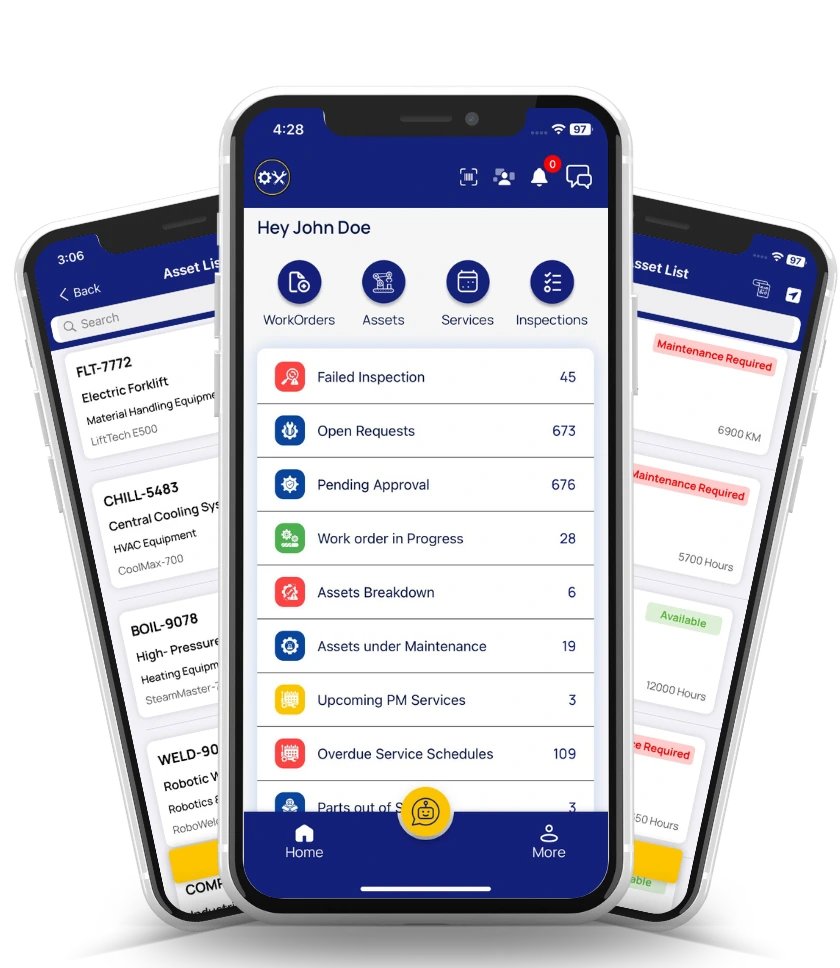
Spreadsheets and wall calendars cannot keep 200+ recurring tasks per column on schedule — or prove it in an OSHA PSM audit. OxMaint's AI-powered CMMS turns this checklist into a self-running program with measurable outcomes:
Recurring PM Scheduling
Every task in this checklist becomes an auto-generated work order by calendar, runtime, or condition trigger. Plants report cutting missed PMs by 90%+ in the first quarter — no PSV ever goes silently overdue again.
Condition & Trend Tracking
Log tray DP, reboiler duty, and thickness readings against each asset. OxMaint's analytics flag degrading trends — like a 15% heat-transfer drop — so you clean on your schedule, not the failure's.
PSM Mechanical Integrity Records
Every inspection, pop-test, and repair is timestamped, photo-documented, and tied to the equipment tag. Generate an audit-ready mechanical integrity file for any column in minutes, not weeks.
Spare Parts & Turnaround Kitting
Link tray hardware, gaskets, and spare bundles to each column's BOM. OxMaint reserves parts against planned work orders, cutting turnaround delays caused by missing materials — a top-3 cause of schedule overrun.
See OxMaint Running Your Column PM — Book a 30-Min Demo
Bring one distillation column's task list. We will show you the scheduled work orders, PSV tracking, and audit reports live on your own data.
Distillation Column Maintenance FAQs
How often should a distillation column be inspected?
External inspections run annually, thickness monitoring every 3–5 years, and full internal tray inspections at turnaround — typically every 4–6 years. Risk-based inspection per API 580/581 can justify shorter or longer intervals based on corrosion rates and service severity.
What are the most common distillation column failures?
Tray fouling and plugging, reboiler/condenser fouling, corrosion under insulation (CUI), and relief valve failures account for the majority of unplanned outages. Most are detectable weeks in advance through DP trends, heat-transfer monitoring, and disciplined PM intervals.
How do I know when a reboiler needs cleaning?
Track the fouling factor: when steam consumption rises or heat-transfer duty drops 10–15% at constant throughput, schedule a clean. Trending this in a CMMS like OxMaint turns a reactive emergency into a planned 8-hour outage.
What does OSHA PSM require for distillation column maintenance?
The mechanical integrity element (1910.119(j)) requires written procedures, documented inspections and tests per recognized standards (API 510/570/576), correction of deficiencies, and records retained for the life of the equipment. A CMMS is the practical way to prove all four during an audit.
Can a CMMS really manage column turnaround scope?
Yes — and it is where the ROI is largest. OxMaint accumulates inspection findings, parts reservations, and deferred repairs into the turnaround worklist automatically, so scope freezes are based on data, not memory. Book a Demo to see turnaround planning on a live column asset.
Make Every Column Inspection On-Time and Audit-Ready
Load your first distillation column, import this checklist, and let OxMaint schedule, track, and document every PM task from day one.
Free 14-day trial · No credit card · Set up your first column in under an hour