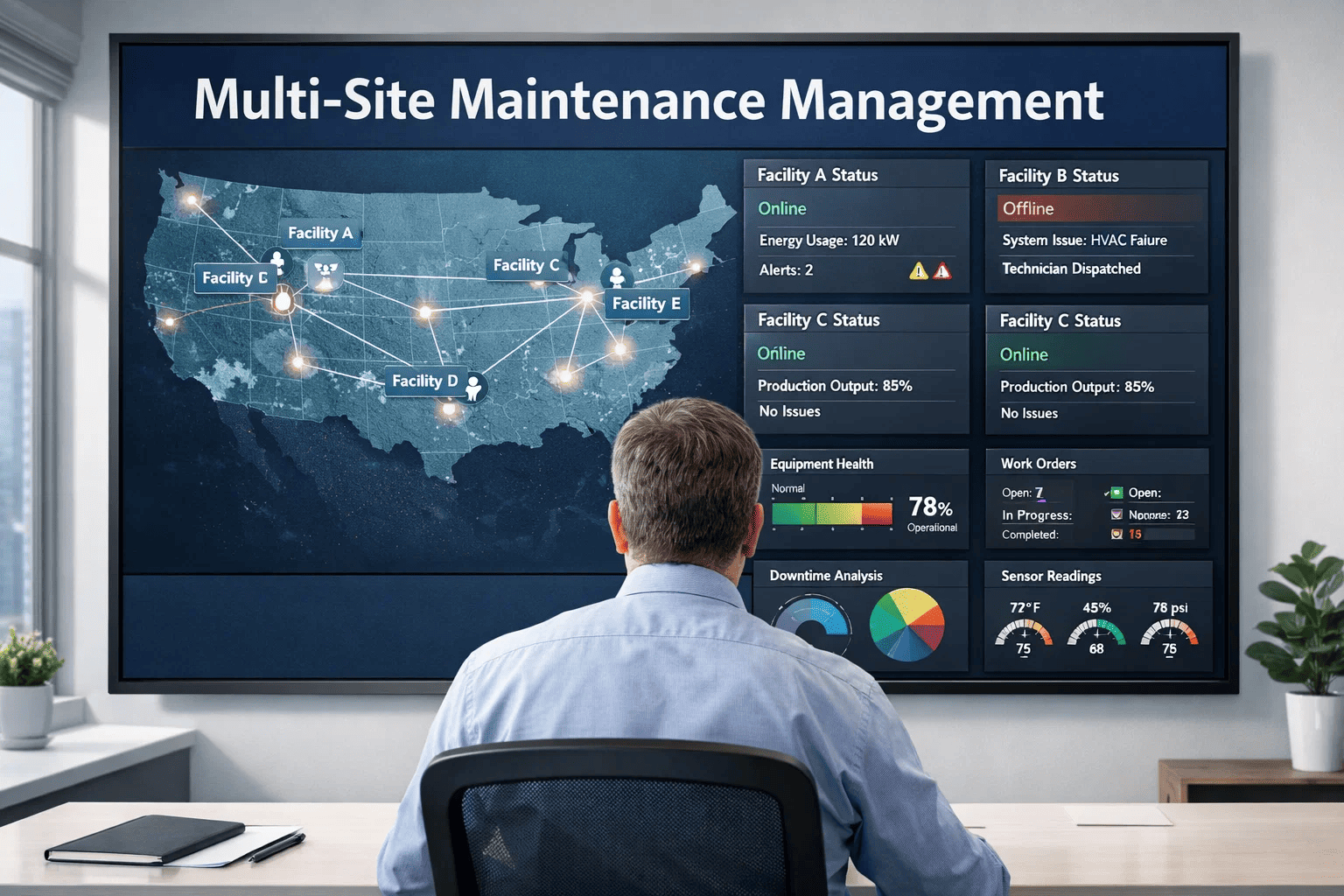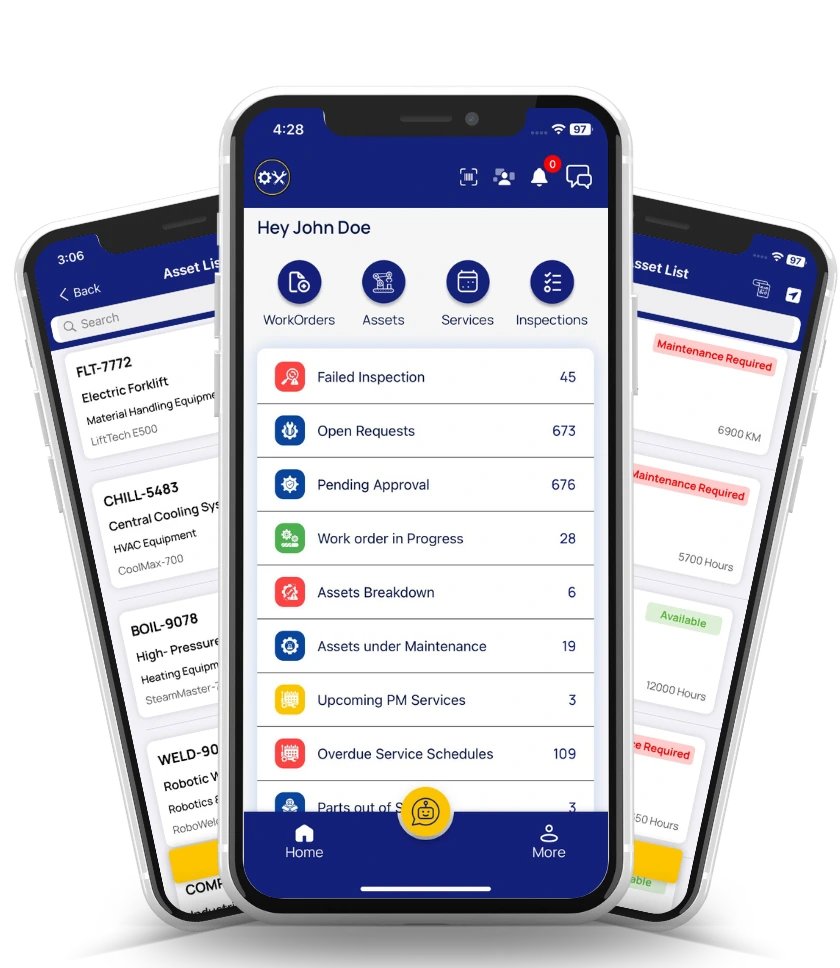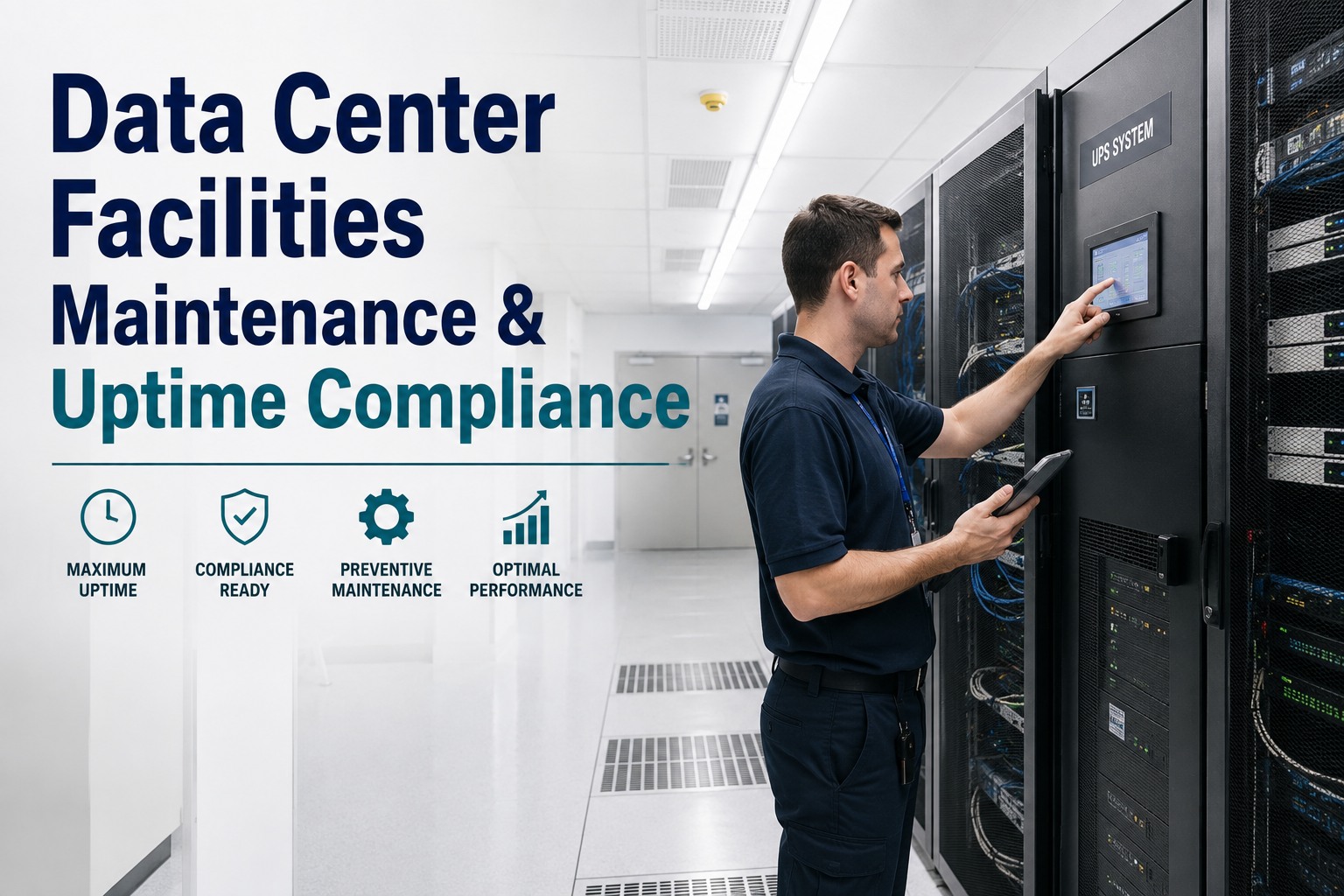
Data center maintenance is the discipline of keeping power, cooling, and life-safety infrastructure at 99.99%+ availability — because in a critical facility, a single missed UPS battery test or an overdue generator load bank run can turn into a six-figure outage in minutes. Unlike general facilities management, data center facilities maintenance is measured against Uptime Institute Tier standards, where Tier III demands 99.982% availability (no more than 1.6 hours of downtime per year) and Tier IV allows just 26 minutes. That means every preventive maintenance task — from precision cooling PM to ATS transfer tests — must be scheduled, executed, documented, and audit-ready without exception. This guide covers the core data center PM programs, Tier compliance documentation, and the CMMS structure that makes it all repeatable, and shows how OxMaint gives critical facility teams the work order rigor and asset history that uptime demands. You can Start Free Trial and have your first UPS maintenance schedule running today.
What does a 99.982% uptime maintenance program actually look like?
It looks like every UPS string tested on schedule, every generator load-banked annually, every CRAH unit trended — and every task documented to Uptime Institute Tier standards. Here is the cost of getting it wrong:
Why data center facilities management tolerates zero missed PMs
Over 60% of data center outages cost more than $100,000, and roughly 1 in 6 exceeds $1 million — and the Uptime Institute consistently attributes the majority of serious incidents to power and cooling failures, the two systems your PM program directly controls.
Human error and process gaps — skipped steps, undocumented changes, missed inspections — sit behind most preventable downtime. A structured data center CMMS closes those gaps by making every task assigned, time-stamped, and provable. When a colocation customer or auditor asks "show me the maintenance history on UPS-2," the answer should take seconds, not a weekend of binder archaeology.
Data center PM checklist: the 4 systems that decide your uptime
A Tier-grade preventive maintenance program covers four asset families. Miss one interval on any of them and your redundancy math collapses.
UPS & Battery Maintenance
- Monthly: visual inspection, alarm review, ambient temperature log
- Quarterly: battery string voltage & internal resistance/impedance testing
- Semi-annual: thermal scan of connections, capacitor inspection
- Annual: full UPS load test, battery discharge (capacity) test, firmware review
- Per OEM: capacitor & fan replacement at 5–7 year marks
Generator & ATS Maintenance
- Weekly: no-load run, fluid levels, block heater & battery check
- Monthly: ATS transfer test, fuel system inspection
- Annual: load bank test at 30%+ of nameplate (NFPA 110 Level 1), coolant & oil analysis
- Every 2–3 yrs: fuel polishing / tank testing for stored diesel
- After every event: run-hours log, alarm history, fuel consumption record
Precision Cooling / HVAC PM
- Monthly: filter inspection/replacement, belt & fan check, condensate drain clear
- Quarterly: refrigerant pressures, coil cleaning, humidifier service
- Semi-annual: CRAH/CRAC redundancy test — N+1 failover verification
- Annual: chiller tube cleaning, water treatment analysis, economizer calibration
- Continuous: temperature/humidity trend review against ASHRAE envelopes
Electrical Distribution & Life Safety
- Annual: infrared thermography of switchgear, PDUs, busway connections
- Annual: breaker testing & coordination study review, torque checks
- Semi-annual: PDU/remote power panel load balance review
- Quarterly: fire suppression & VESDA detection tests, EPO verification
- Monthly: leak detection sweep under raised floor / in white space
Tier III & Tier IV maintenance documentation: what auditors ask for
Uptime Institute Tier certification — and colocation SLAs — require provable maintenance history. A single missing generator test record can stall a certification or trigger an SLA credit.
| Requirement | Tier III (Concurrently Maintainable) | Tier IV (Fault Tolerant) | CMMS Evidence Needed |
|---|---|---|---|
| Availability target | 99.982% (1.6 hrs/yr) | 99.995% (26 min/yr) | Downtime & incident logs tied to assets |
| Redundancy | N+1 | 2N or 2(N+1) | Asset hierarchy showing redundant paths |
| Planned maintenance | Any component removable without shutdown | Any single fault tolerated without impact | Scheduled PM records + method of procedure (MOP) history |
| Generator testing | NFPA 110: monthly + annual load bank | Same, across duplicated plants | Time-stamped test results, run-hours, fuel logs |
| Change management | Documented MOPs/SOPs/EOPs | Same + fault-response drills | Work orders linked to change tickets & approvals |
| Battery health | Regular impedance & discharge tests | Same, per string, per plant | Trended readings per battery string over time |
The pattern is clear: Tier compliance is a documentation discipline as much as an engineering one. OxMaint stores every PM result, reading, and signature against the asset record, so an audit response is a filtered report — not a scramble.
The cost of one missed task: a 2 MW colocation scenario
A 2 MW colocation facility running 40 racks per hall skipped quarterly battery impedance testing for two cycles while short-staffed. Here is how the math played out.
The miss
One cell in a 40-cell VRLA string drifted high-resistance — invisible without impedance testing. Nameplate said healthy; reality said the string could carry load for 90 seconds, not the designed 5 minutes.
The event
A utility sag hit. The UPS carried load for 90 seconds, then dropped a hall of 40 racks before generator transfer completed. Total customer-facing outage: 11 minutes.
The bill
SLA credits to 14 colocation tenants (~$180K), emergency battery string replacement ($65K), and one enterprise tenant invoking a contract exit clause. Total impact: $400K+ — from a test that costs about $1,200 per quarter.
Preventive maintenance in critical facilities is not a cost center — it is the cheapest insurance you will ever buy, with ROI routinely exceeding 10:1 versus reactive repair and downtime.
Data center CMMS software built for Tier-grade reliability
OxMaint is an AI-powered CMMS + EAM platform that turns your PM program from calendar reminders and spreadsheets into an auditable, automated system of record.
Preventive Maintenance Automation
Calendar, meter, and run-hour triggers auto-generate work orders for UPS tests, load bank runs, and cooling PM — so no interval is ever silently skipped. Teams report 30–50% less unplanned downtime within the first year.
Asset Hierarchy & History
Model your facility the way Tier auditors think: site → hall → electrical path → UPS → battery string → cell. Every reading, repair, and test lives on the asset record — audit-ready in seconds, not weekends.
Compliance Documentation & MOPs
Attach MOPs, SOPs, and EOPs to work orders with enforced checklists and sign-offs. Generate Uptime Institute, NFPA 110, and ISO 55000-aligned maintenance reports with one click when auditors or tenants ask.
Predictive Analytics & Spare Parts
Trend battery impedance, coolant temps, and vibration to flag degradation before failure. Link critical spares — capacitors, fans, filters, cells — to assets so a part is never out of stock during an emergency repair.
What critical facility teams gain with structured maintenance
Facilities that move from spreadsheets to a purpose-built data center CMMS typically see PM completion rates climb from ~70% to 98%+ within two quarters.
"Our last Uptime Institute operational review took one afternoon of report exports instead of three weeks of digging through binders. Every generator test, every battery reading, time-stamped and tied to the asset."
"We caught a failing UPS fan through trended temperature alerts three weeks before it would have tripped a module. That one catch paid for the platform for the next five years."
See OxMaint running on your critical assets
Book a 30-minute demo and we will walk through a live UPS PM schedule, generator test log, and Tier-ready compliance report — built on your asset structure.
Data center maintenance questions, answered
How often should UPS batteries be tested in a data center?
At minimum: quarterly impedance or internal resistance testing, plus an annual full discharge (capacity) test per IEEE 450/1188 guidance. VRLA batteries typically deliver 3–5 years of real service despite 10-year nameplates, so trended test data — stored per string in your CMMS — is the only reliable way to spot a weak cell before it fails under load.
What maintenance is required for Tier III data center compliance?
Tier III requires that any component can be removed for planned maintenance without shutting down IT load — which means documented, scheduled PM on every power and cooling path, plus provable MOPs/SOPs. Auditors expect time-stamped maintenance history per asset. OxMaint generates exactly this evidence trail automatically; Book a Demo to see a Tier-ready report.
How often should a data center generator be load bank tested?
NFPA 110 Level 1 (which covers most data centers) requires monthly exercise under available load and an annual load bank test — typically at 30%+ of nameplate for at least 2 hours — to prevent wet stacking and prove the set can carry the facility. Every run should log run-hours, fuel burn, voltages, and alarms against the generator's asset record.
What is the difference between data center facilities management and IT maintenance?
Facilities maintenance covers the physical infrastructure — UPS systems, generators, switchgear, CRAH/CRAC units, chillers, fire suppression — while IT maintenance covers servers, storage, and network gear. The two meet at the PDU. A data center CMMS like OxMaint manages the facilities asset base, while integrating with change management so facilities work never surprises IT operations.
Can a CMMS really reduce data center downtime?
Yes — industry data shows roughly 80% of outages are preventable, and most trace to power or cooling assets with missed or undocumented maintenance. Teams using structured PM automation report 30–50% reductions in unplanned downtime and PM completion rates above 98%. Start Free Trial and load your first 50 assets in under an hour.
Your uptime is only as strong as your last documented PM
Put every UPS test, load bank run, and cooling PM on autopilot — with the audit trail Tier III/IV operations demand. Start free, or see it live on your assets first.