Somewhere under your campus, a single feeder line splits to carry electricity to fourteen buildings — a dorm, a lab, the library, the data center. Nobody thinks about it until it trips, and then every one of those buildings goes dark at once. That's the nature of a central plant: it's invisible right up until it isn't, and when it fails, the damage isn't contained to one building — it's the whole campus, all at once. Central plant and utility distribution maintenance is fundamentally different from building-level maintenance because the failure mode is systemic, not local. This guide covers what's actually running through a campus plant, where single points of failure hide in the distribution loop, and the maintenance and redundancy program that keeps hundreds of buildings running on one shared backbone. Book a free central plant reliability review for your campus.
One Plant. One Loop. Every Building Downstream.
A central plant failure doesn't take down a room — it takes down the campus.
1 Source
Steam, chilled water, and power often trace back to a single plant
Systemic
A failure here cascades across buildings, not just one room
N+1
The redundancy standard a reliable plant is designed against
What's Actually Running Through Your Campus
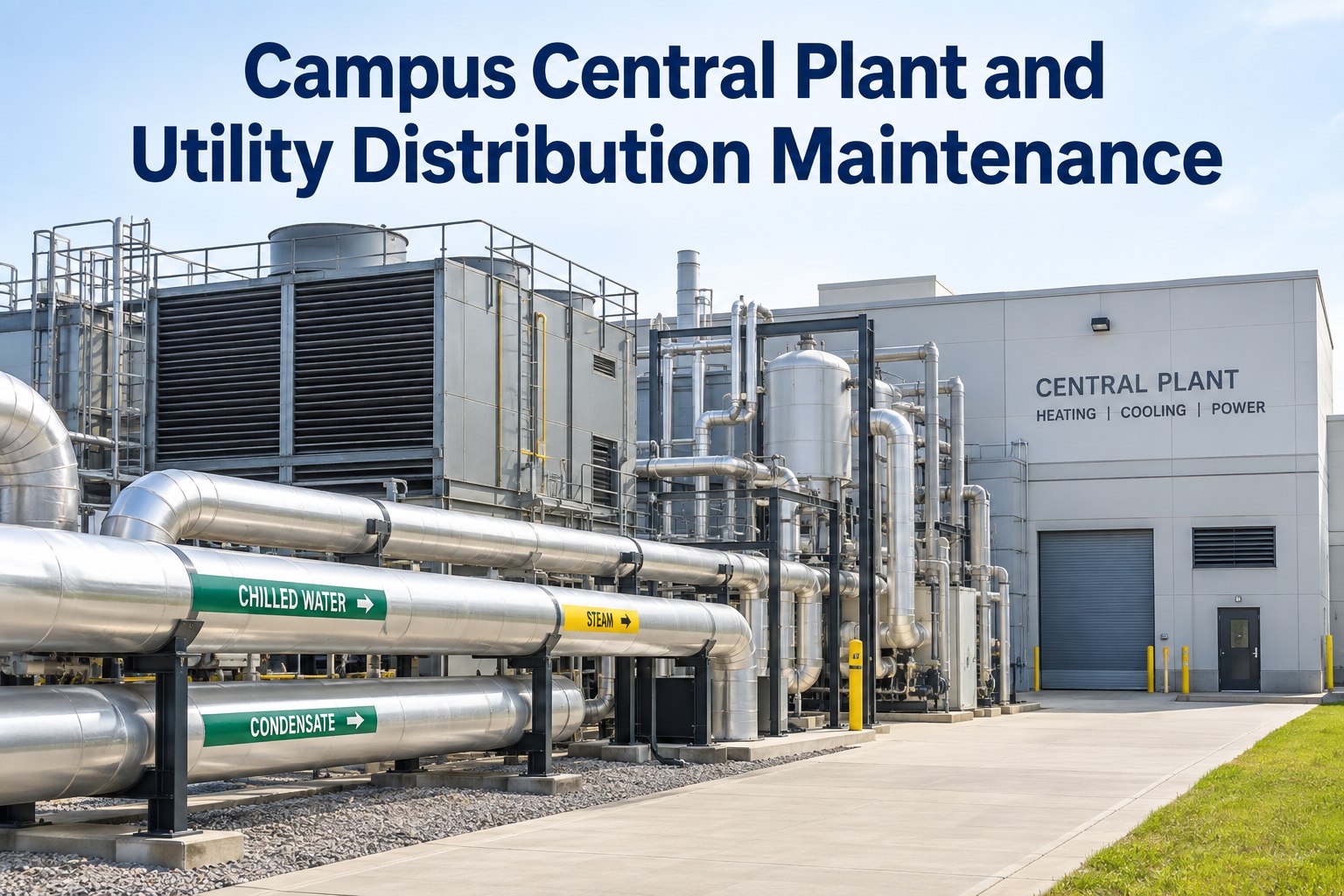
A central plant typically carries four utility systems, each with its own failure risk and its own maintenance discipline — but all sharing the same consequence when something goes wrong: everything downstream loses service at once.
Steam & Heating
Boilers and steam mains feeding heat to dozens of buildings — a leak in one tunnel section can take entire zones offline.
Chilled Water
Central chillers and distribution loops cooling labs, dorms, and data centers — critical spaces have zero tolerance for outage.
Electrical Distribution
Feeder lines and substations splitting power across the campus grid — a single feeder often serves more buildings than anyone realizes.
Natural Gas
Gas mains feeding boilers, generators, and lab equipment — leak detection and pressure monitoring carry direct safety stakes.
Where Single Points of Failure Hide
Most campus utility failures don't come from the plant itself — they come from the distribution loop, where redundancy was never built in or has quietly degraded over time.
01
Unlooped Distribution
A dead-end main instead of a loop means one break isolates every building past that point — with no way to reroute.
02
Undersized Redundant Equipment
A backup chiller or boiler exists on paper but can't actually carry full load if the primary unit goes down.
03
Aging Isolation Valves
Valves meant to isolate a failed section instead of shutting the whole loop — seized or untested until the day they're needed.
04
Shared Feeder Overload
Buildings added to the grid over decades, quietly stacking load onto feeder lines never sized for today's demand.
Map Your Campus's Single Points of Failure
Bring your distribution drawings — we'll walk the loop with you and flag where redundancy is assumed but not actually built in.
The Central Plant PM Program
Plant equipment carries a heavier PM load than typical building assets — because downtime here isn't a comfort complaint, it's a campus-wide service interruption.
1
Daily Plant Rounds
Pressure, temperature, and vibration checks on boilers, chillers, and generators — catching drift before it becomes failure.
2
Scheduled Valve & Isolation Testing
Every isolation valve exercised on a schedule, so it actually closes when a section needs to be cut off in an emergency.
3
Distribution Loop Inspection
Tunnels, manholes, and buried mains inspected for leaks, corrosion, and insulation loss before they surface as a break.
4
Redundancy Load Testing
Backup equipment tested under real load, not just started and idled — confirming it can actually carry the campus if called on.
5
Capacity & Growth Review
Feeder and main loads reviewed against new buildings added to campus, before load creep turns into an outage.
Reactive Repair vs. Planned Reliability
On a shared utility backbone, the cost of a reactive failure is multiplied by every building on that loop — which is why planned reliability pays for itself differently here than in single-building maintenance.
Reactive Model
Valves tested only when a failure forces the question
Redundant equipment untested until it's actually needed
A single break can black out an entire zone for hours
No visibility into which buildings share a feeder or main
Planned Reliability
Isolation valves exercised on a fixed inspection schedule
Backup equipment load-tested regularly, not just started
Faults isolated to a small section, not the whole loop
Full map of building-to-feeder and building-to-main dependencies
How Oxmaint Supports Central Plant Reliability
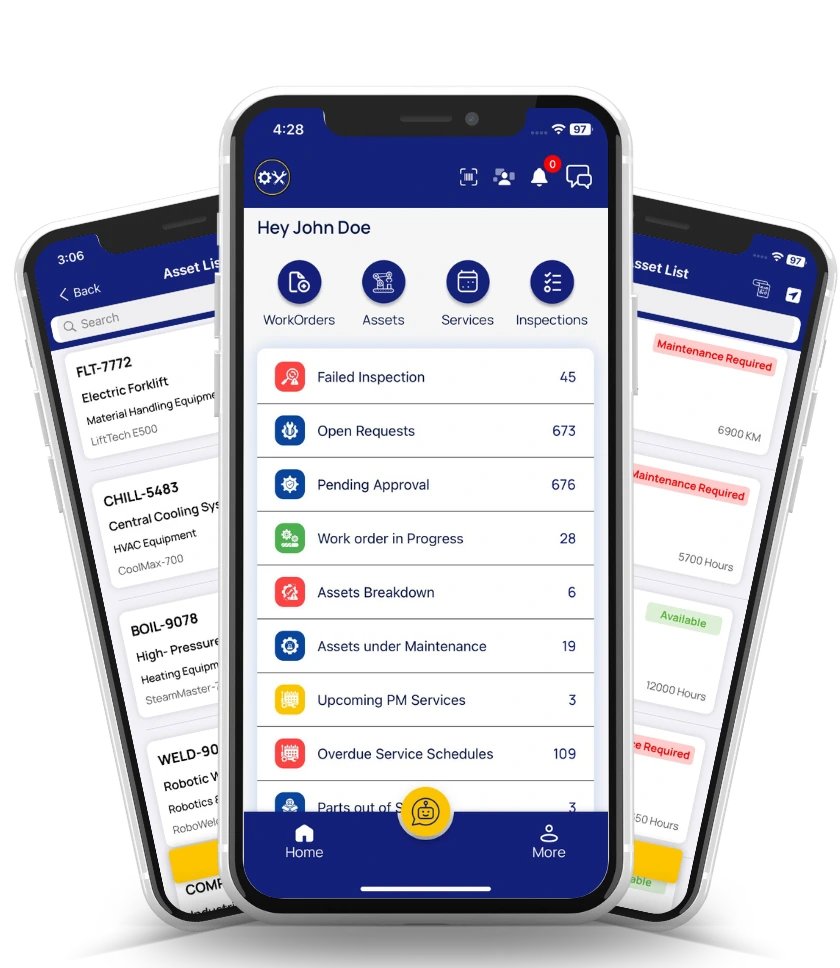
Oxmaint gives central plant and utilities teams one system to run PM, track distribution assets, and see exactly which buildings sit downstream of any given piece of equipment.
Plant Equipment PM
Scheduled rounds and preventive maintenance on boilers, chillers, and generators, tracked to manufacturer intervals.
Distribution Asset Mapping
Valves, mains, and feeders tracked as assets with their downstream building dependencies visible at a glance.
Redundancy Test Scheduling
Backup equipment load tests scheduled and logged, so redundancy is verified, not assumed.
Campus-Wide Outage Visibility
A single work order on a shared asset shows every affected building instantly, speeding up response and communication.
Don't Let One Feeder Decide Your Campus's Bad Day
See how Oxmaint tracks plant equipment, distribution assets, and redundancy testing in one system built for campus-scale reliability. Free forever plan available.
Frequently Asked Questions
What is a campus central plant?
A central plant is the shared infrastructure hub that produces and distributes core utilities — steam or hot water for heating, chilled water for cooling, electrical power, and sometimes natural gas — to buildings across a campus from one or a few central locations, rather than each building having its own independent system. This centralized model is efficient to operate but means a failure at the plant or in the distribution loop can affect many buildings simultaneously.
Book a reliability review to map your own plant's dependencies.
Why is central plant maintenance different from building-level maintenance?
Building-level maintenance failures are typically contained to one space or one building. Central plant and distribution failures are systemic — a break in a shared steam main, a tripped feeder, or a failed chiller can cut service to dozens of buildings at once. This changes the maintenance priority: PM programs focus heavily on redundancy testing, isolation valve function, and distribution loop integrity, not just the plant equipment itself.
What is N+1 redundancy and why does it matter for campus utilities?
N+1 redundancy means having at least one more unit of critical equipment (a boiler, chiller, or generator) than the minimum needed to meet demand, so a single failure doesn't cause a service outage. The redundancy only holds up if the backup equipment is actually tested under real load on a regular schedule — untested backups are a common reason campuses discover their "redundant" system can't actually carry full load when it's needed.
Where do single points of failure typically hide in utility distribution?
The most common hidden risks are dead-end distribution runs instead of loops (so a single break isolates everything downstream), isolation valves that have seized or were never tested, backup equipment that's undersized for full load, and feeder lines or mains that have quietly picked up more building load over years of campus growth than they were originally designed to carry.
Does Oxmaint support central plant and utility distribution maintenance?
Yes. Oxmaint schedules and tracks preventive maintenance on plant equipment like boilers, chillers, and generators, maps distribution assets such as valves, mains, and feeders alongside the buildings they serve, schedules redundancy load testing so backup capacity is verified rather than assumed, and gives facilities teams instant visibility into which buildings are affected by any shared-asset work order. A free forever plan is available to trial the full workflow.
Sign up free and map your first plant asset.