Choosing a CMMS for a cement plant is not the same decision as choosing one for general manufacturing, and the plants that treat it that way end up with software that fights them. A single integrated cement plant runs more than 2,400 maintainable assets — rotary kilns, ball and vertical roller mills, crushers, clinker coolers, preheater cyclone towers, bag filters, and packing lines — all generating maintenance demand at once across 24-hour production. And almost none of it runs on a calendar. Kiln refractory life is governed by heat count and thermal exposure, mill liners by tonnage through the mill, crusher jaws by throughput. A generic platform that schedules PM by date drifts out of sync with actual wear, forces custom-field workarounds for cement-specific asset classes, and produces spreadsheets when the boardroom needs a CapEx forecast. This guide breaks down what a cement-grade CMMS has to do that a generic one cannot, and how to compare platforms for 2026. Start a free Oxmaint trial and load a cement-plant asset template with kiln refractory tracking, or book a demo to see kiln health monitoring and multi-plant dashboards.
Cement Manufacturing · CMMS Selection · 2026
Best CMMS Software for Cement Manufacturing Plants
Bulk material handling, kiln refractory campaign tracking, pyrometer and shell-temperature integration, and multi-plant management — how to compare CMMS platforms for cement in 2026 and pick one built for the way cement equipment actually wears.
-
2,400+
maintainable assets in a single integrated cement plant
-
$100K+/hr
cost of an unplanned rotary kiln shutdown
-
60–90 days
purpose-built CMMS deployment vs 12–18 months for ERP EAM
-
25–40%
lower maintenance cost per tonne within 18–24 months
The Cement-Grade Test
Four Things a Generic CMMS Can't Do
Most platforms marketed as a CMMS handle work orders and calendar PM. Cement breaks them on four specific requirements — the capabilities that separate a cement-grade system from generic software forced into custom fields. Score any platform against these before anything else.
-
Refractory Campaign Tracking
Refractory life is driven by heat count and temperature exposure, not a date. A cement-grade CMMS treats refractory as a first-class asset type — heat count and condition score per kiln zone, remaining-life projection driving the reline schedule, and campaign history accumulating across relining cycles. Generic platforms need custom-field workarounds. -
Cycle-Based PM Triggers
PM must fire on operating reality: kiln revolutions since last refractory inspection, mill running hours since liner change, crusher throughput tonnage since jaw assessment. Calendar-based PM either over-maintains healthy equipment or under-maintains degrading assets — the trigger model is the core of the system. -
Shell Temperature & Pyrometer Feeds
Kiln shell thermal-imaging and pyrometer data must flow into the asset record, auto-alerting when a hot spot signals brick failure behind it. That means integration with process historians and DCS over OPC-UA, MQTT, or REST — connecting the control room to the field, not living in a separate tool. -
Board-Ready CapEx Forecasting
A 2,400-asset base needs remaining-useful-life per asset class feeding rolling 5–10 year CapEx forecasts, with refurbish-versus-replace analysis formatted for board approval without finance translation. Work-order tools that produce spreadsheets instead of capital plans fail this test.
These four are not standard features in platforms designed for discrete manufacturing — girth-gear backlash, liner wear progression, and preheater cyclone scoring simply aren't in the box. Book a demo to see all four built in for cement, not bolted on.
The Asset the Plant Revolves Around
When the Kiln Stops, the Plant Stops
The rotary kiln is the single most critical, most expensive, and most failure-prone asset in the plant — when it runs the plant makes money, when it stops the whole line stops. A cement CMMS has to be organized around protecting it, because a 4-hour mechanical repair that cools the shell unevenly becomes a multi-day refractory reline costing millions.
- Shell hot-spot monitoring — thermal-camera data in the asset record, auto-alerting when shell temperature signals brick failure before a breakthrough forces an uncontrolled shutdown.
- Tyre & roller tracking — oval measurement, creep-rate monitoring, and riding-ring migration tracked per station against manufacturer limits, with lubrication intervals scheduled.
- Main drive & girth gear — vibration monitoring on girth gear, pinion, and main motor, with gear-mesh temperature and backlash tracked on scheduled intervals.
- Refractory life per zone — remaining brick life tracked against each heat's actual thermal profile, so the reline is planned into a scheduled turnaround, not forced by a brick fall.
The same discipline extends down the line — crushers and raw conveyors take the first abrasive hit from limestone, and mills, coolers, and bag filters each carry their own failure mode. Sign up for Oxmaint to register every kiln zone and critical asset with condition scoring.
Calendar Dates Don't Fit Cement
PM Triggered by Wear, Not the Wall Clock
The defining configuration choice is the PM trigger. Cement equipment wears by how hard it works, so the schedule has to follow operating data. This is what condition-based triggering looks like across the main equipment classes.
| Equipment | PM Trigger | What It Prevents |
|---|---|---|
| Kiln refractory | Heat count / kiln revolutions | Brick fall and uncontrolled shutdown |
| Ball / roller mill | Running hours since liner change | Liner breakthrough, gearbox damage |
| Crusher | Throughput tonnage | Jaw-plate failure mid-run |
| Kiln shell | Shell temperature trend | Ovality and refractory breakthrough |
| Mill gearbox | Vibration + oil condition | Bearing seizure, catastrophic loss |
A single mill trunnion bearing seizing with no warning has cost plants millions in hours — exactly the failure a condition trigger with vibration monitoring catches early. Book a demo to see cycle-based PM triggers configured for your equipment.
Purpose-Built vs Bolted-On
The Real Cost Is in the Deployment, Not the License
The platform comparison that matters most is time-to-value. Enterprise ERP-based maintenance modules offer deep integration but typically take 12 to 18 months to deploy at a cement plant and cost $400,000 to $1.2M in implementation fees before the first work order is even raised. Generic CMMS platforms deploy faster but then need months of custom configuration to handle refractory campaigns, girth-gear backlash, and cyclone condition scoring that simply aren't in the box. A purpose-built cement CMMS reaches full operational function — asset registry, cycle-based PM, work orders, spare parts, and CapEx forecasting — within a single production quarter, 60 to 90 days, with no production shutdown. When one prevented kiln failure can cover the entire implementation cost, the deployment timeline is the ROI.
Oxmaint for Cement Plants
How Oxmaint Fits Cement Manufacturing
-
Cement Template
Refractory as a First-Class Asset
A native cement-plant template with kiln-zone refractory tracking — heat count, temperature exposure, condition score, and remaining-life projection driving the reline schedule, with campaign history across relining cycles.
-
Five-Tier Hierarchy
Portfolio to Component
Every kiln, mill, crusher, preheater, and cooler registered across Portfolio, Plant, System, Equipment, and Component tiers with condition score and full history — no silos, no duplicates, no gaps across 2,400+ assets.
-
Process Integration
DCS & Historian Connected
Connects to OSIsoft PI, Wonderware, and Ignition and to DCS via OPC-UA, MQTT, and REST — kiln shell temperature, drive power, and mill differential pressure flowing straight into the asset record.
-
Cycle-Based PM
Revolutions, Tonnage, Hours
PM tied to kiln revolutions, mill running hours, and crusher throughput rather than calendar dates — with overdue-task escalation and PM compliance tracked as an operational KPI.
-
Spares & Offline
Bricks to Liners, on Any Device
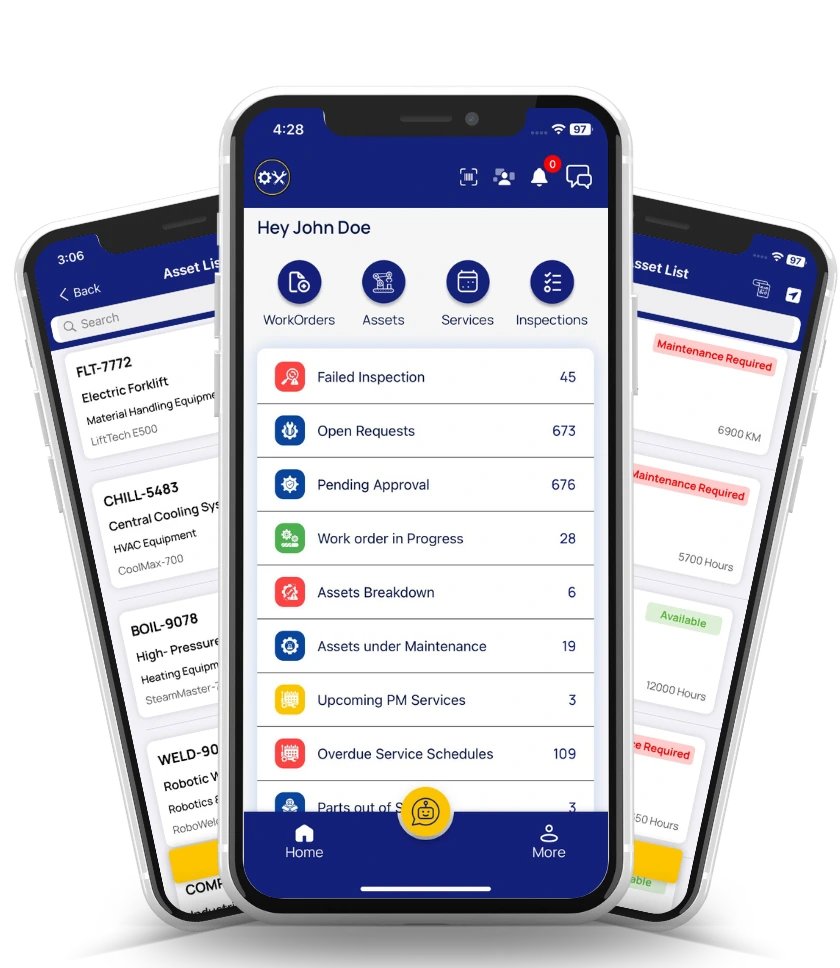
Asset-linked spare catalogue with auto-reorder for kiln bricks, mill liners, and crusher jaws — and a full mobile app with true offline mode for the zero-signal zones inside mill buildings and tunnels.
-
Multi-Plant & CapEx
Board-Ready Across Sites
Shared templates and centralized reporting across multiple plants, with remaining-useful-life feeding 5–10 year CapEx forecasts and refurbish-versus-replace analysis formatted for board approval.
Frequently Asked
Cement CMMS Selection Questions
What separates a cement-specific CMMS from generic maintenance software?
A cement-grade CMMS manages 2,400-plus assets with PM triggers tied to kiln revolutions, mill tonnage, and crusher throughput rather than calendar dates, and treats refractory campaigns as a first-class asset type with heat-count-driven reline scheduling. It also integrates kiln shell temperature and pyrometer feeds into the asset record and produces board-ready CapEx forecasts. Generic platforms require months of custom configuration to approximate these — refractory tracking, girth-gear backlash, and cyclone scoring aren't standard features. Sign up for Oxmaint to access the cement plant template.
Why is calendar-based PM a problem in cement plants?
Because cement equipment wears by operating cycles, not time. A kiln running hard degrades refractory faster than the calendar predicts, while a mill running below capacity gets over-maintained on a fixed schedule. Calendar PM therefore over-maintains healthy equipment and under-maintains degrading assets at the same time — wasting budget and missing real failures. Condition-based triggers tied to revolutions, tonnage, running hours, and temperature trends match service to actual wear.
How long does a cement plant CMMS take to deploy?
It depends heavily on the platform type. Enterprise ERP-based maintenance modules typically take 12 to 18 months and $400,000 to $1.2M in implementation fees at a cement plant. Purpose-built CMMS platforms reach full operational function — asset registry, PM scheduling, work orders, spare parts, and CapEx forecasting — within a single production quarter, roughly 60 to 90 days, with no production shutdown required. Because one prevented kiln failure can cover the implementation cost, faster deployment directly accelerates ROI. Book a demo to see a cement deployment timeline.
Can one CMMS manage multiple cement plants?
Yes, and multi-plant coordination is a core 2026 selection criterion. The right platform uses shared asset templates so every plant follows the same PM depth and inspection standards, with centralized reporting that lets a group compare uptime, PM compliance, and cost per tonne across all sites in one view. Remaining-useful-life data rolls up into portfolio-level CapEx planning, so capital decisions are made across the fleet rather than plant by plant. Sign up for Oxmaint to manage one plant or many.
Refractory · Cycle-Trigger · Integrate · Forecast
Pick the CMMS Built for How Cement Actually Wears
Every calendar-based PM that drifts from real wear, every refractory campaign tracked in a spreadsheet, and every kiln hot spot missed until breakthrough is production and capital at risk. Oxmaint gives cement manufacturers a purpose-built platform — native refractory campaign tracking, cycle-based PM triggers, DCS and pyrometer integration, offline mobile for signal-dead zones, and board-ready CapEx forecasting across every plant — so maintenance runs on how the equipment actually wears, not the wall clock.