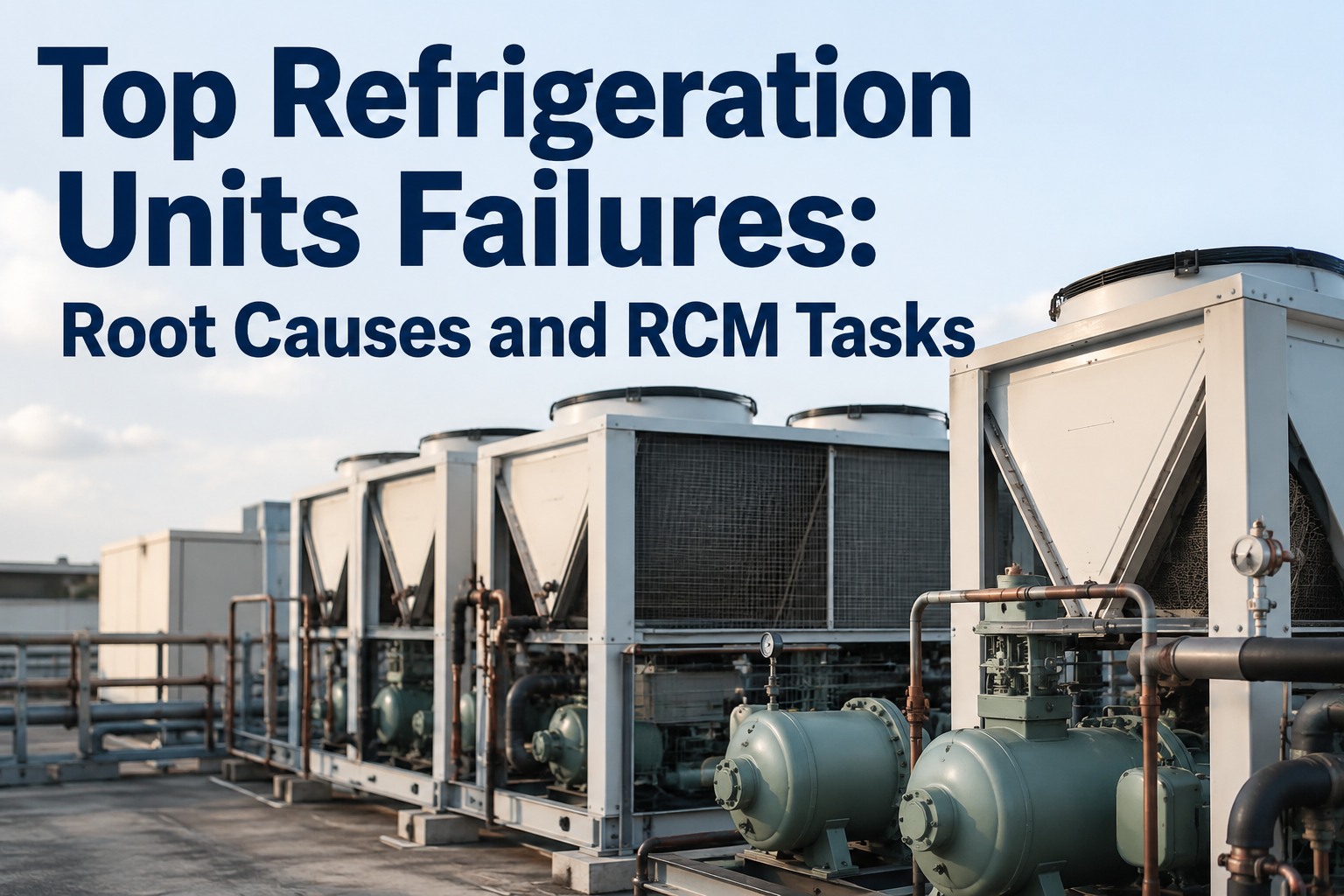
Automotive plants lose an average of 800 hours of production annually to equipment failures — and nearly every one of those failures follows a predictable mode, root cause, and downstream effect that a well-structured FMEA can catch before it hits the line. This automotive plants FMEA database catalogs the failure modes your reliability team encounters on the floor every shift: bearing wear on rotating equipment, seal leakage on hydraulic pumps, control loop drift on PLCs, structural corrosion, and dozens more — each mapped to its most likely root cause, production impact, and recommended RCM task. OxMaint's AI-powered CMMS turns this FMEA reference into daily action, logging failure modes against every asset and automatically triggering the right condition-based or time-based task at the correct interval. Build a searchable failure history that feeds better decisions on every future work order when you Start Free Trial today.
Automotive Plants FMEA Database
Every equipment failure mode, mapped to root cause, effect, and the exact RCM task that prevents it.
Catalogs the failure modes your reliability team encounters on the floor — bearing wear, seal leakage, PLC drift, corrosion, sensor fouling, and 30+ more — each tied to root cause, production impact, and the preventive or predictive task that stops it. Turn this reference into a live, searchable FMEA history inside OxMaint.
Why an FMEA Database Matters
Automotive plants common failures cost more than you think
A single unplanned line stoppage in an automotive stamping or assembly plant averages $22,000 per hour in lost production — and a major powertrain line can exceed $50,000 hourly. Yet 70% of those breakdowns trace back to failure modes that were already known but never converted into a structured, triggered preventive task. That gap is what this automotive plants failure catalog closes.
A 380-asset powertrain plant spending $1.4M annually on reactive maintenance and contractor call-outs typically recovers 25–40% of that spend within 12 months of deploying a structured FMEA-to-PM program. The math is straightforward: identify the failure mode, map the root cause, attach the right condition-based or time-based task, and let the CMMS trigger it automatically — before the failure ever reaches the line.
FMEA Reference Table
Automotive plants failure mode list by equipment category
This automotive plants FMEA worksheet covers the 12 equipment categories that generate the highest downtime hours across body, paint, stamping, powertrain, and assembly shops. Each row maps a failure mode to its dominant root cause, production or safety effect, and the recommended RCM task type and interval.
| Equipment | Failure Mode | Root Cause | Effect | RCM Task & Interval |
|---|---|---|---|---|
| Robotic welder (spot) | Electrode cap wear | Material erosion from repeated thermal cycling | Weak welds, UVL faults, line stoppage | Time-based: tip dress every 200 welds; cap replace every 2,000 |
| Hydraulic pump | Internal seal leakage | Seal degradation from fluid contamination & heat | Pressure loss, actuator drift, unsafe condition | Condition-based: particle count + temp monitoring; fluid analysis quarterly |
| Conveyor motor | Bearing wear | Lubrication breakdown, misalignment, overload | Motor seizure, belt slip, line stop | Predictive: vibration analysis monthly; acoustic ultrasonics weekly |
| PLC control loop | Setpoint drift | Component aging, EMI interference, sensor calibration loss | Quality defects, cycle time variation | Time-based: calibration check every 90 days; auto-tune annually |
| Paint booth air handler | Filter fouling | Particulate loading beyond capacity | Paint defects, EPA compliance risk, airflow drop | Condition-based: differential pressure switch; replace at 1.2 in. WC |
| Press (stamping) | Hydraulic valve spool sticking | Contamination buildup, varnish from fluid degradation | Uncontrolled press stroke, die damage, safety event | Condition-based: oil cleanliness ISO 16/14/11; valve inspection semi-annually |
| Pneumatic cylinder | Seal extrusion / air leak | Pressure spikes, cylinder scoring, degraded seal material | Slow actuation, position errors, energy waste | Condition-based: leak survey monthly; replace seals at 2M cycles |
| AGV / guided vehicle | Battery capacity loss | Cell degradation, charge-cycle count, thermal stress | Mid-shift stoppage, route bottlenecks | Condition-based: SOC/SOH telemetry; cell balancing every 500 cycles |
| CNC machining center | Spindle bearing failure | Lubrication starvation, preload loss, contamination | Surface finish defects, scrap, spindle rebuild ($40K+) | Predictive: vibration + temperature trending; auto-alert at 0.3 in/s |
| Structural mezzanine | Corrosion / section loss | Humidity, chemical exposure, coating breakdown | Load-rating failure, safety risk, regulatory shutdown | Time-based: visual & NDT inspection annually; recoat every 5 years |
| Heat exchanger | Fouling / scaling | Mineral deposition, biological growth, flow imbalance | Process temperature deviation, energy spike | Condition-based: LMTD approach trending; CIP clean quarterly |
| Vision inspection system | Optical misalignment | Vibration, bracket flex, ambient light change | False rejects or escaped defects, quality audit failure | Time-based: golden-sample calibration every shift; bracket torque monthly |
How OxMaint Helps
Turn this FMEA library into automated maintenance action
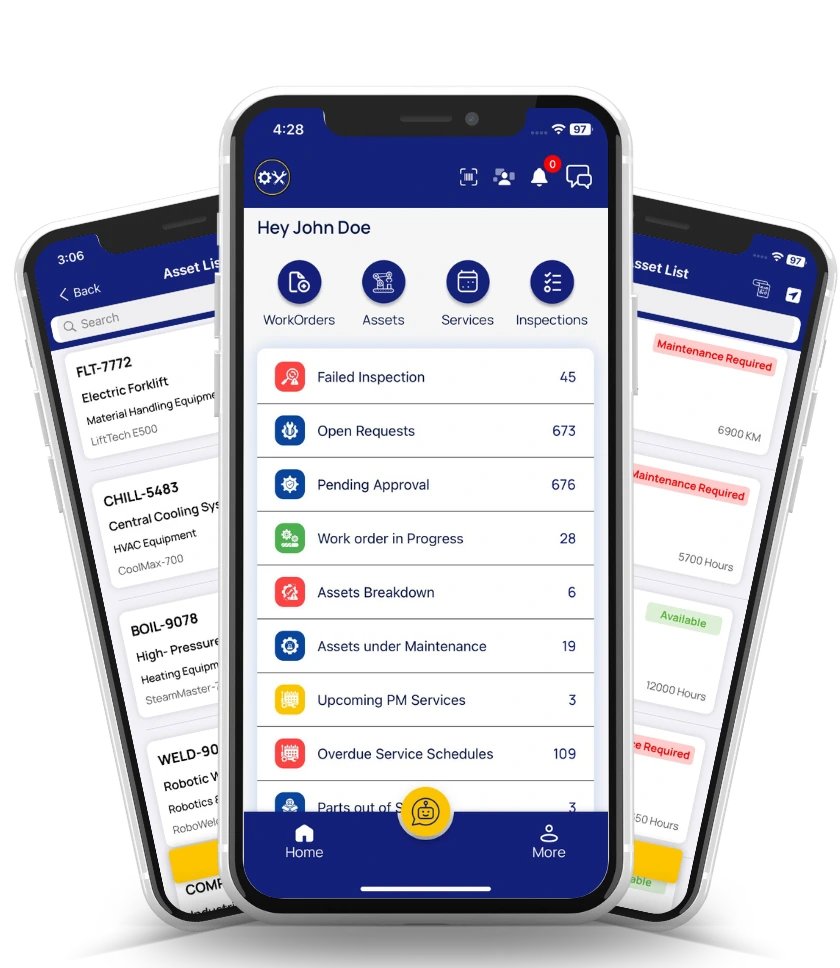
A spreadsheet full of failure modes helps no one if the right task never fires at the right time. OxMaint's AI-powered CMMS connects each failure mode in this catalog directly to the asset it affects — then automatically generates, schedules, and tracks the preventive or predictive work order that prevents it.
Attach failure modes to every asset record
Log the specific failure mode, root cause, and RCM task against each piece of equipment in your hierarchy. Build a searchable FMEA history that grows smarter with every closed work order — so the next technician sees exactly what failed, why, and what fixed it.
Outcome: 50% faster mean-time-to-repair on repeat failuresAuto-trigger condition-based & time-based PMs
Set the RCM task and interval once — vibration threshold, cycle count, calendar date, or differential pressure — and OxMaint generates the work order automatically when the trigger fires. No more missed PMs because someone forgot to check a spreadsheet.
Outcome: 30–50% reduction in unplanned downtimePredict failures with AI-driven analytics
OxMaint's AI engine analyzes vibration, temperature, oil analysis, and cycle-count trends across your asset base — flagging the early signature of bearing wear, seal degradation, or drift before the failure mode ever reaches production. Shift from reactive firefighting to predictive planning.
Outcome: Catch 70%+ of failures 2–6 weeks before breakdownLink spare parts to failure modes
Map the exact bearing, seal, or filter SKU to the failure mode it addresses. When OxMaint auto-generates a PM, it reserves the part in inventory — so the technician has what they need, and you stock what your FMEA actually demands, not guesswork min-max levels.
Outcome: 20% lower inventory carrying cost, zero stock-out delaysWorked Example
From FMEA to ROI: a 180-asset stamping plant
Consider a mid-sized stamping plant running 180 critical assets — presses, conveyors, robots, and hydraulic systems — and losing 1,150 hours annually to unplanned downtime at an average of $18,000 per hour. Their maintenance team tracked failure modes on paper logs and a shared spreadsheet, but PMs fired on calendar guesses rather than actual equipment condition.
The plant's reliability engineer loaded this FMEA catalog into OxMaint, mapped each failure mode to the corresponding asset and RCM task, and let the platform's triggers replace the spreadsheet calendar. Within four months, predictive vibration alerts on two press spindles caught bearing wear six weeks before what would have been a $45,000 spindle rebuild and a 72-hour line stoppage — paying for the entire OxMaint deployment twice over from a single avoided failure.
Getting Started
Run an FMEA workshop and load it into OxMaint in 5 steps
Gather your asset criticality ranking
Pull your asset register and rank equipment by production impact, safety risk, and repair cost. Focus the FMEA workshop on the top 20% of assets that drive 80% of your downtime — presses, robots, pumps, and critical conveyors first.
Week 1–2Workshop each failure mode with operators & techs
Bring maintenance techs, operators, and engineering into a 90-minute session per equipment category. Use this catalog as the starting point — confirm which failure modes actually occur, add plant-specific root causes, and score severity, occurrence, and detection for each.
Week 2–4Map each failure mode to an RCM task & trigger
For every high-risk failure mode, assign the task type (condition-based, time-based, predictive, or run-to-failure) and the specific trigger — vibration threshold, cycle count, differential pressure, or calendar interval. This is where the FMEA becomes actionable.
Week 4–5Load the FMEA into OxMaint as asset-linked PMs
Import the completed FMEA worksheet into OxMaint — each failure mode attaches to its asset record, each RCM task becomes an auto-triggered PM, and each spare part maps to the failure it prevents. Your spreadsheet is now a live, enforced maintenance program.
Week 5–6Review failure history quarterly & refine
Every closed work order feeds OxMaint's analytics — showing which failure modes are declining, which are recurring, and which RCM tasks need a tighter interval or a different trigger. The FMEA is no longer a static document; it's a living reliability engine.
OngoingStop firefighting. Start preventing.
See OxMaint turn your FMEA library into automated, downtime-cutting PMs
Book a 30-minute demo and we'll map your top 10 failure modes to live RCM triggers on your own asset list — before the call ends.
Frequently Asked Questions
Automotive plants FMEA and failure mode questions, answered
What are the most common failure modes in automotive plants?
The most frequent automotive plants equipment failures are bearing wear on rotating equipment (motors, spindles, conveyors), hydraulic and pneumatic seal leakage, PLC control-loop drift, electrode cap wear on robotic welders, filter fouling in paint booths, and corrosion on structural assets. These six categories account for roughly 60% of unplanned downtime in body, stamping, and assembly operations. Each has a well-understood root cause and a proven RCM task — which is why cataloging them in a structured FMEA database pays off immediately.
How do I build an FMEA worksheet for an automotive plant?
Start with your asset criticality ranking, then run a 90-minute workshop per equipment category with maintenance techs and operators. For each asset, list the failure modes from this catalog, confirm the root cause, score severity/occurrence/detection, and assign an RCM task and trigger interval. Load the completed worksheet into OxMaint so each failure mode attaches to its asset and auto-generates the right PM — turning a static document into a live, enforced maintenance program.
What is the difference between FMEA and RCM for automotive maintenance?
FMEA (Failure Modes and Effects Analysis) is the analytical method you use to identify how equipment can fail, why it fails, and what happens when it does. RCM (Reliability-Centered Maintenance) takes that analysis and defines the specific task — predictive, preventive, condition-based, or run-to-failure — that best manages each failure mode at the lowest cost. In practice, FMEA is the diagnostic foundation and RCM is the action plan built on top of it. OxMaint bridges both by attaching FMEA data to each asset and automatically triggering the RCM task when conditions warrant.
How much can an automotive plant save by switching from reactive to RCM-driven maintenance?
A typical automotive plant with 150–200 critical assets can reduce unplanned downtime 30–50% within 12 months of deploying FMEA-linked, condition-based PMs — recovering $3M–$8M in avoided production loss depending on line value. Reactive repair and contractor spend typically drops 40–65%, and spare-parts inventory carrying cost falls 15–25% as stocking levels align to actual failure-mode demand rather than guesswork. The payback period for a CMMS deployment like OxMaint is usually under 4 months when the FMEA-to-PM mapping is done correctly.
Can OxMaint import our existing FMEA spreadsheet or failure history?
Yes — OxMaint supports bulk import of existing FMEA worksheets, asset registers, and failure history from Excel, CSV, and most legacy CMMS exports. Each failure mode maps to its asset record, each RCM task becomes an auto-triggered PM, and historical failure data feeds the AI analytics engine so it starts predicting recurrence from day one. Most automotive plants are fully migrated and live within 4–6 weeks. Book a demo and we'll walk through the import with your actual data.
Your FMEA library is only valuable if it drives action
Start turning every failure mode into a prevented breakdown today
Load this catalog into OxMaint, attach each failure mode to its asset, and let AI-driven PMs cut your unplanned downtime 30–50% in the first year.
Free 14-day trial · No credit card required